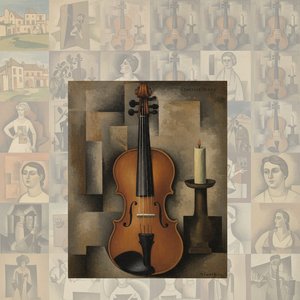
The Master of Shadows: The Life and Legacy of Trophîme Bigot
In the flickering, amber-hued depths of the seventeenth century, few artists possessed the ability to command the darkness as masterfully as Trophîme Bigot. Born in Arles, France, around 1579, Bigot emerged as a pivotal figure within the Baroque movement, carving out a niche that would earn him the evocative title of a "Candlelight Master." His life and work represent a profound intersection of French sensibility and the dramatic, theatrical innovations flowing from Italy. To gaze upon a Bigot canvas is to enter a world where light does not merely illuminate, but rather struggles against an encroaching, velvety gloom, creating a sense of intimacy and spiritual weight that remains unparalleled.
The trajectory of Bigot’s career was shaped by his movement between the cultural hubs of Rome and Provence. This dual existence allowed him to absorb the grand, sweeping traditions of the Italian Baroque while maintaining a connection to the more somber, contemplative atmosphere of his French roots. It was in this crucible of influences that he refined his signature technique: chiaroscuro. By utilizing a single, often unseen light source—such as a guttering candle or a hidden flame—he could sculpt figures out of the void, lending them a tactile, three-dimensional presence. This mastery of light and shadow allowed him to transform simple religious subjects into profound psychological studies, where every crease in a robe or furrow in a brow tells a story of devotion or internal struggle.
A Vision of Devotion and Drama
Bigot’s oeuvre is characterized by an extraordinary ability to evoke the sacred through the mundane. His religious altarpieces are not merely depictions of saints, but immersive experiences of faith. In works such as his St. Jerome, one can witness the intense scholarly focus and spiritual fervor of the hermit, rendered with a meticulous attention to detail that brings the textures of parchment and stone to life. The dramatic contrast between the brilliant highlights on the saint's skin and the impenetrable shadows surrounding him serves to isolate the subject in a moment of eternal contemplation, pulling the viewer into his private sanctuary of prayer.
Beyond his religious commissions, Bigot’s contribution to the development of the Baroque style lies in his ability to manipulate atmosphere. His compositions often rely on a sense of quiet tension, where the stillness of the scene is charged with an unseen energy. This approach heavily influenced later masters of the genre, most notably Georges de La Tour, who would further refine the "candlelight" aesthetic. The historical significance of Bigot’s work resides in this bridge he built between the late Mannerist traditions and the high drama of the Baroque, proving that the most profound truths are often found in the softest glow amidst the deepest dark.
The enduring fascination with Trophîme Bigot continues through his remarkable ability to capture the ephemeral. His legacy is defined by:
- Technical Mastery: The sophisticated use of chiaroscuro to create depth and emotional resonance.
- Spiritual Intimacy: A unique talent for rendering religious figures with a human, relatable vulnerability.
- Atmospheric Innovation: The creation of "candlelight" scenes that redefined the boundaries of light and shadow in European art.
- Cultural Synthesis: The seamless blending of Italian dramatic flair with French stylistic restraint.
Pitanja i odgovori
Koje je boje Trophîme Bigot najčešće koristio/la?
Kolorit dela umetnika Trophîme Bigot možete videti na njegovoj stranici Genom palete.
U kom gradu i državi je rođen/a Trophîme Bigot?
Trophîme Bigot je rođen/a u gradu Arles, u državi France.
Gde mogu da vidim dela umetnika Trophîme Bigot poređana hronološkim redom?
Dostupna je hronologija dela umetnika Trophîme Bigot: na stranici Hronologija dela, umetnikova dela su poređana prema datumu nastanka.