Pengarna tillbaka-garanti · 100 dagar Fri frakt i hela världen
646 446konstverk 53 409konstnärer 5 406museer 32språk
Porträtt av Thomas James Lloyd

De 25 mest kända Thomas James Lloyd-målningarna att välja mellan

Uppdaterad oktober 2026 · rangordnad efter vår popularitetspoäng (sökningar, besök och beställningar för varje verk) · 25 verk av Thomas James Lloyd i vår katalog

Snabbt svar

Det främsta verket bland Thomas James Lloyds målningar är The Rose Garden. På andra och tredje plats: Moussakoo (1968) och In The Punt. Vår katalog innehåller 25 verk av Thomas James Lloyd. De 25 som listas här är de mest kända, i rangordning, med årtal och museum för varje original.

1849 – 1910, London Flest verk: Studio Museum i Harlem

Topp 10: Thomas James Lloyds mest kända målningar

1
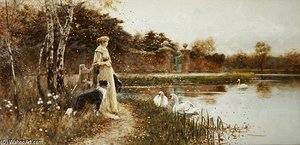
The Rose Garden av Thomas James Lloyd

The Rose Garden

Oil On Canvas

A young woman sits nestled within a lush, flowering sanctuary, her presence a calm anchor amidst the soft textures of a garden. Beside her, a dog rests in quiet companionship, their shared stillness mirroring the peaceful atmosphere of the afternoon. The scene unfolds with a gentle, organic rhythm, where the curves of flowerbeds and the soft silhouettes of distant trees create a sense of secluded intimacy. Sunlight filters through an…

Handmålad oljereproduktion från $170 49 × 20 cm
Välj storlek Visa detaljer
2
Moussakoo (1968) av Thomas James Lloyd

Moussakoo

1968 · Mosaic · Studio Museum i Harlem, New York City

In the vast tapestry of modern visual expression, few pieces command the immediate attention of a room quite like Moussakoo. Created in 1968, this mesmerizing work serves as a luminous intersection between structural precision and chromatic exuberance. At first glance, the viewer is drawn into a complex, honeycomb-like architecture, where a series of hexagonal cells form a rhythmic, interlocking pattern. This geometric mosaic does not merely sit upon the wall;…

Platserna 11 till 25: fler målningar av Thomas James Lloyd

Thomas James Lloyds målningar efter motiv

De fyra vanligaste motiven i denna ranking, med det främsta verket för varje.

Museer som innehar Thomas James Lloyds originalverk

Museet som innehar flest av målningarna på denna sida.

Museum Stad Verk av Thomas James Lloyd Målningar från denna lista
Studio Museum i Harlem, New York CityStudio Museum i Harlem New York City 2 Moussakoo, Moussakoo

Thomas James Lloyds målningar: FAQ

Vilket är Thomas James Lloyds mest kända verk?Visa svar

The Rose Garden rankar först, följt av Moussakoo (1968) och In The Punt.

Vilka är de tio mest kända målningarna av Thomas James Lloyd?Visa svar

The Rose Garden, Moussakoo, In The Punt, Meeting Father, Picking Blossoms, Hastings, Springtime, Moussakoo, Driving Geese, Early Evening och At The End Of The Day. År och museum för varje verk anges i rankningen ovan.

Hur många målningar av Thomas James Lloyd finns listade?Visa svar

25 verk av Thomas James Lloyd finns i vår katalog.

Vilka museer har Thomas James Lloyds mest kända original?Visa svar

Främst i Studio Museum i Harlem (New York City). Se museatabellen ovan för den fullständiga listan.

Vilka motiv förekommer oftast i Thomas James Lloyds målningar?Visa svar

Bland de 25 målningar som rankats här: Flowers (2) och Sunset (2).

Vilka kända målningar av Thomas James Lloyd finns på Studio Museum i Harlem?Visa svar

Studio Museum i Harlem, New York City har 2 av de målningar som finns med i denna ranking, inklusive Moussakoo och Moussakoo.

Kan jag köpa en målning av Thomas James Lloyd som en reproduktion?Visa svar

Ja. Varje målning på denna sida kan beställas som en handmålad oljereproduktion eller som ett tryck. Öppna målningen, välj storlek och lägg din beställning.

Thomas James Lloyd: konstnären bakom målningarna

A Victorian Visionary of the English Landscape

Thomas James Lloyd (1849–1910) stands as a pivotal figure in British landscape painting during the Victorian era, embodying a meticulous approach to observation and an unwavering dedication to capturing the sublime beauty of the English countryside. Born in Melbourne, Australia, Lloyd’s formative years instilled within him a profound appreciation for natural grandeur—a sensibility that would profoundly shape his artistic vision. Upon returning to England in 1873, he swiftly established himself as a respected artist, primarily associated with the prestigious Royal Watercolour Society (RWS), where he honed his skills and cultivated collaborations with fellow luminaries of the Impressionist movement.

His artistic trajectory was significantly impacted by the Romantic landscape painters such as Turner and Constable. Their emphasis on atmospheric perspective and emotive rendering served as a cornerstone for Lloyd’s own stylistic development, championing the idea that art should strive to convey not merely what is seen but also what is felt. This principle of emotional resonance became a hallmark of his work, allowing him to bridge the gap between scientific accuracy and poetic expression.

Technique, Light, and the Art of Observation

Lloyd’s distinctive technique involved layering thin washes of colour onto toned paper, creating luminous surfaces that subtly reflected the ambient light. He was a master of the medium, meticulously studying geological formations and vegetation patterns to translate his scientific understanding into artistic representations characterized by remarkable accuracy and detail. Unlike many Impressionists who prioritized fleeting moments of visual sensation, Lloyd sought to convey a sense of permanence and grandeur—a deliberate contrast to the ephemeral nature of daily life.

His oeuvre comprises over 300 paintings and drawings, predominantly depicting scenes from Cornwall, Dorset, Worcestershire, and Yorkshire. His landscapes are renowned for their serene compositions, masterful tonal harmonies, and evocative depictions of weather conditions. Whether capturing the gentle light of a spring day or the dramatic shifts in a coastal storm, his work remains deeply rooted in the physical reality of the British Isles.

Legacy and Artistic Significance

The historical significance of Thomas James Lloyd lies in his ability to blend the precision of a naturalist with the soul of a Romantic. His works often explore various themes including:

  • Landscape and Nature: A deep reverence for the English countryside, from rolling hills to rugged coastlines.
  • Genre Scenes: Capturing the quiet, idyllic moments of rural life and human interaction with the environment.
  • Marine Subject Matter: An interest in the movement of water and the atmospheric complexities of coastal settings.

Through his dedication to the watercolor medium, Lloyd left behind a legacy of luminous beauty that continues to resonate with collectors and art historians alike. His ability to find the eternal within the landscape ensures his place as a vital voice in the history of nineteenth-century British art.