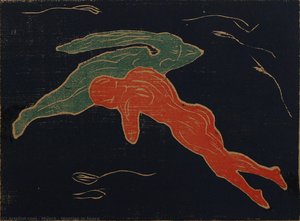
Acrylic On Canvas.

§ 1Catalogue data

§ 2Abstract
Beskrivning av samlarobjekt
Explore Edvard Munch’s ‘untitled (821)’, a poignant landscape painting embodying Expressionism & rural life. Discover its earthy tones, loose brushwork & introspective gaze.
 Visa mer
Konstnärens biografi
Edvard Munch (1863-1944): En norsk konstnär vars mästerverk utforskar ångest, sorg och mänsklighetens innersta värld. Känd för 'Skriet' och en djupgående stil.
§ 3Commentary
A Moment of Introspection: Exploring Edvard Munch’s Untitled Landscape
This captivating painting by Edvard Munch offers a poignant glimpse into the artist's exploration of the human condition within the natural world. While seemingly a serene landscape, it resonates with the underlying emotional currents that define much of his oeuvre. The artwork depicts a young woman positioned in a rural setting – a modest home and expansive fields leading to distant hills under a clouded sky – inviting viewers to contemplate themes of solitude, longing, and the weight of existence.Stylistic Influences & Artistic Technique
The painting’s style demonstrates Munch's engagement with both Impressionism and Post-Impressionism. While sharing Impressionism’s focus on capturing fleeting moments and subjective impressions, it moves beyond mere optical representation towards a more emotionally charged expression – a hallmark of Post-Impressionism. Munch employs visible, expressive brushstrokes and an earthy color palette—ochre, browns, greens, and muted blues—to create warmth and naturalism. The technique involves layering paint to build texture and form, with loose brushwork conveying atmosphere and movement. This approach isn’t about precise detail; it's about evoking a *feeling*.Subject Matter & Composition
The composition is thoughtfully divided into foreground, middle ground, and background, guiding the viewer’s eye through the scene. The woman dominates the foreground, slightly off-center, her gaze directed towards the right side of the canvas. This directional focus isn't simply observational; it suggests an internal preoccupation, a contemplation of something beyond the visible landscape. The simple white house with pink accents provides a grounding architectural element, while the rolling hills and cloudy sky contribute to a sense of vastness and perhaps, uncertainty.Historical Context & Munch’s Personal World
To understand this work fully, it's crucial to consider Edvard Munch’s biography. Born in 1863, his life was deeply marked by tragedy – the early loss of his mother and sister to tuberculosis, coupled with a family history of mental illness. These experiences instilled in him a lifelong preoccupation with mortality, sickness, and psychological distress. While this particular painting doesn't possess the overt anguish of *The Scream*, it shares that work’s underlying sense of unease and existential questioning. Munch sought to depict not just what he saw, but what he *felt* – making his art profoundly personal and emotionally resonant.Symbolism & Emotional Impact
The woman's solitary figure within the expansive landscape is powerfully symbolic. Her gaze suggests introspection, perhaps a yearning for something unattainable or an acceptance of life’s inherent loneliness. The natural world itself can be interpreted as a reflection of her inner state – the muted colors and overcast sky mirroring feelings of melancholy or quiet contemplation. The painting isn't simply *about* a woman in a landscape; it’s about the universal human experience of searching for meaning, grappling with loss, and confronting one’s own mortality.Collecting & Interior Design Considerations
A reproduction of this work would be a stunning addition to any collection, particularly those focused on Expressionism or Symbolist art. Its muted color palette lends itself well to various interior design schemes – from rustic farmhouse aesthetics to more contemporary minimalist spaces. The painting’s emotional depth and contemplative mood make it an ideal focal point for living rooms, studies, or bedrooms—spaces designed for relaxation and reflection. Its subtle power lies in its ability to evoke a sense of quiet introspection within the viewer.Frågor och svar
Vilken stil tillhör "untitled (821)"?
Konststilen som förknippas med "untitled (821)" av Edvard Munch är Expressionism. Denna klassificering placerar verket bland relaterade konstnärer och konstverk.
Hur laddar jag ner bilden av "untitled (821)" av Edvard Munch?
"untitled (821)" av Edvard Munch kan laddas ner som en högupplöst digital bildnedladdning via verkets sida för Ladda ner digital bild.
Är "untitled (821)" överlag mer ljus eller mörk?
"untitled (821)" av Edvard Munch har registrerats med en ljusstyrka på balanced och en luminans på Soft Shadow.


 Byt till tryck


 För konstverk eller reproduktioner som är större än 105 cm (cirka 41 tum) på någon sida, levereras ramen som ett isärplockat kit. Denna metod säkerställer en trygg leverans och förhindrar skador under transport.