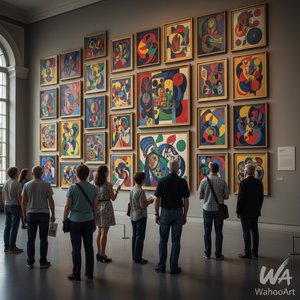
1914. Acrylic On Canvas, 65.0 x 50.0 cm.

§ 1Katalogdata

- 65.0 x 50.0 cm


Detta konstverk är upphovsrättsligt skyddat
Konstverket som visas på denna sida skyddas av upphovsrättslagen, vilket innebär att vi inte lagligt kan skapa eller sälja en identisk reproduktion. Detta skydd upprätthålls genom internationella avtal såsom den Bernkonventionen och genom nationella lagar, inklusive de som fastställs av Amerikansk upphovsrättslag – Titel 17. Alla rättigheter förbehållna. Återgivning av konstverk är förbjuden utan skriftligt tillstånd från WahooArt.
Som ett respektfullt och lagligt alternativ erbjuder vi skräddarsydda, handmålade konstverk inspirerade av originalet. Våra skickliga och professionella konstnärer studerar noggrant originalets stil, stämning och konstnärliga essens för att skapa ett nytt, unikt verk som väcker samma känsla – samtidigt som det förblir en originell skapelse i egen rätt.
Denna metod följer fullt ut upphovsrättsliga regler eftersom den inte innebär kopiering eller duplicering av det skyddade konstverket. Istället är det en kreativ nytolkning – en ny målning som är influerad av originalet men inte identisk med det.
 Läs mer
§ 2Abstrakt
Beskrivning av samlarobjekt
Explore Joan Miró’s ‘The Farmer’ (1914), a Fauvist masterpiece! Bold colors & expressive brushstrokes evoke emotion. A key work in modern art history – view now!
Konstnärens biografi
Upptäck Joan Mirós fantastiska värld! Surrealistisk konst och abstrakta mästerverk från Katalonien – utforska hans ikoniska verk på AllPaintingsStore!
§ 3Kommentarer
A Glimpse into Rural Spain: Joan Miró’s ‘The Farmer’ (1914)
Joan Miró's *The Farmer*, painted in 1914, is more than just a portrait; it’s a pivotal work marking the artist’s early foray into modernism and a fascinating precursor to his later Surrealist explorations. Measuring 65 x 50 cm, this oil on canvas captures a seated man – a Catalan farmer – with an arresting directness that belies the complex artistic currents swirling around Miró at the time.Fauvism & The Dawn of Modern Expression
While often associated with Surrealism, *The Farmer* is firmly rooted in the principles of Fauvism. This short-lived but influential movement, spearheaded by Henri Matisse and André Derain, championed intense, non-naturalistic color and energetic brushwork as a means of expressing emotion. Miró, still developing his unique voice, absorbed these lessons, employing a bold palette – particularly the striking red jacket worn by the farmer – to imbue the scene with a palpable sense of drama. The painting reflects a broader shift in Western art at the turn of the 20th century, moving away from representational accuracy towards subjective experience and expressive form. Artists like Van Gogh, Cézanne, and Seurat had already laid the groundwork for this revolution, paving the way for movements that prioritized feeling over fidelity to reality.Decoding the Composition & Technique
The composition is deceptively simple. A man sits squarely facing the viewer, arms crossed in a gesture of quiet contemplation or perhaps weary resignation. He’s positioned against a vaguely defined interior – a couch and another figure are hinted at but remain secondary to the central subject. Miró's technique is characterized by loose, gestural brushstrokes and an emphasis on texture achieved through *impasto*—the thick application of paint. This tactile quality adds depth and physicality to the work, drawing the viewer into its emotional landscape. The flattened perspective further intensifies the painting’s impact, eliminating any sense of traditional spatial recession.Symbolism & Emotional Resonance
Beyond its stylistic features, *The Farmer* invites deeper interpretation. The figure isn't merely a depiction of rural life; he embodies a certain stoicism and connection to the land. The intense coloration – particularly the vibrant red – could symbolize passion, vitality, or even hardship. The man’s crossed arms suggest both defensiveness and introspection. Miró wasn’t aiming for photographic realism but rather sought to capture an *essence* of his subject—a psychological portrait that speaks to universal themes of labor, identity, and human existence.Miró's Artistic Journey & Lasting Influence
This early work provides crucial insight into Miró’s artistic development. While *The Farmer* demonstrates a clear affinity with Fauvism, it also foreshadows his later explorations of abstraction and Surrealism. Paintings like *The Farm* (1922) and *The Tilled Field* (1924) build upon the foundations laid in this earlier piece, pushing further into dreamlike imagery and symbolic representation. Miró’s influence extends far beyond these specific works; he remains a towering figure of 20th-century art, inspiring generations of artists with his innovative approach to form, color, and emotion.Collecting & Interior Design Considerations
A reproduction of *The Farmer* offers a compelling statement piece for any collection or interior space. Its bold colors and expressive energy can inject vibrancy into a modern living room, study, or office. The painting’s relatively small size makes it versatile – suitable for both intimate settings and larger galleries. Its historical significance and artistic merit ensure its enduring appeal to art lovers and collectors alike.- Style: Fauvism, Early Modernism
- Artist: Joan Miró (1893-1983)
- Medium: Oil on Canvas
- Dimensions: 65 x 50 cm
- Consider pairing with works from the same period or exploring Miró’s later Surrealist pieces for a cohesive collection.
Frågor och svar
Vilka färger dominerar i "The Farmer" av Joan Miró?
"The Farmer" definieras av en Dark-palett med Driftwood (#a0783e) som dominerande färg.
Vilket år skapades "The Farmer" av Joan Miró?
"The Farmer" av Joan Miró skapades år 1914.
Vilken färg dominerar i "The Farmer"?
Driftwood (#a0783e) är den dominerande färgen i "The Farmer" av Joan Miró.


 Byt till tryck


 För konstverk eller reproduktioner som är större än 105 cm (cirka 41 tum) på någon sida, levereras ramen som ett isärplockat kit. Denna metod säkerställer en trygg leverans och förhindrar skador under transport.