

Acrylic On Canvas.

§ 1Catalogue data

Detta konstverk är upphovsrättsligt skyddat
Konstverket som visas på denna sida skyddas av upphovsrättslagen, vilket innebär att vi inte lagligt kan skapa eller sälja en identisk reproduktion. Detta skydd upprätthålls genom internationella avtal såsom den Bernkonventionen och genom nationella lagar, inklusive de som fastställs av Amerikansk upphovsrättslag – Titel 17. Alla rättigheter förbehållna. Återgivning av konstverk är förbjuden utan skriftligt tillstånd från WahooArt.
Som ett respektfullt och lagligt alternativ erbjuder vi skräddarsydda, handmålade konstverk inspirerade av originalet. Våra skickliga och professionella konstnärer studerar noggrant originalets stil, stämning och konstnärliga essens för att skapa ett nytt, unikt verk som väcker samma känsla – samtidigt som det förblir en originell skapelse i egen rätt.
Denna metod följer fullt ut upphovsrättsliga regler eftersom den inte innebär kopiering eller duplicering av det skyddade konstverket. Istället är det en kreativ nytolkning – en ny målning som är influerad av originalet men inte identisk med det.
 Läs mer
§ 2Abstract
Beskrivning av samlarobjekt
Explore Mark Rothko's Untitled 127 – an iconic abstract expressionist painting brimming with layered color and profound emotion. Discover its history, techniques & lasting impact on art.
Konstnärens biografi
Utforska Mark Rothko (1903-1970) ikoniska Color Field målningar & Abstrakta Expressionismen! Upptäck känslornas djup och konstnärns betydelsefulla arv inom modern konst.
§ 3Commentary
The Genesis of a Silent Dialogue
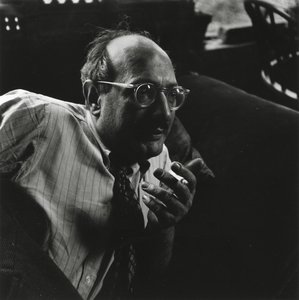
Mark Rothko's "Untitled 127," a deceptively simple black and white photograph capturing an oil-on-canvas painting, isn’t merely a depiction of color; it’s an invitation to a profound, almost unsettling, dialogue with the viewer. Born in 1903 in Dvinsk, Latvia – a landscape etched by displacement and historical upheaval – Rothko's early life profoundly shaped his artistic vision. The anxieties of a Jewish family amidst political unrest instilled within him a sensitivity to human suffering, a theme that would become a recurring motif throughout his oeuvre. This sense of unease, coupled with the trauma of his father’s death shortly after the family’s immigration to Portland, Oregon in 1913, fueled an exploration of existential themes – mortality, loss, and the persistent search for meaning within a seemingly indifferent universe. The photograph itself, stripped of color, forces us to confront the raw emotionality of Rothko's work, highlighting the interplay of light and shadow, form and void that defines his signature style.
Deconstructing Abstraction: Form and Feeling
At first glance, "Untitled 127" presents a deceptively straightforward composition: a large square dominated by a darker central area, encircled by lighter zones. However, closer inspection reveals a complex interplay of smaller squares within this core, creating an intricate pattern that subtly deepens the sense of spatial depth. Rothko’s technique is characterized by its deliberate simplicity and profound restraint. He eschewed overt gestures or brushstrokes, opting instead for thin layers of oil paint applied to canvas – sometimes almost translucent – to create fields of color that seem to vibrate with an inner light. The photograph expertly captures this delicate layering, revealing the subtle gradations of tone and texture that are crucial to understanding Rothko’s approach. The use of black as a dominant element isn't simply about darkness; it represents a void, a space for contemplation, a reflection on the unknown.
Rothko Chapel: A Spiritual Resonance
Understanding Rothko requires considering his broader artistic context and particularly his involvement with the Rothko Chapel in Houston, Texas. Commissioned by John and Dominique de Menil, the chapel was designed to be a space for meditation and reflection, mirroring the emotional intensity of Rothko’s paintings. The fourteen murals within the chapel – including variations on “Untitled 127” – are intended to evoke a sense of awe and spiritual connection. The Chapel's architecture itself—an octagon inscribed in a Greek cross—was heavily influenced by Rothko’s vision, creating an environment that amplifies the contemplative power of his work. The chapel served as a crucial testing ground for Rothko’s ideas about color and form, demonstrating how these elements could be used to communicate profound emotional truths without resorting to representational imagery.
The Enduring Legacy: A Window into the Human Condition
“Untitled 127,” whether viewed as a photograph or the original painting, remains a powerfully evocative work. It’s not about depicting a specific scene or object; it's about conveying an emotional state – a sense of longing, vulnerability, and perhaps even transcendence. Rothko believed that his paintings could act as “windows” into the soul, offering viewers a glimpse beyond the surface of reality. The stark simplicity of the composition, combined with the subtle shifts in color and tone, creates a space for individual interpretation and emotional resonance. Reproductions of this piece offer an accessible way to experience Rothko’s profound vision, bringing his exploration of existential themes into any setting – from a contemplative gallery space to a carefully considered interior design.
Frågor och svar
Hur upplevs ljusstyrkan i "Untitled 127" av Mark Rothko?
När det gäller upplevd ljusstyrka är "Untitled 127" av Mark Rothko bright.
Hur passar "Untitled 127" in i Mark Rothkos teman och stil?
Inom Mark Rothkos produktion är "Untitled 127" skapad i Abstract Expressionism-stil, med de återkommande temana lived experience, trauma, existentialism, jewish identity, displacement, loss, color as emotion, spiritual depth.
Finns en högupplöst nedladdning av "Untitled 127" tillgänglig?
"Untitled 127" finns tillgänglig som en högupplöst digital bildnedladdning och kan köpas direkt på dess Digital bild i hög upplösning-sida.


 Byt till tryck


 För konstverk eller reproduktioner som är större än 105 cm (cirka 41 tum) på någon sida, levereras ramen som ett isärplockat kit. Denna metod säkerställer en trygg leverans och förhindrar skador under transport.


