


 Visa i rummet
 Skicka
 Dela
Dela
 Detaljer
 Studentguide för konstverk

 Ladda ner
 Liknande objekt
 Röntgen
 Bildspel
 Besökstatistik
Landscape
 Oil On Canvas
- WallArt
- Romantic Landscape
 17.0 x 23.0 cm
 National Trust
 Läs mer
Handgjord oljereproduktion
Handmålad olja på duk i din valda storlek och ram, tillverkad efter beställning av våra konstnärer. ( Byt till tryckta exemplar Byt till digital bildförsäljning)




P118B Skr10

P118H Skr10

P118W Skr10

P438Z Skr10

P508JH Skr12

P508YH Skr12

P805H Skr10

P805Z Skr10

P919BZ Skr10

P919G Skr10

P919XJ Skr10

P959ZH Skr10

P968JZ Skr12

W106C Skr8

W218G Skr10

W218JH Skr8

W218Y Skr10

W307PJ Skr10

W316G Skr10

W316PJ Skr8

W316Y Skr10

W398PJ Skr8

W4111J Skr10

W500HY Skr15

W500JH Skr15

W692G Skr12

W849H Skr8

W940BG Skr15

W953PJ Skr8




Välj bland våra förinställda storlekar som motsvarar konstverkets ursprungliga proportioner.

Ange den bredd och höjd du behöver för att passa din ram eller din vägg. Eftersom detta är handmålat kan konstnären vid en annan form måla lite mer runt bilden eller beskära den något – du väljer själv. Vi skickar en digital mockup för godkännande innan målningen påbörjas. Bilden som visas på denna sida representerar inte det slutgiltiga resultatet — det är endast mockuppen som visar det.
Efter beställning kommer AllPaintingsStore.com team att mejla kunden för instruktioner och tillhandahålla en skissförhandsvisning
Leverans över hela världen () på 3–4 veckor istället för standard 5 veckor. (23 oktober). Inga kompromisser med kvaliteten.

Fri expressfrakt över hela världen

Högkvalitativ linnecanvas

Fullständig fraktförsäkring

Garantier för återbetalning av tullavgifter

Garantier för exakt färgåtergivning

100 dagars returrätt vid fabrikationsfel

100% pengarna tillbaka-garanti

Mängdrabatt erbjuds
 Glasalternativet är endast tillgängligt i storlekar under 110 cm.

Landscape
Tryckteknik
Reproduktionsstorlek
-


Totalpris
Skr 2559
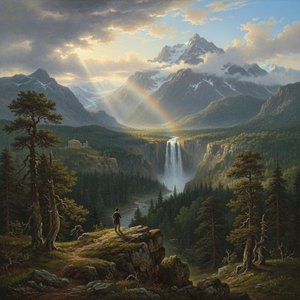
William Wyld’s “Landscape”: A Moment of Tranquil Contemplation
William Wyld's "Landscape," painted circa 1850, isn’t merely a depiction of rolling hills and a distant horizon; it’s an invitation to pause, to breathe, and to lose oneself in the quiet grandeur of nature. Born in London in 1806, Wyld’s artistic journey was far from conventional, beginning not with formal training but through a series of unexpected circumstances – a childhood inheritance of drawing materials, service as a diplomat's secretary, and ultimately, a profound connection to the landscapes of Europe and beyond. This painting embodies the culmination of these experiences, reflecting a sensibility deeply influenced by the Romantic movement while retaining a distinctly British sensibility.
The scene unfolds with remarkable restraint. The composition is dominated by horizontal lines – the subtle undulations of the land, the hazy suggestion of distant mountains – creating an immediate sense of depth and vastness. There’s no dramatic lighting or bold color; instead, Wyld employs a carefully calibrated palette of muted greys, blues, browns, and greens. These cool tones evoke a feeling of atmospheric distance, drawing the viewer into the scene as if they were standing on that very hillside, enveloped in a gentle mist. The artist masterfully utilizes atmospheric perspective – objects in the foreground are rendered with greater detail and vibrancy, while those receding into the background fade softly, blurring their outlines and suggesting an infinite expanse.
A Painter’s Journey: Influences and Techniques
Wyld's artistic development was shaped by a fascinating confluence of influences. His early years in Calais, under the tutelage of François Louis Thomas Francais, exposed him to the techniques of watercolourist Richard Parkes Bonington, while his travels throughout Europe – particularly to Algiers, Rome, and Brittany – broadened his visual vocabulary and deepened his understanding of light and color. The painting’s loose, painterly style—characterized by visible brushstrokes and a deliberate lack of precise detail—is a testament to this diverse experience. Wyld wasn't striving for photographic realism; rather, he sought to capture the *feeling* of the landscape – its mood, its atmosphere, its inherent tranquility.
The artist’s technique is particularly noteworthy in his use of layering and glazing. Thin washes of color are applied over one another, building up depth and luminosity gradually. This creates a subtle sense of texture and movement, as if the wind is whispering through the grasses and the clouds are shifting overhead. The impasto—the application of thick paint—is minimal, allowing the underlying layers to peek through, contributing to the painting’s overall sense of airiness and transparency. The brushwork itself feels almost spontaneous, conveying a sense of immediacy and capturing the fleeting beauty of the moment.
Symbolism and Emotional Resonance
Beyond its technical merits, “Landscape” resonates with profound symbolic meaning. The muted colors and solitary setting evoke feelings of solitude, contemplation, and perhaps even a touch of melancholy. It’s a scene that invites introspection—a reminder of our place within the vastness of nature and the enduring power of the natural world. The distant mountains, barely discernible through the haze, can be interpreted as symbols of resilience and permanence, standing in stark contrast to the ephemeral beauty of the foreground landscape.
Considering Wyld’s own life – his diplomatic service, his travels, and his eventual settling into a quieter artistic pursuit – this painting feels like a distillation of those experiences. It's not simply a representation of a place; it’s an expression of a state of mind—a yearning for peace, beauty, and connection with the natural world. The painting speaks to a Romantic sensibility that valued emotion, imagination, and the sublime power of nature, qualities that continue to resonate deeply with viewers today.
A Legacy in Reproduction
AllPaintingsStore is proud to offer meticulously crafted reproductions of William Wyld’s “Landscape,” allowing you to bring this evocative work into your home or office. Each reproduction captures the painting's subtle nuances and atmospheric effects, ensuring that you experience the same sense of tranquility and contemplation that captivated viewers in Wyld’s time. Whether displayed as a statement piece or incorporated into a broader interior design scheme, this artwork is sure to become a cherished focal point.
Frågor och svar
Hur populärt är "Landscape" inom Romantic Landscape?
"Landscape" är noterad som Recognized bland Romantic Landscape-verken i katalogen.
Vilket medium och vilka mått har "Landscape" av William Wyld?
Tekniken i "Landscape" av William Wyld är Oil On Canvas och de angivna måtten är 17 x 23 cm.
Hur kan jag förhandsgranska en reproduktion av "Landscape" av William Wyld?
En förhandsvisning av "Landscape" av William Wyld finns tillgänglig på konstverkets Förhandsvisning-sida.
Liknande konstverk


Om konstnären
A Life Bridging Diplomacy, Commerce, and Artistic Vision
William Wyld, born in London in 1806, embodies a fascinating intersection of worlds – the refined circles of diplomacy, the bustling energy of commerce, and ultimately, the captivating realm of art. His journey was not one of immediate artistic dedication, but rather a gradual unfolding of passion nurtured by circumstance and opportunity. Inheriting drawing materials at the tender age of six following a family tragedy sparked an early inclination towards visual expression, yet his path initially led him away from formal training. Following his father’s death, connections secured Wyld a position as secretary to the British Consulate in Calais, immersing him in European culture and political landscapes. This formative period proved crucial, exposing him not only to international affairs but also to artistic influences that would shape his future style. It was in Calais that he came under the tutelage of François Louis Thomas Francia, a watercolourist deeply influenced by masters like Thomas Girtin and Richard Parkes Bonington – a mentorship that laid the groundwork for Wyld’s own distinctive approach.Early Influences and Artistic Beginnings
Wyld's formative years in Calais instilled within him an appreciation for meticulous observation and atmospheric rendering—skills honed under Francia’s guidance. The landscapes of Northern France, particularly those depicted by Bonington and Girtin, served as a powerful stimulus to his burgeoning artistic sensibilities. These masters championed the watercolor medium, prioritizing tonal subtlety and capturing fleeting moments of light and shadow – techniques that would become hallmarks of Wyld's oeuvre. While initially hesitant about pursuing a full-time career, Wyld’s innate talent persisted, fueled by continued sketching expeditions and a growing fascination with depicting the natural world. His early drawings demonstrate an exceptional command of watercolor, foreshadowing his later achievements in capturing the grandeur of Venetian vistas and the dynamism of industrial cities.Champagne Exports and Artistic Exploration
A serendipitous encounter with Horace Vernet propelled Wyld onto an unexpected trajectory: the realm of champagne export. From 1827 to 1833, he established a business transporting Épernay champagne to England, fostering valuable connections within aristocratic society and deepening his understanding of French viticulture. This commercial venture wasn’t merely a means of financial stability; it provided invaluable experience in navigating social circles and appreciating the beauty of rural landscapes—elements that would later enrich his artistic vision. Wyld consistently painted during these travels alongside Vernet, diligently refining his technique while patiently awaiting the opportunity to fully dedicate himself to art. He deliberately delayed pursuing a full-time career as an artist, prioritizing the establishment of his younger brother in the family business – a testament to his familial responsibility and unwavering loyalty.The Venetian Influence and Recognition at the Salon
Wyld’s artistic breakthrough arrived at the Paris Salon of 1839 with “Venice at Sunrise,” a monumental watercolor that captured the ethereal beauty of the city at dusk. The painting, lauded for its masterful tonal gradation and evocative depiction of light—a technique directly influenced by Bonington—earned him a prestigious first gold medal, catapulting him into artistic prominence. This accolade solidified his reputation as one of the foremost watercolourists of his time and secured commissions from influential patrons, including Queen Victoria herself. Wyld’s subsequent voyages to Brittany further nurtured his artistic inspiration, resulting in paintings that embody the spirit of Romanticism—characterized by dramatic landscapes and emotionally resonant compositions.A Legacy of Detail and Atmospheric Skill
Throughout his career, William Wyld remained actively engaged with the artistic community, becoming a member of both the New Society of Painters in Watercolors and later the Royal Institute of Painters in Watercolour. His meticulous attention to detail—a characteristic inherited from Francia—allowed him to reproduce landscapes and cityscapes with unparalleled accuracy and expressive power. He continued exhibiting at various salons until his death in Paris in 1889, leaving behind a substantial body of work that exemplifies the highest standards of watercolor painting. Wyld’s legacy lies in his ability to synthesize diverse artistic influences—particularly Bonington's tonal subtlety and Girtin's topographical precision—to create paintings that transcend mere representation and convey profound emotional resonance. He stands as a significant successor to Richard Parkes Bonington, inheriting his keen eye for detail and ability to capture the atmosphere of place. His paintings offer not merely depictions of scenes but immersive experiences, inviting viewers to step into the vibrant world he so skillfully portrayed. Wyld’s enduring influence can be seen in subsequent generations of watercolour artists who sought to emulate his masterful technique and expressive vision—a testament to his indelible mark on British art history.
William Wyld
1806 - 1889 , Storbritannien
Snabbfakta
- Artistic Movement Or Style: Orientalism, Aquarellfärgning
- Artists Or Movements Influenced By This Artist: ['Watercolorister']
- Artists Who Influenced This Artist:
- François Louis Thomas Francia
- Richard Parkes Bonington
- Horace Vernet
- Date Of Birth: 1806
- Date Of Death: 1889
- Full Name: William Wyld
- Nationality: Engelska
- Notable Artworks:
- Venedig vid gryningen
- Vy över Verona
- Hannover, Tyskland
- Place Of Birth: London, UK
Relaterade artiklar

Romantiska landskap: Topp 10 mästerverk som definierade en epok – AllPaintingsStore.se
Utforska de 10 mest ikoniska mästerverken inom romantisk landskapsmålning! Lär känna Caspar David Friedrich, Turner & andra. Hitta inspiration och köp museumkvalitativa konsttryck på AllPaintingsStore.com.
Evoking Nature's Sublime: A Comprehensive Exploration of 19th-Century Landscape Painting
Explore the captivating world of 19th-century landscape painting! Discover renowned artists like Friedrich & Monet, key movements, and find the perfect artwork to bring nature's serenity into your home. Expert insights at AllPaintingsStore.

William James Müller: Navigating Victorian Sentiment & Realism in British Landscape Painting
Explore the captivating landscapes of William James Müller, the leading artist of the Bristol School. Discover his Victorian masterpieces, Egyptian travels & Lycian sketches – a journey through 19th-century art and technique.

Evocations of Place: A Historical Journey Through Landscape Art
Explore the rich history of landscape art with AllPaintingsStore. Discover renowned artists, movements like Impressionism & Romanticism, and expert guidance for collecting timeless pieces. Find your perfect serene escape today!

Capturing the Mist: The Timeless Beauty of British Landscape Impressionism
Explore the ethereal beauty of British Landscape Impressionism. Discover how masters captured light and mist through plein air techniques, offering a profound connection to the English countryside's timeless, atmospheric soul.

