Para İadesi Garantisi · 100 gün Dünya Çapında Ücretsiz Teslimat
449.587sanat eserleri 30.613sanatçılar 4.660müzeler 32Dil Seçenekleri
Para Birimi
    Dil
      Atölye · Kuruluş 2015 · Paris, Fransa
      AllPaintingsStore
      allpaintingsstore.com
      Catalogue entry

      untitled (893)

      Acrylic On Canvas.

      Fig. 1. Egon Şiele, untitled (893). Shown as the reproduction you are specifying: , .

      § 1Catalogue data

      § 2Abstract

      Koleksiyon Açıklaması

      Discover 'untitled (893)' by Egon Schiele – a captivating Expressionist portrait showcasing the artist's signature bold lines and emotionally charged style. Explore reproductions now!

      Sanatçı Özgeçmişi

      Egon Schiele’nin eserlerinde ölüm, cinsellik ve yalnızlık gibi karanlık konuları cesurca ele aldığına dikkat edin. Ekspresyonizm tarzıyla öne çıkan sanatçı Gustav Klimt'ten etkilenmiş ve insan ruhunun karmaşıklığını keşfetmek için biçimsel yenilikleri benimsemiştir.

      § 3Commentary

      A Gaze Into the Soul: Decoding Egon Schiele’s Untitled Portrait

      Egon Schiele's *untitled (893)* is not merely a portrait; it’s an encounter. The woman depicted, rendered in earthy browns and imbued with a palpable sense of self-possession, meets the viewer’s gaze – or rather, looks slightly downward *at* us – with an unsettling directness. This isn't the coy glance of traditional portraiture designed to please; it is a study in psychological intensity, characteristic of Schiele’s Expressionist approach. The simplicity of her attire—a long, flowing brown dress—draws attention not to fashion or status, but to the figure herself, emphasizing the contours of her body and the weight of her presence. A handbag casually placed on the ground adds a touch of everyday reality, grounding the image while simultaneously hinting at a life lived beyond the canvas’s borders. The painting's vintage aesthetic isn't simply about age; it speaks to a deliberate rejection of academic polish in favor of raw emotional honesty.

      The Crucible of Vienna and Schiele’s Artistic Rebellion

      To understand *untitled (893)*, one must consider the turbulent artistic climate of early 20th-century Vienna. A city steeped in tradition yet simmering with avant-garde ideas, Vienna was a breeding ground for artistic rebellion. Gustav Klimt, a mentor to Schiele, had already begun to challenge conventional norms with his opulent and often provocative works. However, Schiele pushed even further, stripping away the decorative elements and delving into the darker recesses of the human psyche. Born in 1890 amidst personal hardship – the early death of his father and a controlling upbringing – Schiele’s art became a vehicle for exploring themes of sexuality, mortality, and alienation. His work was frequently met with scandal and censorship, yet it resonated deeply with a generation grappling with existential anxieties. The painting embodies this spirit of rebellion; it is an unapologetic exploration of the human form and emotional state, rendered with a boldness that shocked and captivated audiences.

      Technique as Emotional Language

      Schiele’s technique in *untitled (893)* is integral to its emotional impact. He eschews smooth blending and idealized forms, opting instead for angular lines, distorted proportions, and a deliberately rough application of paint. This isn't carelessness; it’s a conscious choice to convey unease and vulnerability. The woman’s body appears almost brittle, her posture simultaneously confident and fragile. Schiele’s masterful use of line doesn’t merely define form; it *expresses* emotion. Each stroke seems charged with energy, revealing the artist's own internal struggles and anxieties. This deliberate rawness is a hallmark of Expressionism, where subjective experience takes precedence over objective representation. The painting isn’t about creating a likeness; it’s about capturing an essence—a fleeting moment of psychological truth.

      A Legacy of Introspection

      Though the specific identity of the woman in *untitled (893)* remains unknown, her image transcends individual portraiture to become a universal symbol of female strength and introspection. The painting invites us to contemplate not only the subject’s inner life but also our own relationship to vulnerability, self-awareness, and the complexities of human emotion. Schiele's tragically short life – he died in 1918 during the Spanish flu pandemic at just 28 years old – adds another layer of poignancy to his work. His paintings serve as a powerful reminder of the fragility of existence and the enduring power of art to confront uncomfortable truths. Today, Schiele’s works are celebrated for their emotional depth, technical brilliance, and lasting influence on modern art, continuing to provoke thought and inspire awe in viewers around the world.

      Soru ve Cevaplar

      "untitled (893)" hangi renk paletini ve hangi duyguyu bir araya getiriyor?

      "untitled (893)" eserinde, Neutrals renkler Melancholic bir duyguya eşlik ediyor.

      Egon Şiele imzalı "untitled (893)" için önerilen baskı boyutu nedir?

      Egon Şiele imzalı "untitled (893)" için önerilen baskı boyutu Large'dır.

      Egon Şiele imzalı "untitled (893)" portre, manzara mı yoksa kare kompozisyon mu?

      Egon Şiele imzalı "untitled (893)", Square bir kompozisyona sahiptir. Baskı boyutuna karar vermeden önce oranları kontrol etmeye değer.
      § 4The artist

      Egon Şiele

      Egon Şiele

      1890 - 1918, Avusturya

      Quick facts about Egon Şiele

      • Artistic Movement Or Style: İkinci Ekspresyonizm
      • Artists Or Movements Influenced By This Artist: ['Ekspresyonizm']
      • Artists Who Influenced This Artist: ['Gustav Klimt']
      • Date Of Birth: 12 Haziran 1890
      • Date Of Death: 31 Ekim 1918
      • Full Name: Egon Schiele
      • Nationality: Avusturyalı
      • Notable Artworks:
        • Portre
        • Çift Embracing
        • Kreuzberg Manzarası
      • Place Of Birth: Tulln, Avusturya

      Sanatçı Biyografisi

      A Life Forged in Expression

      Born in 1890 in Tulln an der Donau – a picturesque region with vineyards, onion-domed towers and Baroque monasteries – Egon Schiele’s life was a tempestuous journey marked by both extraordinary artistic vision and profound personal hardship. His early years were shadowed by illness and loss; his father succumbed to syphilis when Egon was just fourteen, a tragedy that would deeply resonate within his work, fueling an obsession with mortality and the fragility of existence. Raised initially by his mother and then under the somewhat controlling guardianship of his uncle Leopold Czihaczek, Schiele’s childhood lacked conventional stability but fostered a fiercely independent spirit. Even as a boy, he displayed an intense fascination with trains—a motif that subtly reappeared in later paintings—and a burgeoning talent for drawing, though this was initially met with disapproval from his father who saw it as a distraction from more practical pursuits. The early death of his sister Elvira also cast a long shadow over the young artist’s psyche. These formative experiences instilled within him a sensitivity and an emotional rawness that would become hallmarks of his artistic expression, a constant grappling with themes of life, death, and the human condition.

      Early Influences & Artistic Training

      Schiele's formal artistic training began at the Kunstgewerbeschule (School of Arts and Crafts) in Vienna, but he quickly found itself stifled by its conservative approach. He transferred to the Akademie der bildenden Künste (Academy of Fine Arts), only to become further disillusioned with its rigid academic traditions. This dissatisfaction led him to abandon formal training altogether, choosing instead to forge his own path—a testament to his unwavering artistic conviction. The influence of Gustav Klimt was pivotal during these early years; Schiele admired Klimt’s decorative style and exploration of symbolism, even receiving mentorship from the established artist. Klimt's bold use of color and stylized forms captivated young Schiele, shaping his aesthetic sensibilities and inspiring him to experiment with innovative techniques. However, Schiele soon diverged from Klimt's aesthetic, developing a distinctly individual voice characterized by its stark honesty and psychological intensity.

      Vienna Secession & Artistic Breakthrough

      Schiele joined the Vienna Secession in 1907 alongside fellow artists like Gustav Klimt, Oskar Kokoschka, and Josef Maria Olbrich—a group that championed artistic freedom and challenged the prevailing conservative values of Viennese society. The Secession’s manifesto declared a rejection of academic conventions and an embrace of expressive art as opposed to mere imitation of nature. This commitment to innovation profoundly impacted Schiele's artistic development, propelling him toward experimentation with new materials and techniques—particularly etching and lithography—that allowed him to convey emotion and psychological complexity in ways that traditional painting could not.

      Major Themes & Artistic Style

      Schiele’s art is immediately recognizable for its raw honesty and psychological depth. He fearlessly confronted themes often considered taboo – sexuality, death, anxiety, isolation – with an unflinching gaze. His distinctive style features elongated figures, contorted poses, and expressive lines that convey a sense of unease and emotional intensity. The human form, particularly the nude, became his primary subject, not as an object of idealized beauty but as a vessel for exploring the complexities of human experience. Schiele didn’t shy away from depicting himself in unflattering or vulnerable poses, revealing a profound level of self-awareness and introspection. Beyond self-portraiture, Schiele created numerous portraits of others, capturing their likenesses with an unsettling realism that seemed to penetrate beneath the surface. His landscapes, while less central to his work than his figurative paintings, demonstrate his mastery of form and color, often reflecting the same emotional intensity as his portraits. The use of line is particularly striking in Schiele’s work; it's not merely a tool for defining shape but an expressive force that conveys emotion and psychological tension.

      Legacy & Influence

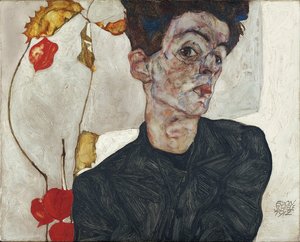
      Despite facing censorship and legal challenges – including a brief imprisonment for allegedly corrupting minors with his art – Schiele gained recognition within Vienna’s avant-garde circles. His work challenged the conventions of the time, provoking both admiration and outrage. By the time of his untimely death during the Spanish flu pandemic in 1918 at the age of twenty-eight, he had established himself as a leading figure in Austrian Expressionism. Significant works such as Self-Portrait with Physalis, Couple Embracing, and Field Landscape (Kreuzberg near Krumau) stand as testaments to his artistic genius. His influence on subsequent generations of artists is undeniable, particularly those interested in exploring psychological themes and challenging conventional artistic norms. Schiele’s bold approach to form and subject matter continues to resonate with audiences today, making him one of the most important and influential figures in early 20th-century art. His paintings are now held in major museum collections worldwide, ensuring his artistic legacy endures.

      § 5Comparanda

      § 6Questions

      Kısa Bilgiler

      • Artistic style: Figurative painting
      • Movement: Expressionism
      • Artist: Egon Schiele
      • Notable elements or techniques: Confident pose, vintage feel

      Sanat Bilgisi Testi

      Her soru için yalnızca bir doğru cevap bulunmaktadır.

      Soru 1:
      Based on the provided information, what is a prominent characteristic of Egon Schiele’s artistic style?
      Soru 2:
      The image description notes the woman in the painting has a specific posture. What is it?
      Soru 3:
      What significant personal event in Egon Schiele's childhood profoundly impacted him?
      Soru 4:
      According to the biography, who served as a mentor to Egon Schiele?
      Soru 5:
      The description mentions the painting has a 'vintage feel'. What contributes to this impression?

      § 7Cite this entry

      AllPaintingsStore.com, “Egon Şiele, untitled (893)”, https://allpaintingsstore.com/tr/art/egon-schiele-untitled-893-9GEUEJ-en/ArtistReproduction/ (accessed 2 Ekim 2026).

      § 8The reproduction

      El Yapımı Yağlı Boya Reproduksiyon

      Sanatçılarımız tarafından sipariş üzerine hazırlanan; istediğiniz boyut ve çerçevede, tuval üzerine el boyaması yağlı boya. ( Baskı Satışına Geç Dijital Görsel Satışına Geç)

      It is specified on the order sheet in the margin; the present state of that sheet reads as follows.

      untitled (893)

      Baskı Tekniği

      Baskı Boyutu

      -

      Seçkin Kıdemli Sanatçı

      Daha fazla detay, incelik ve ek üretim süresi

      -

      Reproduksiyon Çerçeve Seçenekleri

      -

      -

      Herhangi bir kenarı 105 cm'den (yaklaşık 41 inç) büyük olan sanat eserleri veya reprodüksiyonlar için çerçeve, demonte edilmiş bir kit halinde gönderilecektir. Bu yöntem, güvenli teslimat sağlar ve taşıma sırasında oluşabilecek hasarları önler.

      Profesyonel montaj gereklidir; bu ürün kendin yap (DIY) tarzı bir ürün değildir.
      Kit; ahşap tutkalı (pakete dahil değildir), kanvas germe pensi ve tutkal kururken çıtaların dik durmasını sağlayacak işkenceler kullanılarak, deneyimli bir profesyonel çerçeveci tarafından monte edilmeli ve kanvas gerilmelidir. Hatalı montaj veya dengesiz kanvas gerginliği sanat eserine kalıcı zarar verebilir ve bu durum garantimiz kapsamında değildir.

      • Tüm masif ahşap çıtalar dahildir, montaj için hassas bir şekilde ölçülmüştür.

      • Paket içeriğinde bulunan vidalar ve köşe birleşimleri için çerçeve ustanız tarafından temin edilmesi gereken, ancak pakete dahil olmayan ahşap tutkalı ile monte edilir.

      • Profesyonel araçlar gereklidir ve pakete dahil değildir: bir tuval germe aparatı (gerdirici) ve yapıştırıcı kururken çıtaların dik durmasını sağlayacak kıskaçlar.

      Önemli:
      Köşe bağlantıları için ahşap tutkalı gereklidir; tutkal tamamen kuruyana kadar çıtalar işkenceler ile sabitlenmelidir ve monte edilmiş çerçeve üzerindeki kanvasın gerilmesi için bir kanvas germe pensine ihtiyaç duyulur. Bunların hiçbiri kit içerisinde yer almamaktadır. Lütfen bu boyutu sipariş etmeden önce deneyimli bir profesyonel çerçeve ustası ile anlaşın.

      İsimlik

      -

      -

      Koruyucu Vernik

      Parlak Vernik (renkleri canlandırır; ışığa ve neme karşı koruma sağlar)

      -

      Eserimi Özelleştir

      Değiştirilebilecek örneklere göz atın: Yüzü müşteri fotoğrafıyla değiştirin; Evcil hayvan ekleyin (örneğin, kediyi köpek ile değiştirin); Arka plana gizli bir mesaj dahil edin; Arka plan manzarasını veya öğelerini değiştirin.

      -

      Acil

      Dünya Çapında Teslimat (); standart 5 hafta yerine 3/4 hafta içinde. (30 Ekim). Kaliteden ödün verilmez.

      -

      Hızlı Teslimat

      için dünya çapında teslimat süresi 5 haftadır. (6 Kasım).

      Dahil

      Toplam Fiyat

      ₺ 12654

      Included with every order

      • Dünya Çapında Ücretsiz Ekspres Kargo
      • Yüksek Kaliteli Keten Tuval
      • Tam Nakliye Sigortası
      • Gümrük Vergisi İadesi Garantisi
      • Gerçek Renk Uyumu Garantisi
      • 100 Günlük İade Koşulları (Sadece Üretim Hatalı Ürünler İçin)
      • %100 Para İade Garantisi
      • Toplu Alım Avantajı
      Order sheet