Painting.

§ 1Katalog verileri


Bu Eser Telif Hakkı Koruması Altındadır
Bu sayfada sergilenen eser telif hakkı yasasıyla korunmaktadır; bu da yasal olarak eserin birebir kopyasını oluşturamayacağımız veya satamayacağımız anlamına gelir. Bu koruma, aşağıdakiler gibi uluslararası anlaşmalar kapsamında uygulanmaktadır: Bern Sözleşmesi ve aşağıdakiler de dahil olmak üzere ulusal yasalarca belirlenen ABD Telif Hakkı Kanunu - 17. Başlık.
Saygılı ve yasal bir alternatif olarak, orijinalinden ilham alan, kişiye özel, el boyaması sanat eserleri sunuyoruz. Deneyimli ve profesyonel sanatçılarımız, aynı duyguyu uyandıran yeni ve benzersiz bir eser yaratmak için orijinalin stilini, ruhunu ve sanatsal özünü titizlikle inceler; üstelik bu eser, kendi başına özgün bir üretim olarak kalır.
Bu yöntem, koruma altındaki sanat eserinin kopyalanmasını veya çoğaltılmasını içermediği için telif hakkı düzenlemelerine tam uyum sağlar. Bunun yerine, yaratıcı bir yeniden yorumlamadır; orijinalinden etkilenen ancak onunla aynı olmayan yeni bir tablodur.
 Daha fazla bilgi edinin
§ 2Soyut
Eser Açıklaması
Victor Vasarely (1906-1997) was born Károly Vaszary in Pécs, Croatia. Initially pursuing medical studies at Eötvös Loránd University in Budapest, he abandoned medicine for painting in 1927 after enrolling at Sándor Bortnyik’s Műhely – a Bauhaus-influenced school. This formative experience instilled him with the principles of functional design and geometric abstraction, shaping his signature Op Art
Sanatçı Biyografisi
Op Sanatı'nın öncüsü Victor Vasarely (1906-1997)! Geometrik soyutlamaları, optik illüzyonları ve modern sanat & tasarım üzerindeki kalıcı etkisi keşfedin. 'Zebra', 'Suomi' seramikleri gibi eserleriyle tanınır.
§ 3Yorumlar
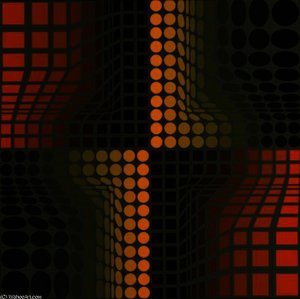
Geometric Composition and Color
The artwork consists of four circles arranged in a square configuration. Each circle is assigned a specific color: blue, orange, yellow, and purple. These shapes are positioned at different points within the square frame. One circle occupies the left side, another is on the right, one is placed above, and the final circle is situated below the others. The composition relies on sharp edges and distinct color zones rather than blended transitions. The artist utilized a method called hydrostatic printing to apply pigment to the canvas, ensuring consistent color application and mathematical precision across the surface.
The arrangement of these circles follows a square motif, a recurring element in the artist's body of work. This specific layout utilizes Euclidean geometry to establish a sense of order. The interplay between the colored circles and the surrounding space creates a shimmering effect that shifts as the viewer's gaze moves across the canvas. This visual phenomenon is a result of the interaction between the specific hues and the eye's perception of light and shape.
The Mechanics of Perception
This piece belongs to the Op Art movement, which emerged in the wake of World War II. The movement focused on the psychological and neurological aspects of vision, using illusionistic effects to challenge how the brain interprets visual information. By employing a systematic methodology involving grids and mathematical principles, the work moves away from representational art. It does not attempt to mimic nature or provide a narrative. Instead, it functions as a visual experiment in how the retina processes high-contrast colors and geometric forms.
The intellectual foundation of the work draws from the Bauhaus movement's focus on functional design and the reductive abstraction of Piet Mondrian. It also incorporates Gestalt principles, which concern how the mind organizes visual stimuli into coherent patterns. The use of hydrostatic printing allowed for a level of accuracy that traditional brushwork could not achieve, emphasizing the mathematical nature of the composition. The result is a work that prioritizes the stimulation of the mind through controlled visual input, focusing on the mechanics of sight rather than the depiction of objects.
Soru ve Cevaplar
Victor Vasarely imzalı "Lain" hangi sanat akımına dahildir?
"Lain", Geometric Abstraction akımına ait bir eserdir. Bu akım, eserin dahil olduğu sanatsal geleneği ifade eder.
Victor Vasarely imzalı "Lain" eserinin sanat tarihindeki yeri nedir?
Victor Vasarely imzalı "Lain", Modern dönemindeki Geometric Abstraction akımına aittir. Bu iki unsur birlikte eserin sanat tarihindeki yerini belirler.
Victor Vasarely imzalı "Lain" eserine benzer sanat eserlerini nasıl keşfedebilirim?
"Lain" ile benzer eserler, eserin Benzer Eserler sayfasında listelenmektedir.


 Baskı Satışına Geç


 Herhangi bir kenarı 105 cm'den (yaklaşık 41 inç) büyük olan sanat eserleri veya reprodüksiyonlar için çerçeve, demonte edilmiş bir kit halinde gönderilecektir. Bu yöntem, güvenli teslimat sağlar ve taşıma sırasında oluşabilecek hasarları önler.