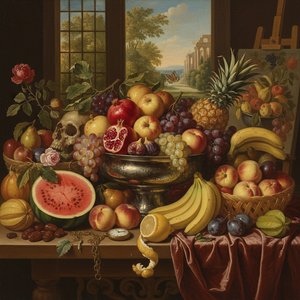
Oil On Canvas.

§ 1Catalogue data

§ 2Abstract
Опис експоната
Experience the dramatic intensity of Caravaggio's still life masterpiece, featuring a colossal pumpkin and scattered apples in a rich Baroque style – perfect for art lovers to discover or own.
 Розгорнути текст
Біографія митця
Відкрийте для себе Караваджо (1571-1610): бароковий майстер реалізму та тенєбризму! Драматичні релігійні сцени, інтенсивне кьяроскуро та революційний стиль.
§ 3Commentary
A Study in Abundance: A Caravaggio Still Life
This captivating still life, attributed to the masterful hand of Michelangelo Merisi da Caravaggio, presents a scene brimming with both earthly bounty and profound emotional resonance. The composition immediately draws the eye to a monumental pumpkin – a dominant presence that speaks volumes about the harvest’s richness and the transient nature of beauty. Scattered around this central figure are a carefully arranged collection of apples, their crimson skins offering a vibrant counterpoint to the earthy tones of the vegetables and fruit. A solitary human form, subtly placed on the right side of the canvas, introduces an element of narrative, perhaps suggesting contemplation or interaction with this opulent display.
- Subject Matter: The painting’s subject is a classic still life – a meticulously rendered collection of fruits and vegetables. However, Caravaggio elevates this genre through his dramatic use of light and shadow, transforming the mundane into something deeply evocative.
- Style & Technique: This work exemplifies Caravaggio's signature *tenebrism*, a technique characterized by stark contrasts between intensely dark areas and dramatically illuminated subjects. The strong directional light not only reveals the textures and forms of the objects but also serves to heighten their emotional impact, creating a sense of theatrical drama. The artist’s brushwork is loose and expressive, contributing to the painting's raw energy and immediacy.
Historical Context & Caravaggio’s Innovation
Created during the tumultuous period of the Baroque era (roughly 1600-1750), this still life reflects a shift in artistic sensibilities away from the idealized forms of the Renaissance towards a more realistic and emotionally charged approach. Caravaggio, working primarily in Rome, was a revolutionary figure who challenged the established conventions of his time. He rejected the polished surfaces and classical allegories favored by many of his contemporaries, instead choosing to depict everyday subjects – often religious scenes – with unflinching honesty and a deep understanding of human psychology. His use of ordinary people as models, rather than idealized figures, further contributed to this revolutionary spirit.
Born in Milan in 1571, Caravaggio’s early life was marked by tragedy—the deaths of his father and grandfather from the plague. This experience profoundly shaped his artistic vision, fueling a preoccupation with themes of mortality, suffering, and redemption. His time in Rome, though initially challenging, provided him with the freedom to develop his unique style, which would ultimately influence generations of artists.
Symbolism & Emotional Impact
- The Pumpkin: The oversized pumpkin is often interpreted as a symbol of abundance, fertility, and even mortality – a reminder of the cyclical nature of life and death.
- Apples: Apples frequently represent temptation, knowledge, or beauty in Western art. Their placement strategically draws attention to specific areas of the composition.
- The Human Figure: The presence of the human figure adds an element of mystery and invites the viewer to contemplate their role within this scene. It could be interpreted as a representation of humanity’s relationship with nature, or perhaps a meditation on faith and doubt.
Ultimately, this Caravaggio still life transcends its simple subject matter to become a powerful exploration of light, shadow, emotion, and the human condition. Its dramatic intensity and masterful technique continue to captivate viewers centuries later, making it a timeless masterpiece worthy of admiration and preservation.
Питання та відповіді
Наскільки насиченими є кольори у «not identified» роботи Караваджо?
Насиченість кольорів у творі «not identified» — Monochromatic. Насиченість описує, наскільки яскравими та виразними є кольори.
Який настрій та емоцію передає «not identified» роботи Караваджо?
Переданий настрій твору «not identified» роботи Караваджо — це Dramatic, а його емоційна тональність — Melancholic.
З якої країни походить твір у стилі Baroque painting під назвою "not identified"?
Твір у стилі Baroque painting «not identified» був створений художником, який народився в Іспанія.


 Перейти до друку


 Для творів мистецтва або репродукцій, розмір яких перевищує 105 см (приблизно 41 дюйм) з будь-якого боку, рама доставляється у вигляді розібраного комплекту. Такий метод гарантує безпечну доставку та запобігає пошкодженням під час транспортування.