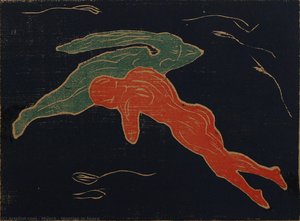
1915. Acrylic On Canvas.

§ 1Catalogue data


§ 2Abstract
Опис експоната
 Розгорнути текст
§ 3Commentary
Anxiety: A Descent into Psychological Landscape
Edvard Munch’s “Anxiety,” painted in 1915, stands as a haunting emblem of the anxieties that gripped Europe during its tumultuous early twentieth century. More than just a depiction of fear; it's an immersive experience into the artist’s tormented psyche—a testament to Munch’s profound understanding of human emotion and his pioneering role in Expressionism.
- Subject Matter & Symbolism: The artwork centers around three figures huddled within a claustrophobic interior space, conveying a palpable sense of isolation and despair. Munch deliberately eschewed realistic representation, prioritizing instead the conveyance of psychological states—specifically anxiety—through distorted forms and unsettling color palettes. The slumped posture of the central figure embodies vulnerability and hopelessness, while the observing individuals represent judgment or perhaps simply an inability to comprehend the protagonist’s inner turmoil.
- Style & Technique: Munch's artistic vision firmly rooted in Expressionism demanded a radical departure from academic conventions. He employed rapid, gestural brushstrokes—often achieved with charcoal—to capture fleeting emotions and impressions rather than meticulously recreating visual reality. The simplified shapes contribute to the artwork’s emotional intensity, mirroring the fragmented nature of anxiety itself.
- Color Palette & Use of Lines: Munch utilized a monochrome grayscale scheme, skillfully manipulating tonal variations to sculpt form and shadow. Thick, expressive lines dominate the composition, radiating outwards from the central figure and emphasizing movement—though it's an unsettling dynamism that underscores the pervasive feeling of unease. These lines aren’t merely delineating shapes; they embody emotion and psychological pressure.
- Composition & Perspective: The cramped room serves as a powerful visual metaphor for entrapment, mirroring the suffocating grip of anxiety. Munch flattened perspective, minimizing depth to heighten the sense of confinement and amplifying the emotional impact of the scene. This deliberate simplification reinforces the artwork’s core message—a confrontation with inner demons.
- Historical Context: Created during a period marked by societal upheaval and intellectual ferment—the dawn of the Great War— “Anxiety” reflects the anxieties prevalent in European culture at the time. Munch's work anticipates the psychological explorations championed by Surrealists decades later, establishing him as a forerunner of modern art’s preoccupation with subjective experience. Explore this evocative masterpiece and discover its enduring relevance to our understanding of human emotion.
Питання та відповіді
Чи є «Anxiety» роботи Едвард Мунк суспільним надбанням?
Статус авторського права для «Anxiety» роботи Едвард Мунк: цей твір є є суспільним надбанням — термін дії авторського права закінчився. Це визначає, чи можна вільно створювати репродукції зображення.
Яка техніка використана у творі "Anxiety"?
Техніка виконання «Anxiety» роботи Едвард Мунк — Acrylic On Canvas. Репродукції мають на меті відтворити вигляд цієї техніки.
«Anxiety» роботи Едвард Мунк — це світлий чи темний твір мистецтва?
Яскравість твору «Anxiety» роботи Едвард Мунк становить brilliant, а показник яскравості (luminance) — Gentle Luminance.


 Перейти до друку


 Для творів мистецтва або репродукцій, розмір яких перевищує 105 см (приблизно 41 дюйм) з будь-якого боку, рама доставляється у вигляді розібраного комплекту. Такий метод гарантує безпечну доставку та запобігає пошкодженням під час транспортування.