

untitled (6596)
Акрил на полотні.

§ 1Catalogue data


§ 2Abstract
Опис експоната
Explore Egon Schiele's haunting 'untitled (6596)' – a powerful Expressionist portrait conveying vulnerability & emotional intensity. Own a hand-painted reproduction of this iconic artwork today! #EgonSchiele #Expressionism #ArtReproductions
 Розгорнути текст
Біографія митця
Еґон Шілельє – австрійський экспресіоністський живописець, відомий своїми емоційно насиченими полотнами та символічним зображенням будинку з сухим пранням. Дізнайтесь більше про мистецтво Шілеля!
§ 3Commentary
A Haunting Portrait of Innocence: Exploring Emotional Depth
This profoundly moving work by Egon Schiele is a masterclass in Expressionist portraiture, capturing a raw and unsettling depiction of childhood vulnerability. More than just a representation, it’s an evocation of feeling – fragility, isolation, and perhaps even suffering – rendered with striking honesty.
Subject & Symbolism: A Study in Human Condition
The artwork centers on a young child, seated and posed in a manner that suggests both resignation and physical exhaustion. The figure’s emaciated form is immediately arresting, hinting at hardship, illness, or profound deprivation. This isn't merely a portrait of a person; it’s a symbolic representation of innocence lost, the impact of societal struggles, and the universal experience of human suffering. The simplicity of the composition – focusing solely on the child against a stark background – amplifies this emotional weight, forcing direct engagement with their plight.
Expressionist Style & Technical Brilliance
Schiele’s signature Expressionist style is powerfully evident in this piece. He rejects traditional representational techniques in favor of distorted forms and emotionally charged lines. Executed primarily in pastel or chalk on paper, the artwork showcases a visible texture that adds to its immediacy and intensity. Loose, gestural strokes define the figure, prioritizing emotional impact over precise detail. The angularity of the body contrasts with softer facial features, creating a dynamic tension that reflects the subject’s inner turmoil.
Color & Composition: A Palette of Austerity
The limited color palette – dominated by earthy tones of ochre, orange-brown, and pale flesh tones – reinforces the somber mood. These muted hues avoid distraction, drawing all attention to the child's physical state and emotional expression. The composition itself is deliberately unbalanced; the figure’s off-center placement contributes to a sense of instability mirroring their precarious condition. Diagonal lines created by the extended arm and leg add dynamism but also heighten the feeling of unease.
Historical Context & Artistic Legacy
Created during a period of significant social and political upheaval, Schiele's work reflects the anxieties and disillusionment of early 20th-century Europe. As a pivotal figure in Austrian Expressionism, alongside Gustav Klimt and Oskar Kokoschka, he challenged artistic conventions and explored taboo subjects with unflinching honesty. His bold exploration of psychological themes and unique line work continue to influence artists today.
Bringing Emotional Resonance into Your Space
This artwork is more than just a visual statement; it’s an invitation for contemplation. A reproduction of this piece would serve as a powerful focal point in any interior, adding depth, complexity, and emotional resonance. Its muted palette complements both modern and traditional settings, while its thought-provoking subject matter sparks conversation and introspection. Ideal for collectors seeking impactful works or designers aiming to create spaces that evoke feeling, this Schiele masterpiece offers enduring artistic value.
Питання та відповіді
Чи можна вільно відтворювати зображення «untitled (6596)» роботи Еґон Шілельє?
Статус авторського права для «untitled (6596)» роботи Еґон Шілельє: цей твір є є суспільним надбанням — термін дії авторського права закінчився. Це визначає, чи можна вільно створювати репродукції зображення.
Як поєднуються контраст і гармонія у творі "untitled (6596)"?
Колірний аналіз «untitled (6596)» роботи Еґон Шілельє підкреслює Безтурботний контраст та Цілісна палітра гармонію.
Який інтер'єр найкраще підкреслить кольори твору «untitled (6596)» роботи Еґон Шілельє?
Завдяки своїй палітрі Темні відтінки, роботу «untitled (6596)» роботи Еґон Шілельє рекомендується розміщувати в Вітальня. Саме кольори є однією з причин такої поради.
§ 4The artist
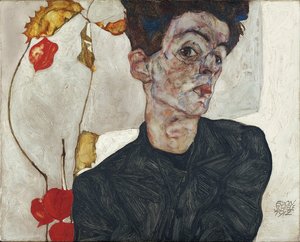
Еґон Шілельє
1890 - 1918, Австрія
Короткі факти
- Artistic Movement Or Style: Експресіонізм
- Artists Or Movements Influenced By This Artist: ['Експресіонізм']
- Artists Who Influenced This Artist: ['Густав Клімт']
- Date Of Birth: 1890
- Full Name: Еґон Шілельє
- Nationality: Австрієць
- Notable Artworks:
- Автопортрет з фізалісом
- Пара обіймається
- Поле краєвид (Креуберг)
- Place Of Birth: Тюльн, Австрія
Біографія митця
A Life Forged in Expression
Egon Schiele’s life, a turbulent and intensely personal journey, unfolded from his birth in Tulln an der Donau in 1890, a small Austrian town nestled along the Danube. His early years were shadowed by profound loss – first the death of his father, Adolf Schiele, a railway station master consumed by syphilis when Egon was just fourteen, and later the untimely passing of his sister Elvira. This early exposure to mortality and grief became deeply ingrained within his artistic vision, fueling an enduring fascination with the fragility of existence and the inevitability of death. Raised initially by his mother and then under the somewhat controlling guardianship of his uncle Leopold Czihaczek, Schiele’s childhood lacked the stability often associated with conventional upbringing, yet it fostered a remarkable sense of independence and self-reliance—qualities that would profoundly shape his artistic approach. Even as a young boy, he exhibited an intense curiosity about trains – a motif that subtly reappeared throughout his career, symbolizing both movement and the passage of time. Simultaneously, he displayed a burgeoning talent for drawing, though this pursuit was initially met with disapproval from his father, who viewed it as a distraction from more “practical” endeavors. The early loss of his sister Elvira cast a long shadow over the young artist’s psyche, contributing to a pervasive sense of melancholy and vulnerability that permeated much of his work. These formative experiences—illness, loss, and a lack of stability—instilled within him an unparalleled sensitivity and emotional rawness, qualities that would become defining characteristics of his artistic expression, constantly grappling with the fundamental questions of life, death, and the human condition.The Crucible of Vienna: Artistic Development
Schiele’s formal artistic training began at the Kunstgewerbeschule (School of Arts and Crafts) in Vienna, but he quickly found himself stifled by its conservative and rigidly academic approach. Seeking a more liberating environment, he transferred to the Akademie der bildenden Künste (Academy of Fine Arts), only to discover that even this institution failed to satisfy his artistic aspirations. The rigid traditions and emphasis on historical precedent clashed sharply with Schiele’s desire for innovation and personal expression. Dissatisfied with these constraints, he ultimately abandoned formal training altogether, choosing instead to forge his own path—a bold decision that underscored his unwavering commitment to his artistic vision. Crucially, during these formative years, Schiele was profoundly influenced by the work of Gustav Klimt, a leading figure in Viennese Secessionism. He admired Klimt’s distinctive decorative style and his exploration of symbolism, even receiving mentorship from the established artist. However, Schiele soon diverged significantly from Klimt's aesthetic, developing a uniquely personal style characterized by its stark honesty, psychological intensity, and unflinching portrayal of human vulnerability. This divergence was further fueled by his encounters with other progressive artists within Vienna’s avant-garde circles, leading to the formation of the Neues Wiener Kunstgruppe (New Viennese Art Group) in 1909—a collective dedicated to challenging conventional artistic norms and pushing the boundaries of modern art. The group included figures like Anton Faistauer, Rudolf Kalvach, and Hans Ehrlich, all seeking to redefine the role of art in a rapidly changing world.Raw Emotion and Unflinching Truth
Egon Schiele’s art is immediately recognizable for its raw honesty and psychological depth. He fearlessly confronted themes often considered taboo – sexuality, death, anxiety, isolation – with an unflinching gaze. His distinctive style features elongated figures, contorted poses, and expressive lines that convey a sense of unease and emotional intensity. The human form, particularly the nude, became his primary subject, not as an object of idealized beauty but as a vehicle for exploring the complexities of human experience. Self-portraits constitute a significant portion of his oeuvre, offering intimate glimpses into his inner world—a world often marked by loneliness and self-doubt. He didn’t shy away from depicting himself in unflattering or vulnerable poses, revealing a profound level of self-awareness and introspection. Beyond self-portraiture, Schiele created numerous portraits of others, capturing their likenesses with an unsettling realism that seemed to penetrate beneath the surface. His landscapes, while less central to his work than his figurative paintings, demonstrate his mastery of form and color, often reflecting the same emotional intensity as his portraits. Recurring motifs like the *Physalis* plant – symbolizing death and transience with its delicate, papery husk – further underscore this preoccupation with mortality. The use of line is particularly striking in Schiele’s work; it's not merely a tool for defining shape but an expressive force that conveys emotion and psychological tension.A Legacy Cut Short: Achievements & Significance
Despite facing censorship and legal challenges—including a brief imprisonment for allegedly corrupting minors with his art—Schiele gained recognition within Vienna’s avant-garde circles. His work challenged the conventions of the time, provoking both admiration and outrage. By the time of his untimely death during the Spanish flu pandemic in 1918 at the age of twenty-eight, he had established himself as a leading figure in Austrian Expressionism. Significant works such as *Self-Portrait with Physalis*, *Couple Embracing*, and *Field Landscape (Kreuzberg near Krumau)* stand as testaments to his artistic genius. His influence on subsequent generations of artists is undeniable, particularly those interested in exploring psychological themes and challenging conventional artistic norms. Schiele’s bold approach to form and subject matter continues to resonate with audiences today, making him one of the most important and influential figures in early 20th-century art. His paintings are now held in major museum collections worldwide, including the Leopold Museum in Vienna and the Egon Schiele Art Centrum in Český Krumlov, ensuring his artistic legacy endures. He left behind a body of work that is not merely aesthetically compelling but profoundly human—a testament to the power of art to confront the complexities of existence with honesty, courage, and unwavering vision.- Key Themes: Mortality, sexuality, isolation, psychological turmoil.
- Influences: Gustav Klimt, Viennese Secession, personal trauma.
- Style Characteristics: Elongated figures, contorted poses, expressive lines, raw emotion.
§ 5Comparanda
Схожі твори мистецтва


§ 6Questions
§ 7Further reading
Пов'язані статті
25 шедеврів Еґона Шіле: глибокі історії та мистецтво для вашого дому | AllPaintingsStore
Відкрийте 25 найвідоміших картин Еґона Шіле – австрійського експресіоніста, майстра психологічного портрету та виразного живопису. Історія мистецтва, техніки та натхнення для декору вашого дому від AllPaintingsStore.com.

Топ-10 шедеврів експресіонізму: мистецтво емоцій та самовираження від AllPaintingsStore
Пориньте у світ експресіонізму! Відкрийте 10 шедеврів Мунка, Ван Гога та інших геніїв. Історія мистецтва, емоції та кольори – все це на AllPaintingsStore.com. Репродукції картин преміум-якості для вашого дому.

The Subtleties of Pastel: A Comprehensive Exploration of Technique, History & Emotional Resonance
Explore the captivating world of pastel art! Discover its rich history, Impressionistic masters like Degas, emotional power & unique techniques. Find museum-quality reproductions at AllPaintingsStore.

Egon Schiele: Expressionism, Anxiety & the Modern Condition – A Comprehensive Exploration
Explore the emotionally charged world of Egon Schiele (1890-1918). Discover his Expressionist masterpieces, psychological themes, and lasting impact on modern art. A comprehensive guide for collectors & enthusiasts.
Топ-10 шедеврів експресіонізму: картини, що змінили мистецтво | AllPaintingsStore.com
Відкрийте для себе 10 шедеврів експресіонізму! Дізнайтесь історії Мунка, Кірхнера та інших геніїв. Купуйте репродукції картин онлайн на AllPaintingsStore.com – музейна якість для вашого інтер'єру.
Cite this entry
AllPaintingsStore.com, “Еґон Шілельє, untitled (6596)”, https://allpaintingsstore.com/uk/art/egon-schiele-untitled-6596-9GEUDH-en/ArtistReproduction/ (accessed 1 Жовтень 2026).
§ 8The reproduction
Олійная репродукція ручної роботи
Написана вручну олією на полотні у вашому розмірі та рамі, виготовлена на замовлення нашими художниками. ( Перейти до друку Перейти до цифрових зображень)
It is specified on the order sheet in the margin; the present state of that sheet reads as follows.

untitled (6596)
Матеріал репродукції
Розмір репродукції
-

Видатний майстер-художник
Більше деталізації, витонченості та додаткового часу на створення твору
-

Рама для репродукції
-
-
Для творів мистецтва або репродукцій, розмір яких перевищує 105 см (приблизно 41 дюйм) з будь-якого боку, рама доставляється у вигляді розібраного комплекту. Такий метод гарантує безпечну доставку та запобігає пошкодженням під час транспортування.
Потребує професійного збирання — це не продукт для самостійного виготовлення (DIY).
Комплект має бути зібраний, а полотно натягнуте досвідченим майстром багетних робіт із використанням клейового дерева (не входить у комплект), щипців для натягування полотна та затискачів, щоб підрамник залишався рівним під час висихання клею. Неправильне збирання або нерівномірне натягування полотна може призвести до незворотного пошкодження твору мистецтва, що не підпадає під дію нашої гарантії.
 Для творів мистецтва або репродукцій, розмір яких перевищує 105 см (приблизно 41 дюйм) з будь-якого боку, рама доставляється у вигляді розібраного комплекту. Такий метод гарантує безпечну доставку та запобігає пошкодженням під час транспортування.
У комплект входять усі бруски з цільного дерева, точно вирізані за розміром.
Збирається за допомогою гвинтів, що входять до комплекту, а також клейового розчину для кутових з'єднань, який не входить до комплекту і має бути підготовлений вашим майстром.
Потрібні професійні інструменти, які не входять до комплекту: щипці для натягування полотна (натягувач) та затискачі, щоб утримувати рейки рівно під час висихання клею.
Важливо:
Для з'єднання кутів потрібен клей для дерева, перекладини необхідно затиснути струбцинами до повного висихання клею, а для натягування полотна на зібрану раму знадобляться щипці для натягування полотна. Жоден із цих інструментів не входить до комплекту. Будь ласка, проконсультуйтеся з досвідченим майстром багетного оформлення перед замовленням рами такого розміру.

Етикетка експоната
-
-

Захисний лак
Глянцевий лак (підсилює яскравість кольорів, захищає від світла та вологи)
-

Персоналізувати мій витвір
Приклади можливих змін: заміна обличчя на фото клієнта; додавання домашньої тварини (наприклад, заміна кота на собаку); додавання прихованого повідомлення на фоні; зміна пейзажу або елементів фону.
-

Прискорено
Доставка по всьому світу () за 3–4 тижні замість стандартних 5 тижнів. (29 Жовтень). Без компромісів у якості.
-
Експрес-доставка
Доставка по всьому світу () протягом 5 тижнів. (5 Листопад).
Включено в ціну
Підсумкова вартість
₴ 11575
Included with every order
- Безкоштовна експрес-доставка по всьому світу
- Високоякісне лляне полотно
- Повне страхове покриття доставки
- Гарантія повернення митних зборів
- Гарантія точного відтворення кольорів
- Політика повернення протягом 100 днів (лише у разі виявлення дефектів)
- Гарантія повернення 100% коштів
- Пропозиція на оптові замовлення


