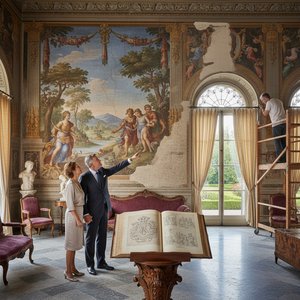
A Life Woven into the Renaissance Fabric
Giorgio Vasari, born in Arezzo, Tuscany, on July 30, 1511, was more than simply a painter; he was a quintessential embodiment of the Italian Renaissance spirit. His life unfolded as a vibrant tapestry woven with threads of artistic creation, architectural innovation, insightful historical writing, and an unwavering dedication to celebrating the masters who came before him. From his earliest training under Guglielmo da Marsiglia, a skilled artisan in stained glass, young Giorgio’s path was steered towards visual artistry. However, it was his move to Florence at sixteen that truly ignited his potential. Immersing himself within the dynamic circle of Andrea del Sarto and absorbing the influences of Rosso Fiorentino and Jacopo Pontormo, Vasari began a journey that would see him become one of the most influential figures of his era. His formative years were also deeply marked by the patronage and friendship of the powerful Medici family, a relationship that would shape both his career and his perspective on art’s role in society.
The Artist's Hand and Eye
Vasari’s artistic style is often categorized as Mannerist, reflecting the prevailing aesthetic trends of the mid-16th century. His paintings are characterized by elongated figures, dynamic compositions, and a sophisticated use of color—qualities highly admired during his lifetime. While perhaps not achieving the same level of enduring fame as some of the artists he chronicled, Vasari’s skill was undeniable. Notable works such as *The Studio of the Painter*, a fresco housed in Casa Vasari in Arezzo, offer a fascinating glimpse into the artistic practices of the time. The sheer scale and ambition of his frescoes for the Palazzo Vecchio in Florence, undertaken between 1555 and 1572, demonstrate his mastery of large-scale decorative schemes. His final monumental undertaking, *The Last Judgement*, adorning the cupola of Florence Cathedral—completed after his death by Federico Zuccari—stands as a testament to his unwavering commitment to grand artistic visions. Beyond painting, Vasari’s architectural contributions were equally significant. He designed the elegant loggia of the Palazzo degli Uffizi, transforming it into a public piazza and creating a vital link within Florence's urban landscape. Perhaps most famously, he conceived and oversaw the construction of the Vasari Corridor, a secret passageway connecting the Uffizi Gallery with the Palazzo Pitti—a feat of engineering and architectural ingenuity that continues to captivate visitors today.
A Historian Forging a Legacy
However, it is arguably as an art historian that Giorgio Vasari secured his most lasting legacy. His monumental work, *Lives of the Most Excellent Painters, Sculptors, and Architects*, published in 1550 (with a revised edition in 1568), revolutionized the way art was understood and appreciated. This groundbreaking text wasn’t merely a collection of biographies; it established a narrative framework for the development of Italian Renaissance art, tracing its evolution from the early masters like Cimabue and Giotto to his contemporaries Michelangelo and Raphael. Vasari's work introduced the very concept of the “Renaissance” – a rebirth of classical ideals—and laid the foundation for modern art history as a discipline. While acknowledging that Vasari’s accounts are not without their biases and inaccuracies, particularly concerning artists predating his own time, the impact of *Lives* remains profound. It provided a crucial historical context for artistic creation, elevating the status of artists from skilled craftsmen to intellectual figures worthy of scholarly attention.
Influences and Enduring Significance
Vasari’s artistic development was profoundly shaped by his exposure to the works of Renaissance masters. His visit to Rome in 1529, where he studied the art of Raphael and other High Renaissance artists, proved pivotal. He absorbed their principles of composition, anatomical accuracy, and idealized beauty, incorporating them into his own style. Michelangelo, whom Vasari greatly admired, exerted a particularly strong influence on both his painting and architecture. The grandeur and dynamism characteristic of Michelangelo’s work are evident in many of Vasari’s projects. Beyond specific artists, the broader intellectual currents of the Renaissance—humanism, classical learning, and a renewed interest in empirical observation—also informed Vasari's approach to art and history. Giorgio Vasari died on June 27, 1574, in Florence, leaving behind a multifaceted legacy that continues to resonate today. He was not only a talented artist and architect but also a pioneering historian whose writings shaped our understanding of one of the most transformative periods in Western art history. His work remains essential for anyone seeking to explore the rich cultural heritage of the Italian Renaissance.
Major Achievements
- The Studio of the Painter (1563): A monumental fresco within Casa Vasari, offering a detailed depiction of an artist’s studio and serving as a testament to Vasari's understanding of artistic practice.
- Frescoes in Palazzo Vecchio (1555-1572): A series of ambitious frescoes adorning the Salone dei Cinquecento, showcasing Vasari’s mastery of large-scale decorative schemes and his ability to integrate historical narratives into architectural settings.
- Design of the Uffizi Gallery (1560): Transforming a former arsenal into a magnificent public space, Vasari's design for the Uffizi Gallery established a new standard for Renaissance architecture in Florence.
- The Last Judgement (1573-1579): A monumental fresco on the cupola of Florence Cathedral, completed after Vasari’s death by Federico Zuccari, representing a culmination of his artistic ambitions and a powerful statement about faith and mortality.
- The Lives of the Most Excellent Painters, Sculptors, and Architects (1550): A groundbreaking historical work that established a framework for understanding the development of Renaissance art and cemented Vasari’s place as a pivotal figure in art history.
Key Influences
- Guglielmo da Marsiglia: Vasari's early teacher, providing him with foundational training in stained glass techniques.
- Andrea del Sarto: A master painter and influential figure in Florence, whose workshop provided Vasari with invaluable artistic experience.
- Raphael & Michelangelo: The High Renaissance masters whose works profoundly influenced Vasari’s style and approach to art.
- Humanism & Classical Learning: The intellectual currents of the Renaissance, emphasizing reason, observation, and a renewed interest in classical antiquity.
Further Resources
Useful Links:


 Розгорнути текст


 Перейти до друку


 Для творів мистецтва або репродукцій, розмір яких перевищує 105 см (приблизно 41 дюйм) з будь-якого боку, рама доставляється у вигляді розібраного комплекту. Такий метод гарантує безпечну доставку та запобігає пошкодженням під час транспортування.