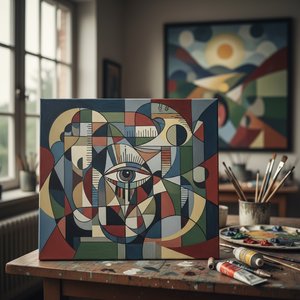
1920. Акрил на полотні, 12.0 x 10.0 cm.

§ 1Catalogue data
 Акрил на полотні
- Настінний декор
- Early Modernism
 1920
1920- — Модерн
 12.0 x 10.0 cm
§ 2Abstract
Опис експоната
Explore Paul Klee’s ‘Park’ (1920) – a stylized abstract landscape in bold geometric forms & vibrant colors. A captivating early modernism piece by the renowned Swiss artist.
 Розгорнути текст
Біографія митця
Відкрийте світ творчості Пауля Клее! Швабський художник експериментував з абстракцією та символізмом, створюючи унікальні полотна, що вражають глибиною емоцій та філософією. Дізнайтесь більше про його стиль та вплив!
§ 3Commentary
A Glimpse into an Abstract Eden: Paul Klee’s ‘Park’ (1920)
- Subject and Composition: This diminutive work, measuring just 12 x 10 cm, presents a captivatingly abstracted vision of a woodland park. Rather than striving for realistic depiction, Klee constructs the scene from geometric forms – squares, rectangles, and triangles – representing trees, foliage, and ground. The composition is densely layered, creating an illusion of depth through overlapping shapes and subtle shifts in color intensity. It’s not a *representation* of a park so much as an evocation of its essence.
- Style & Influences: Created in 1920, ‘Park’ sits at a pivotal moment in modern art. The work embodies elements of early Modernism and leans towards Abstract Expressionism, though predating the full flowering of that movement. Klee's style was uniquely his own, yet demonstrably influenced by movements like Cubism and Expressionism. He wasn’t bound to any single ‘-ism,’ instead synthesizing diverse approaches into a highly individual visual language.
- Technique & Materials: Klee masterfully employs watercolor or gouache on paper, utilizing visible brushstrokes to build texture and form. The paint is applied directly, creating a lively surface that suggests foliage and shadow without explicit rendering. This technique contributes to the artwork’s sense of immediacy and spontaneity.
- Color & Form: Distinct blocks of color define each element of the landscape – trees, ground, and sky. The deliberate use of contrasting hues creates visual interest and emphasizes the geometric forms. Klee's profound understanding of color theory—documented extensively in his influential *Paul Klee Notebooks*—is evident here. He doesn’t simply apply color; he orchestrates it to create mood and spatial relationships.
- Historical Context & The Bauhaus: Paul Klee was a significant figure in the development of modern art, and his career intersected with some of the most important artistic movements of the 20th century. He taught alongside Wassily Kandinsky at the Bauhaus school, where he explored theories of form and design that profoundly impacted his work. This period saw an emphasis on abstraction and a rejection of traditional representational techniques.
- Symbolism & Emotional Impact: While seemingly abstract, ‘Park’ evokes a sense of quiet contemplation and connection to nature. The simplified forms and muted palette create a peaceful atmosphere. Klee often infused his work with personal moods and beliefs, and a subtle undercurrent of melancholy or introspection can be felt in this piece. It's an invitation to pause and reflect on the beauty of the natural world, filtered through the lens of abstraction.
- Klee’s Unique Vision: Paul Klee was not merely painting what he saw; he was visualizing how things *felt*. His works often possess a childlike quality, born from a playful curiosity and an uninhibited approach to form and color. ‘Park’ exemplifies this characteristic, offering a fresh and imaginative perspective on a familiar subject.
Питання та відповіді
Наскільки насиченими є кольори у «Park» роботи Пауль Клеє?
Насиченість кольорів у творі «Park» — Збалансований. Насиченість описує, наскільки яскравими та виразними є кольори.
Чи можна переглянути «Park» роботи Пауль Клеє у форматі слайд-шоу?
«Park» роботи Пауль Клеє можна переглянути у форматі слайд-шоу на сторінці Слайд-шоу цього твору.
Наскільки популярним є твір «Park» у межах Early Modernism?
«Park» роботи Пауль Клеє має рівень популярності Визнаний і належить до течії Early Modernism.


 Перейти до друку


 Для творів мистецтва або репродукцій, розмір яких перевищує 105 см (приблизно 41 дюйм) з будь-якого боку, рама доставляється у вигляді розібраного комплекту. Такий метод гарантує безпечну доставку та запобігає пошкодженням під час транспортування.