Digital.

§ 1Catalogue data


Цей твір захищено авторським правом
Мистецький твір, представлений на цій сторінці, захищений законом про авторське право, що унеможливлює легальне створення або продаж його ідентичної репродукції. Цей захист забезпечується відповідно до міжнародних угод, таких як Бернська конвенція та національним законодавством, зокрема положеннями, що викладені в Законодавство США про авторське право — Розділ 17. Всі права захищені. Будь-яке використання без дозволу заборонено.
Як шанобливу та законну альтернативу, ми пропонуємо унікальні картини ручної роботи, створені натхненням від оригіналу. Наші досвідчені професійні художники ретельно вивчають стиль, настрій та художню сутність оригіналу, щоб створити новий, неповторний твір, який викликає ті ж почуття, — залишаючись при цьому самобутнім творінням.
Цей метод повністю відповідає нормам авторського права, оскільки він не передбачає копіювання чи дублювання захищеного твору мистецтва. Натомість це творче переосмислення — створення нового малюнка під впливом оригіналу, який не є його точним відтворенням.
 Читати далі
§ 2Abstract
Опис експоната
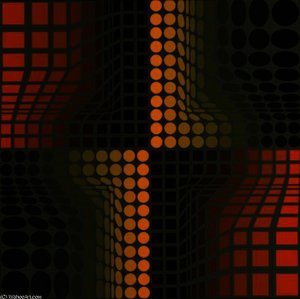
Explore Victor Vasarely’s ‘Obor,’ a mesmerizing Op Art abstraction of geometric shapes & vibrant colors. Discover its layered design & digital rendering style.
Біографія митця
Віктор Вазарелі – піонер оп-арту та кінетичного мистецтва. Його геометричні абстракції, візуальні ілюзії та новаторський підхід вплинули на сучасний дизайн та мистецтво.
§ 3Commentary
A Symphony of Perception: The Vibrating World of Obor
To encounter Victor Vasarely’s “Obor” is to step away from the stillness of traditional viewing and enter a realm where the canvas itself seems to breathe, pulse, and shift beneath one's gaze. This masterpiece of Op Art does not merely sit upon a wall; it interacts with the eye, challenging our very understanding of depth, stability, and movement. At its core, “Obor” is a profound exploration of geometric harmony, where the rigid discipline of mathematical precision meets the fluid, unpredictable nature of human perception. The artwork presents a deceptively simple composition of overlapping rectangles of vibrant hues, yet beneath this apparent austerity lies an intricate system designed to stimulate the viewer’s eye and create a convincing illusion of three-dimensionality.
The foundation of this visual dance is a meticulously structured hexagonal grid. This geometric scaffolding serves as more than just structural support; it actively guides the gaze across the canvas, reinforcing a sense of spatial recession through the careful layering and positioning of shapes. As the eye wanders through the composition, it experiences a rhythmic vibration, a hallmark of Vasarely’s signature style. This technique, deeply rooted in the Bauhaus principles of functional design, allows the artist to manipulate form and color to evoke deep emotional responses, turning a flat surface into a kinetic experience that feels as though it is moving within our own space.
The Chromatic Dance and Emotional Resonance
The color palette employed in “Obor” is far from accidental; it is a carefully engineered emotional journey. The composition begins with the warmth of sun-drenched yellows and oranges at its upper reaches, gradually transitioning downwards into the tranquil, cooler tones of blues and greens. This chromatic progression mirrors a natural cycle, much like the transition from bright daylight to the soft twilight of evening. Such a deliberate use of color does more than please the eye; it operates on a psychological level, subtly influencing the viewer's emotional state by capturing the fleeting sensations of light and atmosphere.
For the discerning collector or interior designer, “Obor” offers an unparalleled opportunity to introduce dynamic energy into a space. The artwork’s ability to create depth through the illusion of receding planes makes it a transformative piece for any high-end environment. Whether placed in a contemporary gallery setting or as a focal point in a sophisticated residential lounge, the painting acts as a window into a world of engineered energy. It provides a sense of intellectual stimulation and visual luxury, inviting guests to linger and lose themselves in its complex, layered geometry.
A Legacy of Innovation
Born Károly Vaszary in 1906 in Pécs, the artist’s journey was one of radical transformation. Having initially pursued medical studies, Vasarely eventually abandoned the biological sciences to master the science of sight. His work stands as a testament to his lifelong pursuit of "art for all," a philosophy that sought to democratize the aesthetic experience through the universal language of geometry. In “Obor,” we see the culmination of this vision—a piece where mathematics and magic converge, creating a lasting legacy of innovation that continues to inspire those who seek beauty in precision and movement in stillness.
Питання та відповіді
«Obor» роботи Віктор Вазарелі — це світлий чи темний твір мистецтва?
Загалом, показник яскравості твору «Obor» становить shadow. Відчутна яскравість описує, наскільки світлим або темним здається цей твір.
Чи є роботи, схожі на "Obor"?
Схожі роботи до «Obor» можна знайти на сторінці Схожі твори цього твору.
Чи використовує «Obor» роботи Віктор Вазарелі сильні контрасти чи м'які гармонії?
Колірна композиція «Obor» роботи Віктор Вазарелі поєднує в собі Statement контраст із Discordant Palette гармонією.


 Перейти до друку


 Для творів мистецтва або репродукцій, розмір яких перевищує 105 см (приблизно 41 дюйм) з будь-якого боку, рама доставляється у вигляді розібраного комплекту. Такий метод гарантує безпечну доставку та запобігає пошкодженням під час транспортування.