The Enigmatic Legacy of Johannes Janson
In the vast, luminous tapestry of the Dutch Baroque era, certain names shine with an undeniable brilliance, while others linger like a soft, atmospheric mist over a morning meadow. Johannes Janson belongs to that latter, more mysterious category. Though often overshadowed by the monumental legacies of Rembrandt or Vermeer, Janson’s work possesses a quiet, profound dignity that invites a different kind of contemplation. Born around 1684 in Zutphen, Netherlands, Janson was a child of artistic lineage, inheriting his craft from his father, Jacob Janson, a painter who held the prestigious position of court painter to William III. This early immersion in the world of fine art provided him with a foundation of technical rigor and a deep-seated respect for the traditions of his homeland.
Janson’s intellectual and artistic development was uniquely shaped by a dual pursuit of faith and aesthetics. During his formative years, he studied theology alongside art at Groningen University, under the guidance of the esteemed portraitist Johann Georg Olearius. This period of study infused his work with a spiritual depth that transcended mere representation. His early canvases often reflected the subtle tonal gradations and meticulous precision characteristic of Olearius’s influence, yet Janson was never content to simply mimic the masters. He possessed an innate ability to move beyond the formal constraints of portraiture, seeking instead to capture the breathing soul of the Dutch landscape.
A Mastery of Light and Landscape
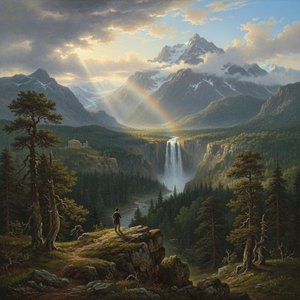
As his style matured, Janson moved away from the rigid structures of his training toward a more evocative, atmospheric approach. He became a master of atmospheric perspective, using light and shadow not just to define form, but to create a sense of infinite depth and movement. His landscapes, particularly his celebrated winter scenes, are studies in serenity and the fleeting beauty of nature. In these works, one can almost feel the crispness of the frost and hear the muffled silence of a snow-covered countryside. He had a remarkable sensitivity for capturing the Dutch landscape, often imbuating even the simplest cattle pieces with a sense of pastoral peace.
His technical repertoire was diverse, ranging from delicate oil paintings to landscape etchings derived from his own drawings. A hallmark of his later work was the use of dramatic receding perspectives, which allowed the viewer’s eye to travel rapidly into the spatial depth of the composition, creating a sense of immersion within the scene. This ability to manipulate space and light made him particularly sought after by the upper middle class of Leyden, who commissioned works that served as visual records of their lush, formal gardens. Through his brush, the mundane elements of rural life—a grazing herd, a distant church spire, or a winding path—were elevated to subjects of profound beauty.
Devotion and Lasting Significance
Beyond the pastoral, Janson’s heart remained deeply tied to his religious convictions. Much of his professional output was dedicated to sacred commissions, providing biblical narratives for churches throughout Groningen and Friesland. His ability to render religious scenes with both meticulous detail and emotional resonance earned him significant respect within ecclesiastical circles. This dedication to spiritual subject matter led to prestigious placements of his work in institutions such as the Stiftskirche St. Johann in Regensburg and the Propsteikirche Dortmund, where his paintings continue to serve as enduring testaments to his piety and skill.
The historical significance of Johannes Janson lies in his role as a bridge between the grand traditions of the seventeenth-century Dutch masters and the more intimate, emotive landscape styles of the following century. While he did not seek the global fame of his contemporaries, his contribution to the Dutch Baroque canon is undeniable. He remains a vital figure for those who seek to understand the quiet, contemplative side of the Golden Age—a master who found the divine in the details of the earth and captured the fleeting moments of nature with an eternal grace.
Питання та відповіді
Чи є загальний огляд усіх сюжетів, які малював Johannes Janson?
Роботи Johannes Janson можна переглянути за тематикою на сторінці Атлас тематик митця.
Скільки творів Johannes Janson представлено в каталозі?
Ви можете переглянути 13 творів мистецтва творів Johannes Janson на сторінці Усі роботи митця.
Чи можна відвідати віртуальний 3D-тур роботами Johannes Janson?
Твори Johannes Janson можна побачити в 3D-галереї на сторінці митця 3D-музей.