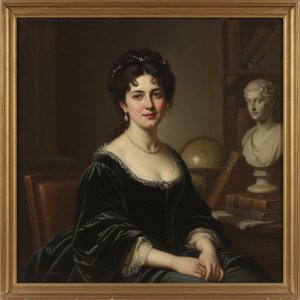
The Soul Behind the Canvas: The Life of Thomas Martine Ronaldson
To encounter the work of Thomas Martine Ronaldson is to step into a world where light and shadow perform a delicate, psychological dance. Born in Paris in 1881 to Scottish parents—his father serving as a diplomat in Algeria—Ronaldson’s very existence was defined by a cosmopolitan fluidity. This early exposure to diverse cultural landscapes instilled in him a unique sensibility, one that allowed him to bridge the gap between the rigorous traditions of classical realism and the experimental fervor of the burgeoning Impressionist movement. His upbringing, steeped in the intellectual ferment of late 19th-century France, provided the fertile soil from which his profound understanding of human emotion would grow.
His artistic journey was shaped by the prestigious halls of the École Supérieure des Beaux-Arts in Paris. It was here that Ronaldson honed a technical precision that would remain a hallmark of his career, even as he embraced more fluid, expressive styles. Studying alongside luminaries such as Frédéric Bazille, he became deeply embedded in the core principles of Impressionism. This connection to the movement’s pioneers allowed him to master the art of plein air painting, capturing the ephemeral, fleeting qualities of natural light with a precision that felt both spontaneous and deeply considered.
A Mastery of Light and Human Emotion
While many of his contemporaries sought to capture only the surface of the world, Ronaldson’s true ambition lay in the exploration of the interior life. His portraits are far more than mere likenesses; they are windows into the psyche. Through a masterful use of color and light, he imbued his subjects with a sense of presence and vulnerability. Whether depicting the quiet contemplation found in Lesley in the Studio or the vibrant, sun-drenched atmosphere of Summer, Ronaldson possessed an uncanny ability to translate atmospheric conditions into emotional states.
His technique was characterized by a striking duality: the structural integrity of his classical training paired with the luminous, broken brushstrokes of the Impressionists. This allowed him to create works that felt structurally sound yet vibrantly alive. In pieces such as The Bather and Sonia, one can observe how he utilized light not just to illuminate form, but to sculpt emotion, creating a sense of depth that invites the viewer to linger and reflect.
Legacy and Historical Significance
Though history occasionally casts a shadow over artists who worked in the wake of giants like Monet and Renoir, the legacy of Thomas Martine Ronaldson remains profoundly significant. He represents a vital link in the evolution of portraiture, moving away from the idealized, stiff representations of the past toward a more nuanced, psychologically driven realism. His work serves as a testament to the power of the Impressionist technique when applied to the complexities of the human condition.
Today, his contributions are preserved in esteemed collections across Europe, including:
- Manchester Art Gallery, which houses evocative works like Summer.
- Falmouth Art Gallery, home to intimate studies such as Lesley in the Studio.
- Russell-Cotes Art Gallery & Museum, where his mastery of form is evident in The Bather.
Ronaldson’s ability to capture the essence of a moment—the way light hits a shoulder or the subtle melancholy in a gaze—ensures that his canvases continue to resonate with modern audiences, offering a timeless connection to the beauty and complexity of life.
Питання та відповіді
Чи можу я переглянути роботи Thomas Martine Ronaldson за ключовими словами?
Сторінка За ключовими словами митця Thomas Martine Ronaldson групує його роботи за ключовими словами.
Де я можу знайти статистику щодо творів Thomas Martine Ronaldson?
Сторінка зі статистикою Статистика відвідувань для Thomas Martine Ronaldson містить дані, розраховані на основі творів цього митця, представлених на цей сайт.
Де я можу переглянути роботи Thomas Martine Ronaldson у хронологічному порядку?
Сторінка Хронологія творів митця представляє роботи Thomas Martine Ronaldson, впорядковані за датою, рік за роком.