


 发送
发送 分享
分享
 详情
详情 指南
指南

 下载图片
下载图片
 相似作品
相似作品 幻灯片播放
幻灯片播放 统计数据
统计数据Everything


 阅读全文
阅读全文
手工油画复制品
由我们的艺术家按需定制,为您提供您所选尺寸及画框的布面手工油画。 ( 切换至版画销售渠道 切换至数字图像销售渠道)




































您可以从与原作比例一致的预设尺寸中进行选择。

请输入您需要的宽度和高度,以适配您的画框或墙面。由于作品为手工绘制,若您选择不同的尺寸比例,艺术家可能会在画面边缘多画一些或稍作裁剪 —— 由您决定。在开始绘画之前,我们会为您发送一份数字效果图供您确认。本页面上展示的图片并非最终实物 —— 只有效果图才能反映真实结果。
下单后,AllPaintingsStore.com 团队将通过电子邮件联系客户获取具体要求,并提供效果预览图


 玻璃选项仅适用于110厘米以下的尺寸。

Everything
复制品材质
复刻品尺寸说明
-


总计金额
¥ 1733
A Symphony of Chaos and Order
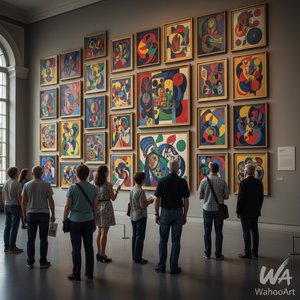
In the vast and intricate tapestry of twentieth-century contemporary art, few works capture the profound tension between randomness and structure as mesmerizingly as Alighiero e Boetti’s Everything. Created in 1988, this masterpiece serves as a breathtaking culmination of the artist's lifelong obsession with the duality of existence. At first glance, the viewer is met with a vibrant, kaleidoscopic explosion of color—a dense, saturated landscape where every inch of the surface is alive with movement. It is a visual cacophony that demands attention, pulling the eye into a labyrinth of shapes, signs, and symbols that seem to dance in a state of perpetual flux.
The brilliance of Everything lies in its ability to balance overwhelming complexity with a hidden, underlying logic. While the surface appears as a chaotic swarm of forms, there is a rhythmic pulse beneath the madness. This reflects Boetti’s deep fascination with mathematical systems and the philosophical concept of order emerging from disorder. To gaze upon this work is to embark on a journey of discovery; as you linger, individual shapes emerge from the crowd—abstract geometries intermingling with recognizable figurative elements—inviting a meditative state of visual exploration that rewards the patient observer.
The Art of Collaborative Alchemy
The creation of Everything is as much a feat of social engineering as it is of artistic vision. Boetti, a pioneer of the Arte Povera movement, often sought to relinquish personal ego in favor of collaborative processes that allowed chance to play a leading role. For this specific series, the artist acted as a conductor of a grand, international orchestra. He began by instructing his assistants to draw every conceivable shape, filling a paper sheet until it reached a state of total saturation. This initial stage was an exercise in pure abundance, leaving no void unfilled.
The transformation from paper to textile, however, took the work far beyond the borders of Europe. Boetti traveled to Afghanistan, where the labor-intensive process of embroidery brought the vision to life. In a beautiful gesture of artistic humility, he surrendered the final aesthetic decisions to the skilled women embroiderers. He provided the blueprint, but they chose the colors, ensuring that no hierarchy was established among the hues. This method infused the work with an organic, human warmth, making Everything not just a painting, but a woven chronicle of shared human effort and cultural intersection.
A Timeless Statement for Modern Interiors
For the discerning collector or interior designer, a high-quality reproduction of Everything offers more than mere decoration; it provides a focal point of intellectual and emotional depth. The piece functions as a "maximalist" anchor, capable of breathing life into minimalist spaces or adding a layer of sophisticated complexity to contemporary settings. Its rich palette and intricate textures evoke a sense of luxury and curated history, making it an ideal centerpiece for those who appreciate art that tells a story of global connection and philosophical inquiry.
Owning a piece inspired by Boetti’s Tutto series is an invitation to embrace the beautiful unpredictability of life. Whether placed in a private gallery, a professional studio, or a grand living space, the work radiates an energy that is both stimulating and contemplative. It serves as a constant reminder that within the vast, overwhelming "everything" of our world, there is a profound beauty to be found in the way individual threads—and individual lives—weave together to create a singular, magnificent whole.
问答详情
为什么“Everything”的版权状态是目前的状况?
Alighiero E Boetti 的《Everything》 已进入 仍受版权保护。版权保护期自艺术家逝世之日起计算,该艺术家于 1994 年逝世。
“Everything”是用什么材质制作的?
Alighiero E Boetti 在作品《Everything》中运用了 Embroidery 技法。该技法界定了原作的材质特性。
Alighiero E Boetti 的《Everything》 的色彩饱和度如何?
Alighiero E Boetti 的《Everything》 中的色彩呈现出 Vivid 的强度。


艺术家简介
Alighiero e Boetti: Life and Art
Early Life and Influences
Alighiero Fabrizio Boetti, known as Alighiero e Boetti, was born in Turin, Italy, in 1940. His parents were Corrado Boetti, a lawyer, and Adelina Marchisio, a violinist. He initially pursued studies at the business school of the University of Turin but soon abandoned them to dedicate himself to art.- Early theoretical interests included philosophy, alchemy, and esoterics.
- He admired authors like Hermann Hesse and painter Paul Klee.
- Boetti also showed a continuing interest in mathematics and music throughout his life.
Artistic Development & Arte Povera
In 1962, Boetti moved to Paris where he met art critic Annemarie Sauzeau, whom he married in 1964 and with whom he had two children. Working in Turin during the early 1960s alongside artists like Luciano Fabro, Mario Merz, Giulio Paolini, and Michelangelo Pistoletto, Boetti became a key figure in the Arte Povera movement.- Arte Povera emphasized using humble materials and techniques to challenge traditional art values.
- Boetti experimented with unconventional materials like plaster, masonite, plexiglass, and light fixtures.
- His first solo show was in 1967 at the Turin gallery of Christian Stein.
Key Themes & Artistic Strategies
Boetti’s work is characterized by several recurring themes:- Twinning: This concept led him to add ‘e’ (and) between his names, exploring duality and self-identity.
- Chance & Order: He often incorporated elements of chance into his work alongside structured systems like grids and maps.
- Non-Western Cultures: Extensive travels to Guatemala, Ethiopia, Sudan, Afghanistan, and Pakistan deeply influenced his art.
Major Works & Achievements
- Mappa (1971-1994): A series of embroidered maps of the world, created with the help of Afghan artisans.
- Lampada annuale (Yearly Lamp) (1966): A light bulb in a mirrored box that randomly illuminates for eleven seconds each year.
- Tavola pitagorica (Pythagorean Table): Explores mathematical permutations and visual patterns.
- Lavori postali (Postal Works) (1969-70): Series of letters sent to prominent figures in the art world, often returned undelivered due to imaginary addresses.
Historical Significance & Legacy
Alighiero e Boetti’s work challenged conventional notions of authorship and artistic control. His exploration of chance, order, and cultural exchange continues to resonate with contemporary artists. He died in Rome in 1994 at the age of 53 from a brain tumor. Boetti's legacy lies in his innovative approach to conceptual art and his ability to blend intellectual rigor with aesthetic beauty. His work remains highly influential, exhibited globally, and continues to inspire new generations of artists and thinkers.
Alighiero E Boetti
1940 - 1994
快速概览
- Name: Alighiero e Boetti
- Movement: Arte Povera, Conceptual Art
- Birth_Date: 1940
- Death_Date: 1994
- Birth_Place: Turin, Italy
- Nationality: Italian
- Date Of Birth: 1940
- Date Of Death: 1994
- Influenced_By:
- Wols
- Lucio Fontana
- Hermann Hesse
- Paul Klee
- Notable_Works: Mappa, Tavola pitagorica, Lampada annuale
相关文章

The Soul of Color: A Journey into the Emotional Resonance of Lyrical Abstraction
Embark on a cultural journey through Lyrical Abstraction. Explore how masters like Kandinsky used color and motion to translate emotion into visual poetry. Discover the profound beauty of abstract expressionism and learn to curate emotional resonance in your own art collection.
Kandinsky's Masterpieces: 25 Paintings That Define Abstract Art | AllPaintingsStore
Journey through Wassily Kandinsky's 25 most iconic abstract paintings. Explore his revolutionary use of color, form & spiritual expressionism. Find museum-quality Kandinsky reproductions and elevate your home decor with AllPaintingsStore.com. Discover all masterpieces on AllPaintingsStore.com!

Beyond the Lines: Mastering the High-Impact World of Contemporary Abstraction
Master the high-impact world of contemporary abstraction. Discover how bold colors, textures, and modern movements like Abstract Expressionism can transform your space with premium, high-energy art curated for the design-conscious professional.

抽象表现主义:十幅定义艺术史的杰作
探索抽象表现主义的十幅经典杰作!波洛克、罗斯科等大师作品,揭秘艺术史上的重要瞬间。AllPaintingsStore.com为您呈现高品质艺术品复制和精选家居装饰方案,感受现代艺术的力量与魅力。立即浏览全系列!

几何抽象艺术十大杰作:定义现代家居装饰的经典之作
探索几何抽象艺术的十大杰作!康定斯基、蒙德里安等大师作品,色彩构成与非具象之美。AllPaintingsStore.com提供博物馆级艺术复制品,为您的家居带来现代艺术灵感。立即在线探索完整系列!

