


 效果预览
效果预览
 分享
分享 分享
分享
 详情
详情 指南
指南

 下载
下载
 相似作品
相似作品 X射线
X射线 幻灯片播放
幻灯片播放 统计数据
统计数据L'HIVER OU LES SATURNALES


 展开详情
展开详情
手工油画复制品
由我们的艺术家按需定制,为您提供您所选尺寸及画框的布面手工油画。 ( 切换至版画销售渠道 切换至数字图像销售渠道)




P118B $10

P118H $10

P118W $10

P438Z $10

P508JH $12

P508YH $12

P805H $10

P805Z $10

P919BZ $10

P919G $10

P919XJ $10

P959ZH $10

P968JZ $12

W106C $8

W218G $10

W218JH $8

W218Y $10

W307PJ $10

W316G $10

W316PJ $8

W316Y $10

W398PJ $8

W4111J $10

W500HY $15

W500JH $15

W692G $12

W849H $8

W940BG $15

W953PJ $8




从与原作比例一致的预设尺寸中进行选择。

您可以输入自定义尺寸,以适配特定的画框或空间。如果所选尺寸与原图比例不符,我们将通过裁剪作品或添加手绘元素来扩展画面。数字样稿将在制作开始前发送给您确认。
请注意,屏幕预览无法准确反映实际的裁剪或扩展效果,只有样稿才能真实呈现最终的构图。
虽然我们提供定制尺寸服务,但为了保留原作比例,建议您从预设列表中选择尺寸。
下单后,AllPaintingsStore.com 团队将通过电子邮件联系客户获取具体要求,并提供效果预览图。


 玻璃选项仅适用于110厘米以下的尺寸。

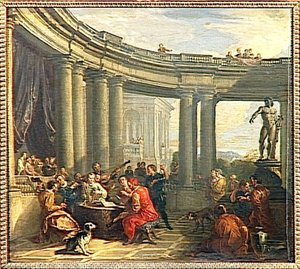
L'HIVER OU LES SATURNALES
复制材质
复制品尺寸
-


最终总价
$ 533
A Feast for the Senses: Echoes of Roman Revelry
To gaze upon this magnificent depiction, L'HIVER OU LES SATURNALES, is to be instantly transported across the centuries, into the heart of an ancient, joyous excess. The scene pulses with a palpable energy, capturing not merely a gathering, but a moment suspended in time—a glorious outburst of communal spirit reminiscent of the Saturnalian festivals celebrated in Roman antiquity. One feels the warmth emanating from the central table, laden with bounty, suggesting feasting, merriment, and the temporary suspension of everyday strictures. The composition is a masterful tapestry of human interaction; figures overlap one another with such natural grace that the viewer’s eye wanders endlessly, drawn into the vibrant chaos of celebration.
Neoclassical Grandeur Meets Earthy Warmth
Stylistically, the work speaks eloquently of Neoclassicism. There is an inherent sense of order underlying the apparent frenzy; the architectural columns framing the left side lend a classical stability to the scene, while the idealized forms of the figures recall the grand narratives favored by academic painters like Antoine François Callet. The artist has employed a palette dominated by rich, warm earth tones—ochres, deep reds, and grounding browns—punctuated only by cooler accents in the drapery. This color scheme lends the entire piece a beautiful, aged patina, as if it has absorbed the light of countless historical evenings. The technique itself suggests the meticulous layering of oil paint, allowing for subtle gradations that give skin and fabric a believable, tactile quality.
Symbolism of Abundance and Community
Beyond the immediate spectacle of feasting, the painting is rich with symbolic resonance. The sheer abundance displayed on the table speaks to themes of prosperity, harvest, and cyclical renewal—the very essence of seasonal festivals. The statue visible in the background acts as a silent witness, perhaps representing a deity presiding over this temporary release from discipline. Emotionally, the piece radiates an intoxicating blend of joy and indulgence. It is an ode to human connection, suggesting that even amidst the grandeur of history or the formality of classical life, the deepest satisfaction is found in shared experience.
Bringing Antiquity Home: Decorating with History
For the discerning collector or designer, this reproduction offers more than mere decoration; it offers a narrative centerpiece. The dynamic composition and rich tonality make it an unparalleled focal point for any grand hall, library, or dining space aiming to evoke timeless sophistication. While the original masterwork captures the diffused glow of historical lighting, owning a high-quality hand-painted reproduction allows you to curate that atmosphere in your own home. It invites conversation, demanding that guests pause and contemplate the enduring human need for celebration, beauty, and shared stories.
相似艺术品



艺术家简介
The Painter of Allegory and Imperial Splendor
Antoine François Callet, often known simply as Antoine Callet, remains a luminous figure in the grand tapestry of late 18th-century French art. His life and career unfolded against a backdrop of profound historical transformation, spanning the twilight of the Ancien Régime under Louis XVI and the rising sun of the Napoleonic era. Born in Paris in 1741, Callet emerged as a master of both the intimate portrait and the monumental allegory, a painter capable of capturing the delicate psychological nuances of a monarch while simultaneously orchestrating vast, celestial narratives across the ceilings of France's most prestigious palaces.
Callet’s journey toward artistic mastery was paved with the prestigious accolades of the French academic system. His talent was formally recognized when he won the grand prix de Rome in 1764 with his evocative work, Cléobis et Biton conduisent le char de leur mère au temple de Junon. This triumph granted him the invaluable opportunity to study in Italy, where the shadows of masters like Caravaggio and the dramatic architectural energy of Bernini left an indelible mark on his technique. It was during these formative years in Rome that Callet refined his use of chiaroscuro and learned to infuse classical themes with a sense of theatrical movement, a skill that would later define his most celebrated compositions.
A Master of Royal Portraiture and Grandeur
Upon his return to France, Callet ascended to the highest echelons of the art world, securing a position within the Académie Royale de peinture et de sculpture. His ability to blend the elegance of the Rococo style with the emerging discipline of Neoclassicism made him the preferred choice for the French nobility and royalty. Perhaps his most enduring legacy lies in his role as the official portraitist to Louis XVI. In works such as his 1779 portrait of the King, Callet did more than merely record a likeness; he constructed an icon of sovereignty. Through the meticulous rendering of ermine-lined robes and the strategic placement of the Fleur-de-lis, he utilized the language of symbolism to project stability and divine right during a period of mounting political tension.
Beyond the individual portrait, Callet’s genius flourished in the realm of large-scale decorative painting. He possessed a rare ability to transform architectural spaces into immersive, mythological realms. His contributions to the Galerie d'Apollon at the Louvre, specifically his breathtaking ceiling fresco Le Printemps ou Zéphire et Flore couronnant de fleurs Cybèle, demonstrate his command over color and illusionistic perspective. In these works, the boundaries between the physical room and the painted heavens dissolve, inviting the viewer into a symphony of gold, azure, and eternal spring.
Legacy of an Era in Transition
The significance of Callet’s oeuvre extends far beyond mere decoration; his work serves as a visual chronicle of a world in flux. As France moved from the decadent splendor of the monarchy through the upheaval of the Revolution and into the imperial ambitions of Napoleon, Callet’s brush captured the shifting aesthetic values of the age. His ability to navigate between the Rococo's ornamental grace and the Neoclassical's structured nobility allowed him to remain relevant across decades of intense social change.
To study the works of Antoine François Callet is to witness the heartbeat of French history through paint and pigment. His achievements include:
- Academic Excellence: Winning the prestigious Prix de Rome, which established his foundation in classical antiquity.
- Royal Patronage: Serving as a primary visual architect for the identity of Louis XVI.
- Architectural Transformation: Creating monumental ceiling paintings that redefined the interior grandeur of French palaces like the Palais du Luxembourg.
- Stylistic Synthesis: Successfully bridging the gap between the emotive, flowing lines of the Rococo and the disciplined, heroic themes of Neoclassicism.
Today, Callet’s paintings stand as windows into a lost epoch of elegance, reminding us of a time when art was used to weave together the threads of myth, power, and human emotion into a single, magnificent tapestry.

antoine françois callet
1741 - 1823 , France
艺术家简介
- Artistic Movement Or Style: Rococo Style
- Artists Or Movements Influenced By This Artist: ['Louis XVI']
- Artists Who Influenced This Artist: ['Jean-Baptiste Rousseau']
- Date Of Birth: Paris, France (1741)
- Date Of Death: 1823
- Full Name: Antoine François Callet
- Nationality: French
- Notable Artworks:
- L'aurore
- Allegorie du dix-huit brumaire
- Allegorie de la bataille d'Austerlitz
- Place Of Birth: Paris
相关文章

Nicolas Poussin: Classicism, Allegory & Order in 17th-Century French Painting
Explore the life & work of Nicolas Poussin, a master of French Classicism. Discover his allegorical paintings, Roman influences, and enduring impact on art history. Expert analysis & insights.

Simon Vouet: A Baroque Master's Journey from Italian Influence to French Classicism
Explore the life & art of Simon Vouet, a pivotal French Baroque painter who introduced Italian styles to France. Discover his masterpieces and lasting influence on 17th-century art.

Charles Le Brun: Master of French Baroque Classicism & His Enduring Legacy
Explore the life & art of Charles Le Brun, master of French Baroque Classicism. Discover his royal commissions, influence on Versailles, and enduring legacy through detailed analysis & stunning artworks.

Anne-Louis Girodet: Bridging Neoclassicism & Romanticism with Emotional Truth
Explore the captivating world of Anne-Louis Girodet, a pivotal figure bridging Neoclassicism & Romanticism. Discover his masterpieces and unique artistic vision with AllPaintingsStore.

Reason vs. Emotion: The Epic Clash of Neoclassicism and Romanticism in Art History
Explore the profound tension between Neoclassicism's rational order and Romanticism's emotional depth. An expert journey through the masters of art history, from David to Delacroix, perfect for collectors and enthusiasts seeking a deeper understanding of artistic evolution.

