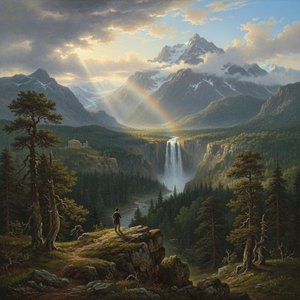
1833. Oil On Canvas, 78.0 x 105.0 cm. 新畫廊.

§ 1Catalogue data

- 78.0 x 105.0 cm


§ 2Abstract
藏品详情
Blechen pioneered Romantic industrialization, portraying scenes of technological advancement alongside sublime landscapes. Explore his Italian sketches and lasting influence.
 展开全文
展开全文
艺术家简介
卡尔·布莱肯(1798-1840)是德国浪漫主义画家,以其富有感染力的风景画和对早期工业化开创性的描绘而闻名。探索他的意大利素描以及他对后世艺术家的深远影响,见证自然与现代化的交融之美。
§ 3Commentary
A Symphony of Ambition and Nature
In his 1833 masterpiece, Building the Devil's Bridge, Carl Blechen invites the viewer into a profound dialogue between human ingenuity and the indomitable spirit of the natural world. This oil on canvas work is far more than a mere documentation of construction; it is a poignant exploration of the Romantic era’s complex relationship with progress. As a bridge begins to span a dramatic, yawning gorge, we witness a moment frozen in time where the burgeoning industrial revolution meets the ancient, silent majesty of the earth. The scene captures a sense of monumental effort, as workers navigate the rugged terrain, their small figures serving as a testament to human resilience amidst the towering, intimidating cliffs that frame the composition.
The painting breathes with a palpable tension, a duality that Blechen masterfully orchestrates through his use of light and shadow. The atmosphere is thick with a certain melancholic grandeur, achieved through a muted palette of earthy browns, somber greys, and subdued greens. This choice of color grounds the work in a raw, naturalistic reality, yet it is the dramatic lighting that truly stirs the soul. Soft, diffused daylight casts long, sweeping shadows across the gorge, highlighting the precariousness of the construction. These shadows do more than provide depth; they act as a metaphor for the inescapable shadow of mortality and the inherent vulnerability of human endeavors when pitted against the immense scale of geological time.
Symbolism and the Industrial Sublime
To gaze upon this work is to encounter the "Industrial Sublime." Blechen, a pioneer who dared to look beyond idealized landscapes, utilizes the bridge itself as a powerful symbol of human ambition and the desire to dominate formidable natural forces. The jagged edges of the rocks and the verticality of the cliffs represent the resistance of nature, while the presence of the crane—reminiscent of an instrument of execution—hints at the potential cost of such rapid advancement. There is a haunting beauty in this struggle, a sense that every step toward progress carries a weight of consequence.
For the discerning collector or interior designer, Building the Devil's Bridge offers a sophisticated focal point that commands attention through its narrative depth and structural complexity. The strong diagonal perspective draws the eye deep into the heart of the landscape, leading from the immediate human presence toward the hazy, distant mountains. This use of atmospheric perspective creates an expansive sense of space, making the artwork feel like a window into another era. Whether placed in a contemporary gallery or a classic study, this reproduction brings with it an aura of intellectual curiosity and emotional resonance, perfect for those who appreciate art that challenges the mind while captivating the eye.
常见问题与解答
卡尔·布莱肯 的《Building the Devil's Bridge》 属于哪种艺术流派,又处于哪个时代?
卡尔·布莱肯 的《Building the Devil's Bridge》 属于 Romantic Industrialization 流派,创作于其作者的 19世纪 时期。
哪家博物馆收藏了《Building the Devil's Bridge》的原作?
卡尔·布莱肯 的《Building the Devil's Bridge》 目前正在 新畫廊, München, Deutschland 展出。此处列出的博物馆指代原作,而非复制品。
哪些色调与主导色彩定义了“Building the Devil's Bridge”?
卡尔·布莱肯 的《Building the Devil's Bridge》 的色彩特征:Earthy 色调,以 Espresso (#4f4b4b) 为主导。




 切换至版画销售渠道


 对于任何边长超过 105 厘米(约 41 英寸)的艺术品或复制品,画框将以拆解后的组件形式发货。此方法可确保安全送达并防止运输过程中的损坏。