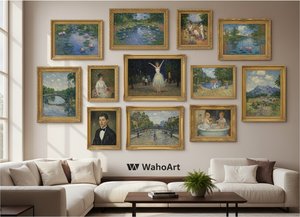
Acrylic On Canvas.

§ 1目录数据

§ 2摘要
藏品详情
 展开全文
展开全文
§ 3赏析
A Window into Impressionism: Examining Claude Monet’s Untitled (2803)
Claude Monet, a name synonymous with Impressionism, wasn't merely a painter of landscapes; he was a chronicler of fleeting moments, a poet of light and color. Born in Paris on November 14, 1840, his early life took an unexpected turn when his family relocated to Le Havre, Normandy, at the age of five. While initially destined for a commercial career by his father, young Claude’s innate artistic talent quickly surfaced, manifesting first in charcoal caricatures sold locally – a testament to both his skill and entrepreneurial spirit. However, it was his encounter with Eugène Boudin that proved pivotal. Boudin didn't just teach Monet *how* to paint; he instilled within him the revolutionary idea of painting en plein air—directly from nature—a practice that would define his entire artistic journey. Monet’s formal training began in Paris, briefly at the Académie Suisse and later under Charles Gleyre. It was here he forged lasting friendships with fellow artists like Pierre-Auguste Renoir and Camille Pissarro, establishing a core group dedicated to exploring new artistic horizons. This collaborative spirit fueled their experimentation with innovative techniques—particularly the layering of thin glazes—allowing them to capture the subtle nuances of atmospheric conditions and transforming ordinary scenes into shimmering visions of beauty. The influence of Boudin’s insistence on painting outdoors is palpable in Monet's oeuvre, shaping his approach to capturing the ephemeral qualities of light and color as they dance across surfaces like water or foliage.The Composition: A Study in Atmosphere
“Untitled (2803)” exemplifies Monet’s masterful command of composition. The portrait depicts a woman seated indoors, bathed in diffused light emanating from a window behind her. Her gaze is downward, conveying a sense of introspection and quiet contemplation—a characteristic trait found throughout Monet's oeuvre. Notably, the inclusion of a curtain serves as more than just a decorative element; it acts as a crucial tool for creating depth and simulating the effects of ambient illumination. This technique—known as chiaroscuro—was championed by Leonardo da Vinci centuries earlier but was reinvigorated by Impressionists like Monet who sought to represent reality as perceived by the eye, prioritizing tonal variations over precise delineation. The subtle interplay between light and shadow contributes significantly to the painting's emotional resonance.Symbolism and Emotional Resonance
While seemingly simple in its depiction, “Untitled (2803)” speaks volumes about the artistic sensibilities of its time. The woman’s posture suggests vulnerability and contemplation—themes frequently explored by Impressionist artists who aimed to convey psychological states alongside visual impressions. Furthermore, the muted palette—dominated by greens and browns—reflects the prevailing mood of tranquility and understated elegance. Monet's deliberate choice of colors isn’t merely aesthetic; it aligns with the broader philosophical currents of Impressionism, which questioned traditional artistic conventions and prioritized subjective experience over objective representation. The painting invites viewers to consider not just what is seen but how it *feels*.Technique: Mastering Light Through Glazes
Monet's technique—characterized by the application of thin layers of translucent pigment known as glazes—is central to achieving his signature luminous effect. These glazes allow light to penetrate through subsequent layers, creating a shimmering depth and vibrancy that surpasses what could be achieved with opaque paints alone. This painstaking process demanded considerable patience and precision but yielded results that captured the fleeting beauty of natural light in ways previously unimaginable. As demonstrated by Norman Garstin’s work at Tate & Penlee House, Monet's dedication to plein air painting cemented his legacy as one of the most influential artists of the 19th century—a true pioneer of Impressionism and a champion of capturing the essence of visual experience.Further Exploration: Musée Marmottan Monet
To truly appreciate the brilliance of Claude Monet’s artistic vision, a visit to Musée Marmottan Monet in Paris is indispensable. Housing the largest collection of Monet paintings globally, including “Impression, Sunrise,” this museum offers unparalleled insight into his stylistic evolution and artistic philosophy. Explore masterpieces alongside Napoleonic art—a testament to Monet's enduring influence on the landscape of modern art.常见问题与解答
"untitled (2803)" 是 Impressionism 运动中著名的艺术作品吗?
在馆藏的 Impressionism 作品中,"untitled (2803)" 的流行程度被记录为 Iconic。
我可以使用增强现实技术在我的房间里预览 克劳德·莫奈 的《untitled (2803)》 吗?
通过兼容设备访问 克劳德·莫奈 的《untitled (2803)》 的 AR 效果预览 页面,即可利用增强现实技术将艺术品呈现在您自己的空间中。
《untitled (2803)》这一Impressionism风格的作品传达了怎样的情感基调?
"untitled (2803)" 在 Impressionism 运动中蕴含着 Reflective 的情感基调。


 切换至版画销售渠道


 对于任何边长超过 105 厘米(约 41 英寸)的艺术品或复制品,画框将以拆解后的组件形式发货。此方法可确保安全送达并防止运输过程中的损坏。