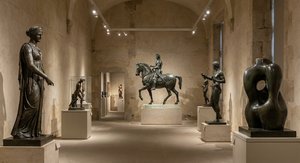
1465. Acrylic, 137.0 x 280.0 cm. 圣洛伦佐大殿.

§ 1目录数据

- 137.0 x 280.0 cm


§ 2摘要
藏品详情
Donatello's 'Pulpit (on the left)' is a stunning marble sculpture showcasing Renaissance artistry & religious themes. A masterpiece by Donatello, it’s a testament to detail and skill.
 展开全文
展开全文
§ 3赏析
The Pulpit’s Silent Sermon: Donatello's Masterpiece of Renaissance Grace
Within the serene confines of San Lorenzo church in Florence resides a sculpture that transcends mere marble; it is a profound meditation on faith, humanity, and the very essence of the Renaissance spirit. Donatello’s “Pulpit (on the left),” crafted in 1465, isn't simply an altar piece – it’s a meticulously realized embodiment of humanist ideals, a testament to the artist’s unparalleled skill, and a window into the soul of a transformative era. The sculpture immediately commands attention with its monumental scale—measuring a substantial 137 x 280 centimeters—yet it never feels overwhelming; rather, it exudes an aura of dignified restraint, inviting quiet contemplation.
Donatello’s genius lies not merely in his technical mastery – the flawless rendering of marble, the exquisite detail of each figure, and the harmonious proportions that define the entire composition – but also in his ability to imbue inanimate stone with a palpable sense of life. The figures depicted are not idealized abstractions; they possess a remarkable degree of realism, capturing subtle nuances of expression and gesture. Notice, for instance, the weary resignation etched on the face of Christ, or the attentive posture of the disciples, seemingly lost in prayer. These aren’t representations of saints elevated to an unattainable perfection; they are human beings grappling with profound questions of faith and mortality.
A Renaissance Dialogue: Form, Faith, and Classical Influence
The “Pulpit” is a quintessential example of Early Renaissance sculpture, deeply rooted in the classical traditions that had been revived during this period. Donatello’s debt to ancient Greek and Roman art is evident in the sculpture's balanced composition, its emphasis on human form, and its use of contrapposto – a technique where the figure’s weight shifts subtly, creating a dynamic sense of movement. However, unlike the static formality of classical sculpture, Donatello infuses his work with a distinctly humanist sensibility, prioritizing emotional expression and psychological depth. The figures are not merely beautiful; they are believable, relatable, and profoundly moving.
The choice of marble itself is significant. It was a material favored by Renaissance artists for its durability, its ability to capture subtle gradations of light and shadow, and its association with purity and spiritual contemplation. Donatello’s skillful manipulation of the stone transforms it into something far more than mere rock; he breathes life into it, imbuing it with an almost ethereal quality. The surface is polished to a breathtaking sheen, reflecting the surrounding light and creating a sense of luminous beauty.
Symbolism and Spiritual Resonance
Beyond its formal qualities, the “Pulpit” is rich in symbolic meaning. The scene depicted—Christ’s agony in the Garden of Gethsemane—is one of the most poignant moments in Christian scripture. It represents not only Christ's suffering but also his humanity, his vulnerability, and his willingness to endure pain for the salvation of humankind. The figures surrounding him – Peter, John, and James – are depicted as ordinary men, caught up in a moment of profound spiritual crisis. Their expressions of doubt, fear, and concern resonate deeply with our own human experience.
The pulpit itself serves as a powerful metaphor for the role of faith in human life. It is a place of instruction, of guidance, and of solace—a space where individuals can connect with the divine and find meaning in their lives. Donatello’s sculpture elevates this humble object to an extraordinary work of art, transforming it into a symbol of hope, compassion, and spiritual grace.
A Legacy Enduring: Art History and Beyond
Donatello's "Pulpit (on the left)" stands as a cornerstone of Renaissance art, influencing generations of artists who followed. Its impact extends far beyond the confines of San Lorenzo church; it has been studied, admired, and imitated by scholars and artists alike for centuries. The sculpture’s enduring appeal lies in its ability to transcend time and culture, speaking to universal themes of faith, humanity, and beauty.
Today, reproductions of this masterpiece continue to inspire awe and wonder. Whether viewed in person or through a high-quality print, the “Pulpit” offers a glimpse into the artistic genius of Donatello and the profound spiritual values that shaped the Renaissance era. It’s a reminder that art can not only reflect our world but also illuminate our souls.
常见问题与解答
我可以在全屏幻灯片模式下观看“Pulpit (on the left)”吗?
您可以在作品的幻灯片展示页面上观看“Pulpit (on the left)”的幻灯片展示。
多纳泰罗 的《Pulpit (on the left)》 原作的技法和尺寸是多少?
《Pulpit (on the left)》采用Acrylic创作,原件尺寸为137 x 280 cm。
针对 多纳泰罗 的《Pulpit (on the left)》 的版画,推荐的尺寸和方向是什么?
对于“Pulpit (on the left)”,建议的打印设置尺寸为 Large,方向为 Landscape。


 切换至版画销售渠道


 对于任何边长超过 105 厘米(约 41 英寸)的艺术品或复制品,画框将以拆解后的组件形式发货。此方法可确保安全送达并防止运输过程中的损坏。