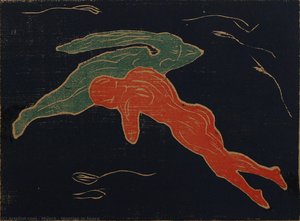
1915. Acrylic On Canvas.

§ 1目录数据


§ 2摘要
藏品详情
 展开全文
展开全文
§ 3赏析
A Silent Plea from the Precipice: Edvard Munch’s “Anxiety, because”
Edvard Munch's "Anxiety, because," created in 1915, isn’t merely a drawing; it’s a raw, visceral embodiment of the psychological landscape of its time. The image depicts a group of figures perched precariously on the edge of a cliff, their faces turned towards an unseen horizon – a posture that immediately speaks to vulnerability and a profound sense of unease. The stark black and white palette amplifies this feeling, stripping away any potential distraction and forcing the viewer to confront the unsettling reality presented before them. It’s a work born from Munch's deeply personal struggles with loss, illness, and an enduring awareness of mortality, themes that relentlessly informed his artistic output.
Munch’s technique here is deliberately loose and expressive, prioritizing emotional impact over meticulous detail. The figures are rendered with broad, gestural strokes, their forms dissolving into the surrounding rock formation. This blurring of boundaries – between individual and environment, self and landscape – reflects a key aspect of Munch's artistic philosophy: the interconnectedness of human experience and the natural world. He wasn’t interested in creating realistic representations; instead, he sought to capture the *feeling* of an emotion, translating internal turmoil into visible form. The lack of shading and precise lines contributes to the drawing’s unsettling quality, lending it a dreamlike, almost hallucinatory atmosphere.
The Weight of Personal History
To understand “Anxiety, because,” one must delve into the context of Munch's life. His childhood was profoundly shaped by tragedy – the deaths of his mother and sister from tuberculosis at young ages instilled in him a lifelong preoccupation with illness, death, and the fragility of human existence. His father, a devout Lutheran, fostered a sense of religious anxiety that further complicated Munch’s emotional landscape. These experiences weren't simply biographical details; they became the bedrock upon which he built his artistic language, informing his recurring motifs of sickness, despair, and isolation. The drawing can be interpreted as a visual manifestation of this inherited trauma, a collective expression of grief and fear passed down through generations.
Furthermore, Munch’s own struggles with mental illness – including periods of intense anxiety and depression – undoubtedly influenced the work's somber tone. He famously described his creative process as “a battle against life,” suggesting that art was not merely a means of expression but also a form of survival. "Anxiety, because" embodies this struggle; it’s a testament to the artist’s ability to transform personal suffering into a universally resonant image.
Symbolism and the Unseen Horizon
The cliff itself is a potent symbol within the drawing. It represents not just a physical location but also a metaphorical precipice – a point of no return, a threshold between life and death, sanity and madness. The figures’ unified gaze towards the horizon suggests a shared experience of dread, as if they are all contemplating an impending doom. The fact that we cannot see what lies beyond the cliff face further intensifies the sense of mystery and uncertainty. It's a deliberate withholding of information, forcing the viewer to project their own anxieties onto the scene.
The composition’s asymmetry – with the large rock formation dominating the left side of the image – creates a feeling of imbalance and instability. This visual disruption mirrors the emotional turmoil depicted within the drawing, reinforcing its overall sense of unease. The figures themselves are rendered in varying states of distress: some appear frozen in silent contemplation, while others seem to be actively struggling against an unseen force.
A Timeless Exploration of Human Emotion
"Anxiety, because" remains a powerfully evocative work of art over a century after its creation. It’s not a comfortable image; it confronts us with the darker aspects of human experience – fear, grief, and the awareness of our own mortality. Yet, it is precisely this unflinching honesty that makes it so compelling. Munch's ability to translate these complex emotions into a single, arresting drawing speaks to his genius as an artist and his profound understanding of the human psyche. A reproduction of this piece offers a unique opportunity to engage with one of the most significant works in modern art history, inviting contemplation on the enduring nature of anxiety and the search for meaning in a world often fraught with uncertainty.
常见问题与解答
爱德华·蒙克 的《Anxiety, because》 的色彩是鲜艳夺目还是柔和低调?
爱德华·蒙克 的《Anxiety, because》 的色彩呈现出 Muted 的饱和度。饱和度描述了色彩的鲜艳或柔和程度。
爱德华·蒙克 的《Anxiety, because》中的主导色调是什么?
“Anxiety, because”呈现出Green to Violet Spectrum色调。
Expressionist Anxiety 流派的作品 "Anxiety, because" 源自哪个国家?
通过创作者的出生地,《Anxiety, because》将Expressionist Anxiety运动与瑞典紧密联系在了一起。


 切换至版画销售渠道


 对于任何边长超过 105 厘米(约 41 英寸)的艺术品或复制品,画框将以拆解后的组件形式发货。此方法可确保安全送达并防止运输过程中的损坏。