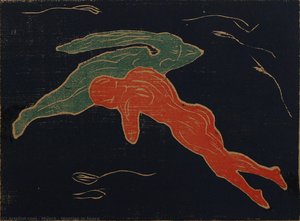
1915. Etching.

§ 1Catalogue data


§ 2Abstract
藏品详情
Munch’s "Galloping Horse" – a dynamic Expressionist etching of chaos & movement. Explore this powerful monochrome artwork's unsettling style and symbolic depth.
 展开全文
展开全文
§ 3Commentary
A Tempest of Humanity: Decoding Munch’s ‘Galloping Horse’ (1915)
- Subject & Composition: This striking monochromatic work centers on a powerfully rendered horse, seemingly bursting forth from a chaotic throng of figures. The scene evokes a public space – perhaps a marketplace or gathering – but one fractured and distorted by intense energy. Munch doesn’t present a narrative so much as an *impression* of overwhelming movement and unrest. The composition is dominated by the horse's dynamic form, its swirling lines creating a vortex that draws the eye, while surrounding figures are fragmented and partially obscured, contributing to the overall sense of disorder.
- Expressionist Roots & Technique: Created in 1915, ‘Galloping Horse’ is deeply rooted in the Expressionist movement. Munch masterfully employs etching or woodcut techniques – evidenced by the stark contrasts and meticulous line work – to convey raw emotion rather than objective reality. The lines aren't merely descriptive; they *are* the feeling. Thick, swirling strokes define the horse, while jagged outlines characterize the human figures. This deliberate distortion of form is a hallmark of Expressionism, prioritizing subjective experience over accurate representation. The varying density of line creates texture and suggests depth, despite the flattened perspective.
Echoes of Anxiety: Historical Context & Munch’s Inner World
- A Time of Turmoil: 1915 was a year steeped in global upheaval, with World War I raging across Europe. While the artwork doesn't explicitly depict war, it undeniably reflects the anxieties and societal stresses of the era. Munch’s personal life continued to be marked by emotional struggles; his lifelong battles with mental illness and grief profoundly influenced his artistic vision.
- Munch’s Psychological Landscape: Edvard Munch was a pioneer in exploring the human psyche through art. His childhood traumas – the early loss of his mother and sister to tuberculosis, coupled with a family history of mental instability – instilled in him a deep preoccupation with mortality, sickness, and psychological distress. ‘Galloping Horse’ can be seen as an externalization of these internal anxieties, a visual representation of overwhelming forces beyond control.
Symbolism & Emotional Resonance
- The Horse as Symbol: The horse itself is a potent symbol. Historically representing power, freedom, and untamed energy, here it feels less majestic and more like a force of disruption. Its frenetic gallop suggests escape or perhaps an unstoppable momentum towards an unknown fate.
- A Collective Unease: The distorted faces and fragmented figures hint at a collective sense of unease and alienation. They are not individuals so much as representations of humanity caught in the throes of chaos. The artwork doesn’t offer answers; it presents a visceral experience of anxiety, inviting viewers to confront their own emotional responses.
- Interior Design & Emotional Impact: This piece would serve as a compelling focal point in a modern or eclectic interior. Its monochromatic palette and dynamic composition lend themselves well to spaces seeking a touch of dramatic intensity. However, its emotionally charged nature should be considered – it’s not a passive artwork; it demands attention and evokes strong feelings.
常见问题与解答
如何发现与 爱德华·蒙克 的《Galloping horse》 风格相近的艺术品?
与“Galloping horse”相似的作品已列在艺术品的 相似作品 页面中。
爱德华·蒙克 的《Galloping horse》 的图像可以自由转载吗?
爱德华·蒙克 的《Galloping horse》 属于 属于公有领域 —— 其版权已过期。此版权状态决定了该作品图像的复制方式。
在家的哪个空间摆放 "Galloping horse" 的复制品最为合适?
爱德华·蒙克 的《Galloping horse》 的推荐陈列空间为 Living Room。当然,该建议也可根据您的室内装饰进行灵活调整。


 切换至版画销售渠道


 对于任何边长超过 105 厘米(约 41 英寸)的艺术品或复制品,画框将以拆解后的组件形式发货。此方法可确保安全送达并防止运输过程中的损坏。