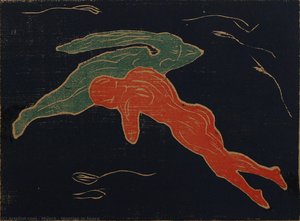
1900. Oil On Canvas, 80.0 x 120.0 cm.

§ 1目录数据

- 80.0 x 120.0 cm


§ 2摘要
藏品详情
Experience Edvard Munch's 'Golgotha,' a haunting oil painting capturing the crucifixion with raw emotion and Expressionist intensity. Explore its symbolism, artistic context, and order a museum-quality reproduction today.
 展开全文
展开全文
§ 3赏析
A Descent into Anguish: Edvard Munch’s “Golgotha”
Edvard Munch's "Golgotha," painted in 1900, isn’t merely a depiction of the crucifixion; it’s a visceral plunge into the heart of human suffering. Measuring a substantial 80 x 120 cm, this oil on canvas stands as a cornerstone of Expressionism, a movement that sought to capture not just what was seen, but what was felt – the raw, unfiltered emotions beneath the surface of experience. Munch, deeply influenced by his own personal tragedies and a pervasive sense of unease inherited from his family’s history of mental illness, channeled these anxieties into a visual language profoundly unsettling yet undeniably compelling.
The painting immediately assaults the viewer with its intensely saturated colors – fiery reds and oranges dominate the sky, mirroring the agony of Christ's sacrifice. These aren’t gentle hues; they are aggressive, almost violent, reflecting the chaotic emotional landscape Munch aimed to portray. The figures surrounding the central crucifixion scene are rendered in distorted forms, their faces contorted in expressions ranging from horrified disbelief to detached apathy. This deliberate distortion is a hallmark of Expressionism, rejecting realistic representation in favor of conveying subjective feeling. Notice particularly the individuals in the crowd wearing ties – a subtle yet potent symbol referencing the established religious and political authorities who witnessed this pivotal event, highlighting the disconnect between power and empathy.
The Language of Distress: Style and Technique
Munch’s technique is deliberately unsettling. He employs broad, sweeping brushstrokes that contribute to the painting's sense of movement and instability. The composition itself draws the eye relentlessly towards the central figure on the cross, while the surrounding figures seem trapped within a vortex of despair. The use of color isn’t intended to be beautiful in a conventional sense; it’s designed to evoke a powerful emotional response. Munch masterfully utilizes complementary colors – like the juxtaposition of red and green – to heighten the drama and create a visual tension that mirrors the psychological turmoil depicted.
Furthermore, the painting's surface is not smooth or polished. It retains a visible texture, as if reflecting the artist’s own agitated state of mind. This tactile quality invites the viewer to engage with the work on a deeper level, fostering a sense of intimacy and shared experience. The overall effect is one of raw immediacy – as if we are witnessing this agonizing scene unfold before our very eyes.
Symbolism and Context: A Reflection of an Era
"Golgotha" exists within the broader context of late 19th-century Europe, a period marked by rapid social change, scientific advancements, and a growing sense of disillusionment. As explored in resources like Moderna Museet’s “Inner Crisis but Artistic Success,” Munch's work resonated with many artists grappling with similar anxieties about modernity and the loss of traditional values. The painting can be interpreted as a commentary on the indifference of society to suffering – those observing Christ’s crucifixion are not united in grief, but divided by apathy and self-interest.
The inclusion of figures wearing ties is particularly significant. It speaks to the hierarchical structures of power that often fail to acknowledge or address human pain. Munch's own personal struggles with mental illness, exacerbated by his family history, undoubtedly informed this powerful symbolism. “Golgotha” isn’t simply a religious depiction; it’s a deeply personal exploration of mortality, anxiety, and the isolating experience of being an outsider in a rapidly changing world.
A Legacy of Emotional Intensity
Edvard Munch's "Golgotha" remains one of the most profoundly moving works of the Expressionist movement. His ability to translate internal emotional states into visual form continues to resonate with audiences today, solidifying his place as a pivotal figure in modern art. As highlighted by resources like AllPaintingsStore.com and other platforms offering high-quality reproductions, this painting’s enduring power lies in its unflinching honesty and its willingness to confront the darkest aspects of human existence. A reproduction of “Golgotha” offers a unique opportunity to bring this intensely emotional artwork into your home, serving as a constant reminder of our shared vulnerability and the importance of empathy.
常见问题与解答
建议将 爱德华·蒙克 的《Golgotha》 悬挂在哪个空间?
"Golgotha" 的复制品非常适合陈设于 Living Room 中。
爱德华·蒙克 的《Golgotha》 的构图比例如何,尺寸是多少?
爱德华·蒙克 的《Golgotha》 是一幅 Landscape 构图的作品,原件尺寸为 80 x 120 cm。
"Golgotha" 与 爱德华·蒙克 的其他作品有何共通之处?
"Golgotha" 是 爱德华·蒙克 Expressionism 时期的代表作,其创作主题涵盖了 expressionist angst, christian symbolism, personal trauma, societal critique, mortality themes, psychological depth, iconic grief, emotional intensity。



 切换至版画销售渠道


 对于任何边长超过 105 厘米(约 41 英寸)的艺术品或复制品,画框将以拆解后的组件形式发货。此方法可确保安全送达并防止运输过程中的损坏。