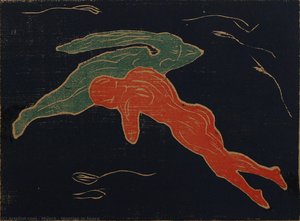
1895. Oil On Canvas.

§ 1Catalogue data


§ 2Abstract
藏品详情
A hauntingly intense Expressionist masterpiece by Edvard Munch, Jealousy captures raw psychological tension through fiery crimson hues and distorted forms, inviting you to experience this profound exploration of emotion.
 展开全文
展开全文
§ 3Commentary
A Symphony of Unspoken Tension
In the hauntingly beautiful canvas of Edvard Munch’s Jealousy, painted in 1895, we are not merely observers of a scene, but witnesses to a psychological storm. This masterpiece serves as a cornerstone of the Expressionist movement, a period where artists began to tear away the veil of objective reality to reveal the raw, often uncomfortable, truths of the human psyche. The painting presents a triangular confrontation: a man with a heavy, bearded presence stares intently at two women, his gaze thick with suspicion and possessiveness. There is an undeniable magnetism in this composition, a sense that we have stumbled upon a private moment of profound emotional upheaval. For the collector or the designer, this piece offers more than just visual interest; it provides a window into the universal complexities of desire and resentment.
Munch’s technique is nothing short of visceral. Eschewing the delicate, light-dappled strokes of Impressionism, he embraced a bold, emotive approach that prioritizes feeling over form. The palette is dominated by a fiery crimson that pulses through the background, acting as a visual metaphor for the heat of passion and the consuming nature of envy. Through the use of thick impasto, Munch creates a textured surface that mirrors the agitation of the subjects' souls. The distorted facial features and fluid, almost liquid lines contribute to an atmosphere of instability, making the canvas feel alive with movement and unease. This tactile quality ensures that a high-quality reproduction remains a striking focal point in any curated space, drawing the eye with its rhythmic energy and dramatic depth.
Symbolism and the Echoes of History
Beyond the immediate visual drama, Jealousy is layered with profound symbolism that connects the personal to the primordial. The figures within the frame evoke the biblical archetypes of Adam and Eve, a theme Munch frequently revisited to explore themes of temptation and fallibility. The woman in red, positioned as a beacon of allure, represents the very object of desire that fuels the man's torment. Her presence is both captivating and threatening, much like the "sinful" apple that often accompanies such allegories. Even the subtle inclusion of greenery and natural elements serves to contrast the organic world with the unnatural, suffocating grip of human emotion. This interplay between the seen and the unseen allows the artwork to resonate on multiple intellectual levels.
To possess or display a work inspired by Munch is to invite a conversation about the depths of human experience. The painting does not offer easy comfort; instead, it celebrates the beauty found in vulnerability and the intensity of our most difficult emotions. For interior designers seeking to add a sense of narrative weight and intellectual sophistication to a room, this piece acts as an anchor of profound meaning. It is a work that demands attention, inviting viewers to contemplate the shadows of the human heart while appreciating the masterful execution of one of history's most influential psychological painters.
常见问题与解答
“Jealousy 3”的浏览量是多少?
"Jealousy 3" 拥有专属的 访问统计 页面。该页面通过国家和语言维度的细分,展示了该作品及艺术家其他作品的每月访问量趋势图。
爱德华·蒙克 的《Jealousy 3》 的创作媒介和创作日期是什么?
爱德华·蒙克 的《Jealousy 3》 的创作媒介为 Oil On Canvas,创作于 1895 年。
爱德华·蒙克 的《Jealousy 3》 采用了什么技法?
爱德华·蒙克 的《Jealousy 3》 的媒介为 Oil On Canvas。复制品旨在呈现该技法的视觉效果。
 切换至版画销售渠道


 对于任何边长超过 105 厘米(约 41 英寸)的艺术品或复制品,画框将以拆解后的组件形式发货。此方法可确保安全送达并防止运输过程中的损坏。