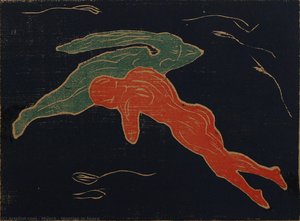
1899. Oil On Canvas.

§ 1目录数据


§ 2摘要
藏品详情
Explore Edvard Munch’s ‘Metabolism,’ a haunting Expressionist masterpiece. Discover its symbolic depth, dramatic use of color & form, and the artist's profound exploration of human emotion.
 展开全文
展开全文
§ 3赏析
A Haunting Dialogue: Decoding Edvard Munch’s ‘Metabolism’
“Metabolism” (1899) is more than a painting; it's a visceral exploration of the human condition, rendered with haunting beauty and psychological depth by Norwegian master Edvard Munch. This evocative work stands as a pivotal piece bridging Symbolism and the burgeoning Expressionist movement, offering viewers a glimpse into the anxieties and complexities of modern life.Subject & Composition: Entwined Destinies
The painting centers on two nude figures – traditionally interpreted as male – enveloped within a dense, shadowy forest. Their bodies are intimately close yet remain distinctly separate, creating a palpable tension. This isn’t a depiction of conventional intimacy; rather, it suggests a silent confrontation, an introspective isolation *with* another being. The off-center composition further amplifies this sense of unease and imbalance, drawing the eye into the psychological space between them. The forest itself is not merely a backdrop but an oppressive presence, its looming vertical forms acting as both enclosure and metaphor for the subconscious mind.Style & Technique: A Mosaic of Emotion
Munch’s technique in “Metabolism” is strikingly meticulous. He employs a distinctive mosaic-like application of small dots or brushstrokes, building up a heavily textured surface that shimmers with an almost metallic quality. This deliberate texture isn't simply aesthetic; it heightens the emotional impact, suggesting fragility and instability beneath the surface. The color palette – dominated by dark blues, purples, and hints of gold – contributes to the painting’s somber mood. While echoes of Art Nouveau can be seen in the flowing lines of the female figure, Munch transcends stylistic categorization, forging his own path toward expressing inner psychological states.Historical Context: Dawn of a New Expression
Created at the cusp of the 20th century, “Metabolism” reflects a growing disillusionment with traditional artistic conventions and an increasing fascination with exploring the complexities of the human psyche. Munch was a pioneer of Expressionism, rejecting objective representation in favor of subjective emotional experience. Influenced by his time amongst Parisian Post-Impressionists like Van Gogh and Gauguin, he embraced bold color and distorted forms to convey inner turmoil – a shift that foreshadowed the anxieties and alienation defining much of modern art.Symbolism & Interpretation: The Cycle of Existence
The title itself, “Metabolism,” is profoundly suggestive. It alludes to processes of transformation, decay, and renewal—concepts deeply intertwined with Munch’s own preoccupation with life, death, and the cyclical nature of existence. The mirrored effect created by the figures can be interpreted as representing inner conflict, duality, or even a fragmented self. The forest setting symbolizes the unconscious mind and hidden dangers. Is this a scene of temptation? A reflection of internal struggle? Munch deliberately leaves these questions open-ended, inviting viewers to project their own interpretations onto the canvas.Emotional Impact & Lasting Legacy
“Metabolism” isn’t simply *about* emotion; it evokes emotion. It's a work that lingers in the mind long after viewing, prompting introspection and a confrontation with uncomfortable truths about human relationships and the darker aspects of the self. As a cornerstone of Expressionism, this piece continues to inspire artists today.- A reproduction of “Metabolism” serves as a compelling focal point for any interior.
- Its depth and intrigue add a touch of haunting beauty to a space.
- The painting’s psychological resonance sparks conversation and contemplation.
常见问题与解答
爱德华·蒙克 的《Metabolism》 的色彩是鲜艳夺目还是柔和低调?
爱德华·蒙克 的《Metabolism》 的色彩呈现出 Subtle Color 的饱和度。饱和度描述了色彩的鲜艳或柔和程度。
爱德华·蒙克 的《Metabolism》 属于哪种艺术流派?
“Metabolism”是一件Expressionism时期的作品。该艺术流派体现了作品所属的艺术传统。
根据创作日期判断,"Metabolism" (1899) 属于 爱德华·蒙克 艺术生涯的哪个阶段?
1899 年的创作日期将《Metabolism》置于 爱德华·蒙克 艺术发展的 Mature Period 时期。


 切换至版画销售渠道


 对于任何边长超过 105 厘米(约 41 英寸)的艺术品或复制品,画框将以拆解后的组件形式发货。此方法可确保安全送达并防止运输过程中的损坏。