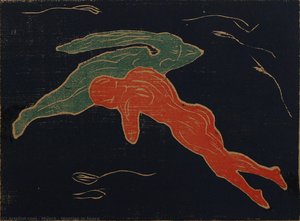
1889. Acrylic On Canvas.

§ 1Catalogue data


§ 2Abstract
藏品详情
Experience Edvard Munch’s evocative Expressionist masterpiece 'Spring,' capturing the poignant beauty of human emotion amidst blossoming flora and shadowed landscapes—a timeless reflection on life's fleeting moments.
 展开全文
展开全文
§ 3Commentary
Introduction
This article provides an analysis of the painting 'Spring' by Edvard Munch, a Norwegian painter known for his Expressionist style. The focus will be on the artist, title, style, date, and composition, as well as the use of light and shadow in this masterpiece.The Artist: Edvard Munch
Edvard Munch (1863-1944) was a Norwegian painter and printmaker who played a significant role in the development of Expressionism. His work, which often depicted intense emotions and psychological states, was influenced by Symbolism, Romanticism, and Realism. He is best known for his iconic painting 'The Scream' (1893), but his oeuvre includes various themes such as love, death, and anxiety.Title: Spring
'Spring' (1889) is one of Munch's early works, painted during his stay in Paris. The painting reflects the artist's fascination with nature, human emotions, and the passing of time. It also marks a transition from his earlier Naturalist style to a more expressive approach that would become characteristic of his mature work.Style: Expressionism
Expressionism is an artistic movement that emerged in the late 19th and early 20th centuries, characterized by the distortion of reality for emotional effect. Artists sought to express their inner worlds, often using bold colors, exaggerated forms, and unconventional compositions. Munch's 'Spring' exemplifies these characteristics with its vivid hues, fluid brushstrokes, and emotionally charged atmosphere.Date: 1889
The year 1889 was significant for Munch as he began to explore new artistic directions during his stay in Paris. 'Spring' reflects the artist's growing interest in capturing the essence of human emotions and the transience of life, themes that would become central to his work.Composition and Use of Light and Shadow
In 'Spring', Munch employs a simplified composition with two main figures: a woman in a red dress and a man in a black suit. The couple is depicted walking along a path, surrounded by lush vegetation and vibrant colors. The use of light and shadow creates depth and atmosphere, emphasizing the emotional connection between the characters and their environment. The artist masterfully employs chiaroscuro to enhance the dramatic effect of the scene. The contrast between light and dark areas adds tension and mystery, inviting viewers to explore the painting's deeper meaning. Munch also uses color symbolism to convey emotions: red represents passion and love, while black signifies melancholy and despair.Conclusion
Edvard Munch's 'Spring' (1889) is a powerful example of Expressionist art that showcases the artist's innovative approach to painting. By examining the composition, use of light and shadow, and symbolic elements, we can better understand Munch's unique vision and his contribution to modern art. AllPaintingsStore.com offers high-quality hand-made oil paintings reproductions of 'Spring' by Edvard Munch, allowing art enthusiasts to appreciate this masterpiece in their homes or offices. Explore our collection and discover the beauty of Expressionist art.- Read more about: the Abstract Expressionism Art Movement
- Discover: Edvard Munch's 'Spring' painting
- Learn about: Muzeul K.h. Zambaccian, Bucharest, Romania, where some of Munch's works are exhibited.
常见问题与解答
是否可以下载"Spring"的高分辨率版本?
若想获取 爱德华·蒙克 的《Spring》 的数字版文件,请前往其 高分辨率数字图像 页面进行 高分辨率数字图像下载。
爱德华·蒙克 的《Spring》传达了怎样的情感?
爱德华·蒙克 的《Spring》 传达出一种 Melancholic 的情感基调。
爱德华·蒙克 的《Spring》 描绘了怎样的场景,又传达了怎样的意境?
"Spring" 描绘了 emotion, landscape, human figure, parisian art, symbolism, nature scene, psychological painting,并传达出 Romantic 的意境。


 切换至版画销售渠道


 对于任何边长超过 105 厘米(约 41 英寸)的艺术品或复制品,画框将以拆解后的组件形式发货。此方法可确保安全送达并防止运输过程中的损坏。