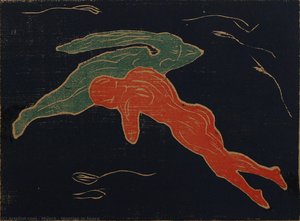
1895. Acrylic On Canvas, 75.0 x 60.0 cm. 蒙克博物馆.

§ 1目录数据

- 75.0 x 60.0 cm


§ 2摘要
藏品详情
 展开全文
展开全文
§ 3赏析
A Portrait of Anxiety: Edvard Munch’s “The Baseball Bat”
Edvard Munch’s “The Baseball Bat,” painted in 1895, isn't merely a depiction of a man; it’s an embodiment of the pervasive anxieties that characterized the fin de siècle – the twilight of the century. Created during a period marked by societal upheaval and burgeoning psychological awareness, this haunting portrait transcends simple representation to delve into the depths of human emotion.
- Subject Matter: The painting centers on a solitary figure—a man with prominent facial features including a beard and mustache—positioned centrally within the frame. His gaze is direct, confronting the viewer, creating an immediate sense of intimacy alongside unease.
- Composition & Technique: Munch employed his signature Expressionist style, prioritizing emotional intensity over realistic accuracy. Thick brushstrokes dominate the canvas, conveying movement and turbulence – mirroring the inner turmoil he sought to capture. The muted palette—primarily blues and browns—further enhances the melancholic atmosphere.
The inclusion of a baseball bat in the lower left corner is no accident. While seemingly incongruous with the figure’s demeanor, it serves as a potent symbol. Baseball bats represent strength, aggression, and perhaps even futile attempts to control forces beyond one's grasp. In Munch’s oeuvre, objects often carry hidden meanings, reflecting anxieties about vulnerability and confronting mortality. The bat could be interpreted as representing an individual battling against overwhelming feelings of despair.
Historical Context: Fin de Siècle Neurosis
“The Baseball Bat” emerged from the intellectual ferment of the late 1890s, a time when Sigmund Freud was pioneering psychoanalysis and artists like Munch were grappling with existential questions. The anxieties of this era stemmed from rapid industrialization, urbanization, and shifting social mores—factors that eroded traditional beliefs and fostered feelings of isolation and uncertainty. Munch’s art reflects these concerns directly, articulating the unspoken fears that simmer beneath the surface of Victorian society.
Symbolism Beyond Appearance
Beyond its visual elements, “The Baseball Bat” resonates with deeper symbolic significance. The man's impassive gaze suggests a detachment from emotion—a defense mechanism against confronting overwhelming sadness. Munch’s masterful use of color and brushwork amplifies this psychological dimension, conveying not just what is seen but what is felt. It’s a portrait that invites contemplation on the human condition, prompting viewers to consider their own vulnerabilities and anxieties.
Emotional Impact & Artistic Legacy
"The Baseball Bat" continues to captivate audiences today because it speaks to universal themes of fear, grief, and introspection. Munch’s ability to translate psychological experience into visual form established him as a pivotal figure in the development of Expressionism—a movement that prioritized subjective emotion over objective representation. Reproductions of this artwork offer an opportunity to engage with one of art history's most poignant explorations of the human psyche.
常见问题与解答
“Stanislaw Przybyszewski”的主题是什么?
爱德华·蒙克 的《Stanislaw Przybyszewski》 中呈现的主题包括 melancholy, anxiety, fear, mortality, expressionism, norwegian art, baseball,这些主题共同构成了该艺术作品的主旨。
爱德华·蒙克 的《Stanislaw Przybyszewski》 的技法与风格具有哪些特征?
“Stanislaw Przybyszewski”采用 Acrylic On Canvas 创作,呈现出 Symbolic Expression 风格。
在爱德华·蒙克反复探讨的主题中,"Stanislaw Przybyszewski"处于怎样的地位?
"Stanislaw Przybyszewski" 描绘了 melancholy, anxiety, fear, mortality, expressionism, norwegian art, baseball,而 爱德华·蒙克 的创作主题则以 psychological depth, symbolism, munch’s vision, existential angst, artistic legacy 见长。通过两者的对比,可以发现此作与艺术家惯用题材之间的内在联系。


 切换至版画销售渠道


 对于任何边长超过 105 厘米(约 41 英寸)的艺术品或复制品,画框将以拆解后的组件形式发货。此方法可确保安全送达并防止运输过程中的损坏。