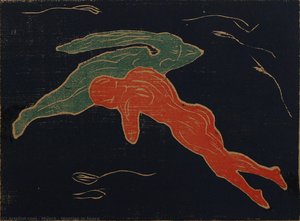
1900. Acrylic On Canvas, 84.0 x 109.0 cm.

§ 1Catalogue data

- 84.0 x 109.0 cm


§ 2Abstract
藏品详情
Explore Edvard Munch's evocative 'Smoke Train,' a masterpiece of Expressionism capturing the bleak beauty of Norwegian landscapes and conveying profound emotional tension through bold colors and brushstrokes.
 展开全文
展开全文
§ 3Commentary
A Breath Held Captive: Edvard Munch’s “Train Smoke”
Edvard Munch's "Train Smoke," completed in 1900, isn’t merely a landscape painting; it’s an embodiment of the anxieties simmering beneath the surface of early 20th-century Europe—a visual distillation of existential dread rendered with breathtaking artistry. Housed at Oslo’s Munch Museum, this monumental canvas (84 x 109 cm) transcends its physical dimensions to deliver a profound meditation on modernity's intrusion upon the tranquility of nature and the inescapable awareness of mortality.The Expressionist Vision: Style and Technique
Munch’s stylistic allegiance firmly rests within Expressionism, a movement that prioritized emotional intensity over objective representation. Unlike Impressionists who sought to capture fleeting moments of light and color, Munch aimed to convey inner turmoil—the artist's own psychological state projected onto the canvas. The painting utilizes oil on canvas, allowing for rich textural layering and vibrant hues that contribute significantly to its emotive power. Notice the deliberate simplification of forms; Munch eschews meticulous detail in favor of bold contours and expressive brushstrokes—a technique characteristic of Expressionist painters who wished to bypass rational thought and tap directly into primal feelings. The rhythmic interplay of lines mimics the movement of wind-swept trees, mirroring a subconscious yearning for freedom amidst confinement.A Landscape Steeped in Symbolism: Composition and Motif
The scene unfolds from Ljan, overlooking Oslo fjord—a location chosen by Munch to heighten the sense of isolation and vulnerability. He captures a hillside dotted with pine trees as a train passes silently along the fjord’s edge. The artist's keen observation isn’t merely descriptive; it’s imbued with symbolic significance. The towering pines represent stability and resilience, yet their undulating lines convey an underlying restlessness—a subtle counterpoint to the locomotive’s passage. However, Munch’s gaze is drawn not to the train itself but to its smoke – a motif that dominates the composition. Rendered in rounded shapes defined by crisp contour lines, the smoke embodies the disruptive force of industrialization and encroaching urbanization, symbolizing the anxieties surrounding technological advancement and societal change. The white smoke cloud hovering above the trees further amplifies this visual metaphor for unease and impending doom.Historical Context: Art Nouveau’s Influence
“Train Smoke” operates within the broader context of Art Nouveau—a decorative style that flourished across Europe in the late 1890s and early 1900s. Munch skillfully blends Art Nouveau's lyrical tints and flowing lines with Expressionist principles, resulting in a harmonious synthesis. This stylistic choice reflects a desire to capture the beauty of the natural world while simultaneously confronting its darker aspects—a preoccupation that aligns perfectly with Munch’s artistic ethos. The painting speaks to a generation grappling with rapid industrialization, social upheaval, and growing disillusionment with traditional values.Emotional Resonance: Beyond Representation
Ultimately, “Train Smoke” succeeds in conveying an overwhelming sense of melancholy and apprehension. It's not simply a depiction of a train journey; it’s an exploration of the human condition—a confrontation with mortality and the inescapable awareness of suffering. Munch achieves this profound emotional impact through masterful use of color – predominantly shades of green and blue – punctuated by flashes of yellow and red that heighten tension and underscore the painting's psychological depth. Viewing “Train Smoke” is akin to stepping into Munch’s tormented mind, experiencing firsthand the artist’s visceral response to the world around him. It remains a testament to Expressionism’s ability to transform visual imagery into a conduit for profound emotional truth.常见问题与解答
爱德华·蒙克 的《Train smoke》 的色彩是鲜艳夺目还是柔和低调?
爱德华·蒙克 的《Train smoke》 的色彩饱和度为 Subtle Color。
什么样的摆放方式最适合 爱德华·蒙克 的《Train smoke》 的画幅?
爱德华·蒙克 的《Train smoke》 的 Landscape 格式推荐用于 Living Room。画幅与空间的结合,将为您提供复制品摆放的指引。
在哪里可以找到关于“Train smoke”的指南?
针对 爱德华·蒙克 的《Train smoke》,我们提供了一个 指南 页面:这是一份可打印的艺术品资料页,专为学生及课堂教学使用而设计。


 切换至版画销售渠道


 对于任何边长超过 105 厘米(约 41 英寸)的艺术品或复制品,画框将以拆解后的组件形式发货。此方法可确保安全送达并防止运输过程中的损坏。