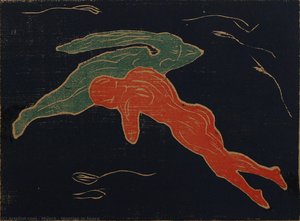
Oil On Canvas.

§ 1目录数据


§ 2摘要
藏品详情
Explore Edvard Munch’s "untitled (5572)", a powerful Expressionist landscape capturing isolation & emotion. Discover its unique style, dramatic lighting & symbolic depth.
 展开全文
展开全文
§ 3赏析
A Silent Scream Echoing Through Time
Edvard Munch’s “untitled (5572),” a haunting landscape rendered in muted blues, greens, and browns, isn't merely a depiction of a forest scene; it’s a visceral embodiment of anxiety and isolation. Painted around 1893, during a period of intense personal turmoil for the artist, this work stands as a cornerstone of Expressionism, capturing not just what Munch *saw*, but what he *felt* – a profound sense of unease that continues to resonate with viewers today. The painting’s power lies in its ability to evoke a primal fear, a silent scream trapped within the confines of nature itself.
Munch's artistic journey was deeply intertwined with his own psychological struggles. Born in 1863 amidst a landscape scarred by illness and premature loss – including the deaths of his mother and sister from tuberculosis – Munch’s childhood instilled in him a lifelong preoccupation with mortality, sickness, and the fragility of human existence. This personal history isn't simply biographical; it fuels the symbolic language of his art, transforming everyday scenes into potent expressions of inner turmoil. His father, a strict religious man, further contributed to a sense of dread, shaping Munch’s worldview and informing his artistic vision.
The Language of Line and Color
Technically, “untitled (5572)” exemplifies Munch's distinctive style – characterized by loose brushstrokes, flattened perspective, and an emphasis on emotional expression over realistic representation. The composition is dominated by vertical elements: the towering trees and the central figure create a sense of height and isolation, drawing the viewer’s eye upwards into the dramatic sky. Lines are primarily straight and angular, defining the rigid structure of the trees and the woman's clothing, contrasting sharply with the softer curves of the clouds and her silhouette. This deliberate juxtaposition creates a dynamic tension within the scene.
Munch masterfully employs color to amplify the painting’s emotional impact. The muted palette – predominantly blues, greens, and browns – evokes a sense of melancholy and foreboding. However, the vibrant yellow-orange glow of the setting sun injects a jarring element of intensity, suggesting both beauty and impending doom. This interplay of cool and warm tones further intensifies the painting’s unsettling atmosphere.
Symbolism and Emotional Resonance
The solitary woman standing in the forest is often interpreted as an embodiment of human vulnerability and isolation. Her posture – slightly hunched, her gaze averted – suggests a profound sense of loneliness and despair. The dense foliage surrounding her creates a claustrophobic atmosphere, trapping her within a world of silent suffering. Some art historians believe that Munch was inspired by a specific sunset he witnessed while walking near Oslofjord, experiencing a sudden surge of anxiety and dread.
The painting’s symbolism extends beyond the individual figure. The forest itself can be seen as a metaphor for the unconscious mind – a dark and mysterious realm where anxieties and fears reside. The setting sun represents the passage of time and the inevitability of death, while the woman's silhouette evokes a sense of anonymity and universal suffering. “untitled (5572)” is not simply a landscape; it’s a profound meditation on the human condition – a poignant exploration of isolation, fear, and the search for meaning in a world often devoid of comfort.
A Legacy of Emotional Intensity
Edvard Munch's “untitled (5572)” remains one of the most enduringly powerful works of art ever created. Its raw emotional intensity continues to captivate viewers more than a century after its creation, solidifying Munch’s place as a pioneer of Expressionism and a master of psychological portraiture. Reproductions of this iconic painting offer a window into the artist's troubled soul, inviting us to contemplate our own anxieties and vulnerabilities in the face of an often-unpredictable world. The work is now housed at The Munch Museum in Oslo, Norway, where it continues to draw visitors from around the globe.
常见问题与解答
是否有关于 爱德华·蒙克 的《untitled (5572)》 的幻灯片展示?
您可以在作品的幻灯片展示页面上观看“untitled (5572)”的幻灯片展示。
如何预览爱德华·蒙克 的《untitled (5572)》的复制品?
若要预览 爱德华·蒙克 的《untitled (5572)》 复制品的详情,请打开该作品的 效果预览 页面。
爱德华·蒙克 的作品《untitled (5572)》是否属于公有领域?其原因是什么?
爱德华·蒙克 的《untitled (5572)》 已进入 属于公有领域 —— 其版权已过期。版权保护期自艺术家逝世之日起计算,该艺术家于 1944 年逝世。


 切换至版画销售渠道


 对于任何边长超过 105 厘米(约 41 英寸)的艺术品或复制品,画框将以拆解后的组件形式发货。此方法可确保安全送达并防止运输过程中的损坏。