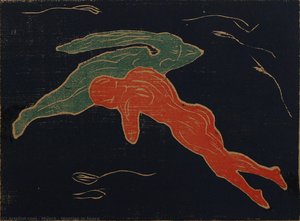
布面丙烯.

§ 1目录数据


§ 2摘要
藏品详情
Explore Edvard Munch’s "Untitled (7446)", a haunting Expressionist masterpiece. Discover its melancholic beauty, impasto texture & symbolic depth – perfect for art collectors.
 展开全文
展开全文
§ 3赏析
A Haunting Echo of the Human Condition
This powerful work by Edvard Munch is a quintessential example of Expressionism, distilling anxieties and emotional turmoil into a visually arresting scene. Created during a period marked by personal tragedy and philosophical questioning for the artist, it offers a poignant glimpse into themes of isolation, longing, and perhaps even despair – emotions that continue to resonate deeply with viewers today.Subject & Composition: Figures Within a Psychological Space
The composition centers around two figures set within an ambiguous outdoor environment. A woman, strikingly pale with flowing golden hair, dominates the left side of the canvas. Her gaze is directed away from the viewer, lost in contemplation or sorrow. To her right, a slumped figure – likely male – leans against what appears to be a building fragment, embodying resignation and sadness. The setting itself feels less like a physical location and more like an internal landscape, constructed from blurred shapes suggesting buildings, foliage, and water. This deliberate ambiguity invites viewers to project their own interpretations onto the scene, enhancing its dreamlike quality. The chaotic overlapping of forms and flattened perspective further intensify this sense of disorientation and emotional intensity.Style & Technique: Impasto and Expressive Lines
Munch’s masterful technique amplifies the work's emotional impact. He employs a heavily textured *impasto* style, applying thick layers of paint that create a tactile surface and emphasize the physicality of emotion. The brushstrokes are loose and visible, eschewing precise delineation in favor of expressive lines that convey feeling rather than form. This approach is characteristic of Expressionism, where distortion and exaggeration serve to communicate inner states. The color palette is predominantly cool – blues and whites – punctuated by the warmth of the woman’s hair and strategically placed red dots. These crimson accents act as visual jolts, hinting at underlying tension or perhaps even trauma.Historical Context: A Pioneer of Psychological Expression
Edvard Munch (1863-1944) was a pivotal figure in the development of modern art, particularly Expressionism. His life was profoundly shaped by loss and illness; his mother and sister both succumbed to tuberculosis during his childhood, and he lived with the constant fear of inheriting his father’s mental instability. These experiences fueled a lifelong preoccupation with themes of mortality, anxiety, and psychological distress – all powerfully reflected in his art. He rejected academic conventions, committing himself to exploring the darker recesses of the human psyche. He sought not to depict *what* he saw, but *how* he felt about what he saw, paving the way for future generations of artists to embrace subjective expression.Symbolism & Emotional Resonance: Loneliness and Unfulfilled Desire
The symbolism within this painting is open to interpretation, yet certain elements consistently evoke feelings of loneliness and unfulfilled desire. The woman’s distant gaze suggests a longing for something unattainable, while the slumped figure embodies defeat and resignation. The ambiguous setting reinforces these themes, creating a sense of isolation and disorientation. The red dots scattered throughout the canvas can be interpreted as symbols of passion, pain, or even blood – adding layers of complexity to the emotional narrative. Ultimately, this painting is not simply a depiction of two figures; it’s a powerful evocation of universal human emotions that continue to resonate with viewers today.For Collectors & Designers: A Statement Piece
This work would serve as a compelling statement piece in any collection or interior design scheme. Its muted color palette and emotionally charged subject matter lend themselves well to spaces seeking depth and introspection. The textured surface adds visual interest, while the painting’s historical significance provides intellectual weight. Whether displayed in a modern loft, a classic study, or a contemporary living room, this work by Munch is guaranteed to spark conversation and inspire contemplation.Key Features
- Artist: Edvard Munch (1863-1944)
- Style: Expressionism
- Technique: Impasto, Expressive Brushwork
- Themes: Isolation, Longing, Despair, Psychological Turmoil
常见问题与解答
在“untitled (7446)”中,媒介与笔触是如何交融的?
在“untitled (7446)”中,布面丙烯技法与Expressionism运动交相辉映。
我能查看爱德华·蒙克 的《untitled (7446)》的X光影像吗?
您可以在作品的 X射线透视 页面上逐层探索 “untitled (7446)”;该交互式查看器的设计灵感源自修复师使用的光源台,通过十一层光学读数呈现图像细节。
是否有与“untitled (7446)”风格相似的作品?
与“untitled (7446)”相似的作品已列在艺术品的 相似作品 页面中。


 切换至版画销售渠道


 对于任何边长超过 105 厘米(约 41 英寸)的艺术品或复制品,画框将以拆解后的组件形式发货。此方法可确保安全送达并防止运输过程中的损坏。