


 效果预览
效果预览
 购买手绘画作
 分享
分享 分享
分享
 详情
详情

 下载
下载
 相似作品
相似作品 X射线
X射线 幻灯片播放
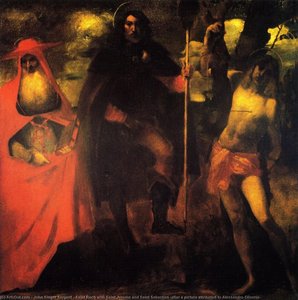
幻灯片播放Saint Christopher
 展开详情
展开详情




































从与原作比例一致的预设尺寸中进行选择。

您可以输入自定义尺寸,以适配特定的画框或空间。如果您选择的尺寸与原图比例不符,我们将对作品进行裁剪,或通过镜像填充/纯色填充边缘的方式来扩展图像。在开始制作之前,我们会向您发送一份数字效果图供您确认。
请注意,屏幕上的预览并不能反映实际的裁剪或扩展效果。只有效果图才能准确展示最终的构图。
虽然我们提供定制尺寸,但为了保持原图比例,我们建议您从预设列表中选择尺寸。


 玻璃选项仅适用于110厘米以下的尺寸。

Saint Christopher
艺术微喷/版画
复制品尺寸
-


最终总价
$ 64
相似艺术品



艺术家简介
A Serene Visionary: The Life and Art of Edward Reginald Frampton
Edward Reginald Frampton, a name perhaps less immediately recognizable than his Pre-Raphaelite predecessors, nonetheless occupies a fascinating niche in the history of British art. Born in Thornton Heath, England, on October 29th, 1870, Frampton emerged as a painter deeply attuned to symbolism and spirituality, carving out a distinctive path through murals, stained glass, and evocative landscapes. His life, though relatively quiet, was marked by a dedicated pursuit of artistic expression, evolving from early explorations in sculpture and landscape to a mature style characterized by flat planes of color, dignified serenity, and a profound engagement with the human form. Frampton’s story is one of deliberate artistic choices, influenced by both the Italian Renaissance and the ethereal beauty of the Pre-Raphaelite movement, yet ultimately forging an identity uniquely his own.Early Influences and Artistic Development
Frampton's initial artistic training was steeped in familial tradition; his father, Edward Frampton, was a skilled stained-glass artist, providing a foundational understanding of color, composition, and the technical demands of working with light and form. He attended Brighton Grammar School before moving to Westminster School of Art, where he found himself among contemporaries like Aubrey Beardsley – though their artistic trajectories would diverge significantly. Early in his career, Frampton experimented with various mediums, including sculpture, but it was landscape painting that initially captured his attention. However, a pivotal moment arrived after a visit to an exhibition showcasing the works of Sir Edward Burne-Jones. This encounter proved transformative, igniting a passion for the Pre-Raphaelite aesthetic and prompting a shift towards illustrating the human figure as the central focus of his art. He began to concentrate on compositions featuring symbolic subjects, landscapes serving more as backdrops or settings for narratives rich in meaning.The Murals and the Pursuit of Decorative Harmony
Frampton’s most significant contributions lie in his murals, particularly those commissioned for churches as war memorials. These were not merely commemorative pieces; they were carefully considered works designed to evoke contemplation and spiritual solace. He painted in a distinctive flat, stately style – a deliberate departure from the illusionistic techniques favored by many of his contemporaries. This approach was deeply influenced by French Symbolism and, notably, the work of Pierre Puvis de Chavannes, whose compositions emphasized simplified forms and subdued tonality. Frampton consciously sought to create a sense of decorative harmony, prioritizing “flat effect and the subordination proper to mural backgrounds” over the dramatic realism that might detract from the overall architectural scheme. He believed in a restrained use of light and shadow, opting for diffused illumination that lent his figures a timeless quality and fostered an atmosphere of restful dignity.Pre-Raphaelite Echoes and Italian Inspiration
While deeply indebted to the Pre-Raphaelites, Frampton wasn’t simply an imitator. He synthesized their romanticism with a fascination for primitive Italian painting, seeking a balance between expressive detail and simplified forms. As one critic noted, he skillfully navigated a path “between the ‘sexless wraiths’ of Burne-Jones and ‘the coarse physical type’ of de Chavannes.” His compositions often feature symbolic subjects drawn from legend and literature – notably, scenes from *The Legend of St. Brendan* – rendered with meticulous draftsmanship and a subtle palette. The absence of harsh highlights and cast shadows, rather than diminishing the work's impact, served to enhance its ethereal quality and emphasize the underlying spiritual themes. He considered himself influenced by both primitive Italian painting and the English Pre-Raphaelite design, and also by the compositions of Pierre Puvis de Chavannes.Legacy and Historical Significance
Edward Reginald Frampton died in Paris on November 4th, 1923, leaving behind a body of work that continues to resonate with its quiet power and contemplative beauty. Though he may not be as widely celebrated as some of his Pre-Raphaelite forebears, his murals stand as poignant testaments to the enduring human need for remembrance and spiritual connection. His dedication to decorative harmony, coupled with his skillful synthesis of diverse artistic influences, established him as a unique voice in early 20th-century British art. Frampton’s work offers a compelling example of how artists can draw inspiration from the past while forging their own distinctive paths, creating images that are both deeply rooted in tradition and profoundly personal in expression.
edward reginald frampton
1870 - 1923 , United Kingdom
艺术家简介
- Artistic Movement Or Style: French Symbolism, Pre-Raphaelite
- Artists Who Influenced This Artist:
- Edward Burne-Jones
- Pierre Puvis de Chavannes
- Date Of Birth: 1870
- Date Of Death: 4 November 1923
- Full Name: Edward Reginald Frampton
- Nationality: British
- Notable Artworks:
- St. Brendan panel
- Fairy land
- Place Of Birth: Brighton, England



