1910. Acrylic On Canvas, 29.0 x 19.0 cm.

§ 1Catalogue data
 Acrylic On Canvas
- WallArt
- Expressionism
 1910
1910 29.0 x 19.0 cm
§ 2Abstract
藏品详情
 展开全文
展开全文
艺术家简介
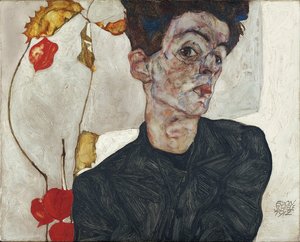
探索奥地利表现主义画家埃贡·席勒 (1890-1918) 的充满情感的艺术:大胆肖像、心理主题和独特的线条。现在就发现他的杰作!席勒以其对死亡、性与孤立的深刻描绘而闻名,作品如《自画像(带石刁柏)》等,是20世纪早期艺术的重要代表。
§ 3Commentary
A Fragment of Intensity: Examining Egon Schiele’s ‘Poem’
Egon Schiele’s “Poem,” completed in 1910, stands as a deceptively simple yet profoundly resonant testament to the artist's signature style and his preoccupation with themes of vulnerability and unspoken emotion. This unassuming watercolor—measuring 29 x 19 cm—captures a moment frozen in time: a sheet of paper bearing handwritten words, rendered in muted tones that amplify rather than diminish their impact.
The photograph itself presents a deliberate ambiguity. The blurry texture of the paper suggests age and preservation, hinting at a history unseen but felt nonetheless. It’s not merely an image of text; it's an emblem of communication—or perhaps its absence—a subtle invitation to contemplate what lies beneath the surface.
The Expressionist Palette: Technique and Style
- Watercolor Medium: Schiele favored watercolor for its ability to achieve delicate gradations of color and luminosity, qualities perfectly suited to conveying psychological states. Unlike oil paints which offer bolder hues and textural richness, watercolor allows for a softer, more ethereal quality that mirrors the artist’s introspective gaze.
- Linear Emphasis: Characteristic of Schiele's oeuvre is his masterful use of line—thick, agitated strokes that delineate forms with unsettling precision. These lines aren’t merely descriptive; they embody movement and tension, mirroring the inner turmoil he sought to express.
- Monochromatic Undertones: Despite its apparent simplicity, “Poem” employs a carefully considered monochromatic palette dominated by shades of grey and brown. This deliberate restraint serves to heighten the emotional intensity of the piece, focusing attention on the contours of the paper and the subtle nuances of light and shadow.
Historical Context: Vienna’s Artistic Crucible
Schiele's work emerged during Vienna’s vibrant artistic milieu—a period marked by experimentation and a fervent embrace of Expressionism. Influenced heavily by Gustav Klimt, Schiele wrestled with anxieties surrounding sexuality, mortality, and the human condition. The painting reflects this broader cultural preoccupation with confronting uncomfortable truths about existence.
Vienna at the turn of the century was undergoing rapid social change—industrialization, urbanization, and burgeoning intellectual currents challenged traditional values. Artists like Schiele responded to these shifts by rejecting academic conventions in favor of emotionally charged imagery that prioritized subjective experience over objective representation. “Poem” embodies this spirit of rebellion against established norms.
Symbolism Beyond the Surface: The Weight of Words
The handwritten words on the paper are deliberately obscured, adding another layer of complexity to the artwork’s symbolic significance. They represent unspoken thoughts—perhaps desires, fears, or confessions—that remain hidden from view. This deliberate concealment underscores Schiele's fascination with psychological depth and his ability to convey emotion through visual suggestion.
The paper itself serves as a metaphor for fragility—a vulnerable surface bearing the marks of time and experience. Like Schiele’s own life, “Poem” confronts us with the inevitability of decay and loss, prompting contemplation on the ephemeral nature of beauty and consciousness. It's a piece that lingers in the mind long after viewing, inviting repeated observation and rewarding careful consideration.


 切换至版画销售渠道


 对于任何边长超过 105 厘米(约 41 英寸)的艺术品或复制品,画框将以拆解后的组件形式发货。此方法可确保安全送达并防止运输过程中的损坏。