

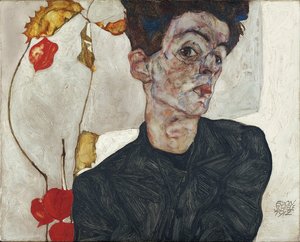
1910. Gouache.

§ 1目录数据


§ 2摘要
藏品详情
A hauntingly vulnerable expressionist portrait of a sleeping boy by Egon Schiele captures the raw psychological depth of 1910 Vienna through angular lines and muted tones, inviting you to explore this masterpiece.
 展开全文
展开全文
艺术家简介
探索奥地利表现主义画家埃贡·席勒 (1890-1918) 的充满情感的艺术:大胆肖像、心理主题和独特的线条。现在就发现他的杰作!席勒以其对死亡、性与孤立的深刻描绘而闻名,作品如《自画像(带石刁柏)》等,是20世纪早期艺术的重要代表。
§ 3赏析
A Haunting Encounter with Vulnerability
In the quiet, unsettling depths of Egon Schiele’s 1910 masterpiece, “Sleeping Child,” we encounter more than just a portrait; we witness a profound psychological excavation. This exquisite gouache on canvas serves as a haunting testament to the artist's lifelong preoccupation with mortality and the fragile boundaries of the human psyche. The painting depicts a young boy nestled in repose, his small frame curled inward, arms wrapped tightly around himself in a posture that immediately evokes a sense of defenselessness and raw vulnerability. Schiele, a master of the Expressionist movement, eschews the polished idealism of traditional portraiture to instead capture a deeper, more unsettling truth—the quiet ache of existence that lies beneath the surface of even the most innocent subjects.
The technical execution of the piece is as striking as its subject matter. Schiele employs a distinctive Expressionist style characterized by angular, almost jagged lines and a flattened perspective that pushes the figure toward the viewer, demanding an intimate, if uncomfortable, engagement. His palette is deliberately muted, dominated by somber browns, earthy ochres, and shadowy tones that contribute to a heavy, melancholic atmosphere. By layering thin, translucent washes of gouache, Schiele builds a texture that feels palpably alive, creating a surface that seems to vibrate with the artist's own internal anxieties. This meticulous approach ensures that every stroke contributes to the painting's overall sense of tension and psychological weight.
Symbolism and the Shadows of Vienna
To look upon “Sleeping Child” is to navigate a labyrinth of symbolic meaning. The boy’s fetal position is laden with significance, representing an innocence that feels perpetually threatened by an encroaching darkness—a recurring motif throughout Schiele's turbulent oeuvre. There is a deliberate concealment within the work; the child's face is partially obscured by his own limbs, creating a mask-like effect that hints at hidden emotions and the deliberate shielding of identity from a harsh world. This interplay between presence and absence, between what is revealed and what remains shrouded, invites the viewer to contemplate the complexities of the human condition.
The historical context of the piece further enriches its emotional resonance. Created during Schiele’s formative years in Vienna, the painting reflects the broader intellectual ferment and societal upheaval of the early twentieth century. It was an era marked by a profound shift in how humanity perceived itself, as the certainties of the past gave way to the psychological explorations of modernism. For collectors and lovers of fine art, this piece offers a window into that transformative period, capturing the very essence of Expressionism—the desire to convey inner turmoil through distorted imagery and intense emotionality. Whether displayed in a curated gallery or as a focal point in a sophisticated interior, “Sleeping Child” remains an evocative powerhouse, offering a timeless meditation on the beauty found within fragility.
常见问题与解答
在埃贡·席勒的创作生涯中,"Sleeping Child"处于怎样的地位?
在埃贡·席勒的作品中,"Sleeping Child" 呈现出Expressionism风格,并延续了psychological exploration, expressionist style, mortality concerns, train motif, inner turmoil的主题。
"Sleeping Child" 的版画推荐用于何处?
埃贡·席勒 的《Sleeping Child》 的复制品非常适合用于 Mood。这一建议源于作品的主题、意境与色彩。
埃贡·席勒 的《Sleeping Child》中的主导色调是什么?
埃贡·席勒 的《Sleeping Child》 的主导色调为 Amber to Saffron,这一色调构成了整个色板的基调。


 切换至版画销售渠道


 对于任何边长超过 105 厘米(约 41 英寸)的艺术品或复制品,画框将以拆解后的组件形式发货。此方法可确保安全送达并防止运输过程中的损坏。


