

- 首页

- 帆布打印
- Felipe Bigarny
- Main Altar

 Preview
 分享
分享 分享
分享
 详情
详情

 下载
下载
 相似作品
相似作品 X射线
X射线 幻灯片播放
幻灯片播放Main Altar


 展开详情
展开详情
艺术微喷/版画
博物馆级艺术微喷或帆布版画,制作高效,并提供多种饰面选择。 ( Switch to hand made Painting Switch to Image)




































从与原作比例一致的预设尺寸中进行选择。

您可以输入自定义尺寸,以适配特定的画框或空间。如果您选择的尺寸与原图比例不符,我们将对作品进行裁剪,或通过镜像填充/纯色填充边缘的方式来扩展图像。在开始制作之前,我们会向您发送一份数字效果图供您确认。
请注意,屏幕上的预览并不能反映实际的裁剪或扩展效果。只有效果图才能准确展示最终的构图。
虽然我们提供定制尺寸,但为了保持原图比例,我们建议您从预设列表中选择尺寸。


 玻璃选项仅适用于110厘米以下的尺寸。

Main Altar
艺术微喷/版画
复制品尺寸
-


最终总价
$ 64
相似艺术品


艺术家简介
The Sculptor of the Spanish Renaissance
In the grand tapestry of the Spanish Renaissance, few names resonate with as much structural and artistic authority as Felipe Bigarny. A master whose hands shaped the very soul of Spanish sacred spaces, Bigarny was far more than a mere carver of stone; he was an architect of devotion and a bridge between the fading echoes of the Gothic era and the burgeoning light of the Renaissance. Born in Langres, Burgundy, around 1475, his early life was marked by a nomadic artistic education that would eventually define his unique aesthetic. His youth took him to Italy, where the air of Rome likely instilled in him the classical proportions and anatomical precision that would later breathe life into his Spanish commissions. This profound synthesis of Flemish detail, Burgundian tradition, and Italian grace allowed him to transcend local styles, creating a visual language that felt both intimately familiar to the Spanish faithful and strikingly modern.
The trajectory of Bigarny’s career shifted irrevocably in 1498 when, at the age of twenty-three, he embarked on the pilgrimage to Santiago de Compostela. This journey led him to settle in Burgos, a city that would become the stage for his greatest triumphs. It was here that his technical mastery first captured the attention of the ecclesiastical elite. His execution of the incredibly precise reliefs within the main retrochoir of the Burgos Cathedral served as a definitive calling card, establishing him not just as a skilled artisan, but as the preeminent sculptor of his generation. This prestige soon paved his way to the highest echelons of Spanish power, leading to his appointment as the master sculptor and carver for one of Spain's most significant religious landmarks.
A Legacy Carved in Stone and Wood
Bigarny’s professional life was characterized by an extraordinary industriousness that allowed him to operate several studios simultaneously. This organizational brilliance enabled him to undertake massive, multi-decade projects for the Crown of Castile, effectively shaping the visual identity of a nation. His work was remarkably versatile, spanning various sculptural genres and mediums; he moved with equal grace between the rugged permanence of stone and the delicate, emotive potential of polychromed wood. This versatility ensured that his influence permeated every corner of Spanish liturgical art, from grand altarpieces to intimate devotional figures.
His most significant architectural and sculptural contributions can be seen in several monumental sites:
- Toledo Cathedral: In 1499, under the patronage of Cardinal Archbishop Francisco Jiménez de Cisneros, Bigarny designed the fundamental structure of the cathedral's main altarpiece. His work on this project, including the creation of figures such as Saint Mark the Evangelist, showcased his ability to manage complex, large-scale theological narratives through sculpture.
- University of Salamanca: During the early 16th century, he expanded his reach by producing a series of profound sculptures for the university's altarpiece, including depictions of Saint Augustine, Saint Barbara, and Saint Jerome, further cementing his role as a primary educator of the visual arts through his work.
- Palencia Cathedral: His involvement in the chapel of the sanctuary at Palencia demonstrated his role as a director of artistic vision. While much of the heavy labor was delegated to his skilled studio, Bigarny personally oversaw the most vital elements, meticulously sculpting the faces and hands to ensure the emotional resonance of the work remained true to his hand.
The Architect of an Era
Beyond the chisel, Bigarny functioned as an architect, a role that required him to understand the spatial relationship between sculpture and the structures they inhabited. This dual mastery allowed him to create works that were not merely placed within buildings but were integral to their very architecture. His ability to blend the intricate, almost overwhelming detail of the Flemish style with the balanced, harmonious compositions of the Italian Renaissance created a tension that defined the Spanish aesthetic of the 16th century. He brought a sense of movement and humanism to religious iconography, making the divine feel tangible and present.
By the time of his death in 1542, Felipe Bigarny had achieved a level of wealth and renown that few artists of his era could claim. His legacy is not found merely in individual statues, but in the very atmosphere of the great Spanish cathedrals. Through his tireless work for the Church and the Crown, he helped transition Spain from the medieval mindset into the modern age, leaving behind a monumental heritage of stone and wood that continues to inspire awe in all who walk through the shadows of his masterpieces.

Felipe Bigarny
1475 - 1542 , Spain
艺术家简介
- Artistic Movement Or Style: Renaissance
- Artists Or Movements Influenced By This Artist:
- Flemish Renaissance
- Burgundian Renaissance
- Artists Who Influenced This Artist: ['Lodovico Mazzolino']
- Date Of Birth: ca. 1475
- Date Of Death: 1542
- Full Name: felipe bigarny
- Nationality: Spanish
- Notable Artworks:
- Main Altar
- Circumcision
- Place Of Birth: Toledo, Spain
相关文章

Theatricality & Triumph: Baroque Drama in Painting & Sculpture
Explore the dramatic world of Baroque art! Discover its history, defining characteristics, & lasting influence on painting & sculpture. Expert insights into Caravaggio, Zurbarán, and Bernini – plus high-quality reproductions at AllPaintingsStore.

西班牙巴洛克艺术:信仰、戏剧与黄金时代的重塑
深入探索西班牙巴洛克艺术的辉煌时代!从反宗教改革到鲁本斯、维米尔等大师的作品,解读信仰、戏剧与黄金时代的重塑。AllPaintingsStore.com提供精美油画复制和专业艺术咨询。

Luca della Robbia: Renaissance Sculpture & the Innovation of Terracotta Glazing
Discover the innovative terracotta glazing techniques of Luca della Robbia, a Renaissance master sculptor. Explore his iconic works, legacy, and collecting tips with AllPaintingsStore.

Bronze Age to Modern Masters: 10 Sculptures That Redefined Art | AllPaintingsStore
Journey through art history with 10 legendary bronze sculptures – from Michelangelo's David to Rodin’s Thinker. Explore the stories, techniques & timeless beauty of these masterpieces. Find museum-quality reproductions & elevate your home decor on AllPaintingsStore.com.
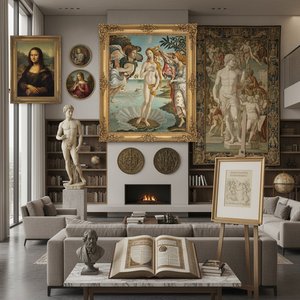
Renaissance Humanism's Greatest Art: 10 Masterpieces for Your Home
Explore 10 Renaissance Humanism masterpieces by Leonardo da Vinci, Michelangelo & Raphael. Discover the stories behind these iconic paintings & sculptures and bring timeless art into your home with museum-quality reproductions from AllPaintingsStore.com. Explore the full collection online!



