

1918. Acrylic On Canvas.

§ 1Catalogue data


§ 2Abstract
藏品详情
Explore Fernand Léger’s ‘Composition of the Medallion’! A dynamic, abstract masterpiece blending Cubism & Surrealism with bold colors & geometric forms. Discover modern art's evolution.
 展开全文
展开全文
艺术家简介
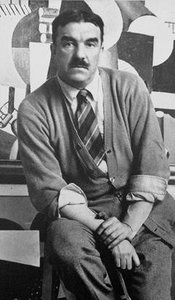
法国艺术家费尔南·莱热(1881-1955),现代主义先驱,以其独特的“筒状主义”和对机械美学的探索而闻名。他的作品融合了抽象与具象,预示着波普艺术的到来,并以大胆的色彩和简化形式描绘现代生活与工业景观。
§ 3Commentary
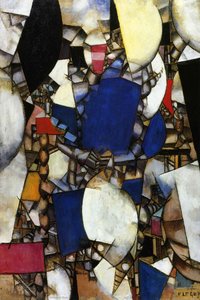
Fernand Léger’s “Composition of the Medallion”: A Symphony of Geometric Form
A Life Forged in Form: The World of Fernand Léger Fernand Léger, born Joseph Fernand Henri Léger in 1881 amidst the rural landscapes of Argentan, Normandy, stands as a pivotal figure in the evolution of modern art. His journey from the farmlands of his youth to the forefront of Parisian avant-garde circles is a testament to an unwavering artistic vision and a relentless pursuit of capturing the spirit of the machine age. Unlike many of his contemporaries who embraced abstraction as a retreat from representation, Léger sought to *integrate* modernity – its dynamism, its mechanical forms, its very essence – into a new visual language that was both powerfully abstract and deeply rooted in the observable world. His early life, steeped in the physicality of agricultural labor, provided a grounding contrast to the industrialized future he would so passionately depict. Initially destined for architecture, Léger’s path shifted towards painting after arriving in Paris around 1900, supporting himself through illustration work while honing his artistic skills.Cubism and Surrealist Influences: Bridging Two Movements
Léger's artistic development was profoundly shaped by the burgeoning movements of Cubism and Surrealism. Initially drawn to Picasso’s pioneering explorations of fractured perspectives – a technique he adopted early in his career – Léger skillfully blended these influences with elements of Surrealist dream imagery. This fusion resulted in canvases that defied conventional notions of realism, prioritizing instead the expressive power of geometric abstraction. The deliberate simplification of forms and the fragmentation of surfaces served not merely as stylistic choices but as conceptual devices aimed at conveying a sense of mechanized repetition and underlying order amidst apparent chaos. Léger wasn’t simply rejecting traditional art; he was actively constructing a new visual vocabulary to articulate the anxieties and aspirations of his time.Technique: Bold Color Palette and Textured Surfaces
Léger's distinctive technique involved applying paint in thick, textured layers—a process known as *impasto*. This method allowed him to imbue his canvases with palpable physicality, mirroring the solidity and rhythm of industrial machinery. He favored a vibrant color palette dominated by reds, yellows, blues, and greens – colors he considered “the colors of the machine.” These hues weren’t blended smoothly but rather juxtaposed boldly, creating visual contrasts that heightened the dynamism of the composition. Léger meticulously crafted surfaces using brushes, knives, and spatulas, achieving remarkable textural variations that enhanced the expressive qualities of his artwork. The resulting canvases pulsate with energy, inviting viewers to engage in a tactile experience alongside their visual perception.Symbolism Within Abstraction: Representing Urban Life
Despite its apparent lack of recognizable imagery, Léger’s “Composition of the Medallion” is laden with symbolic significance. The prominent circles—particularly the large one dominating the upper left corner—represent not merely geometric shapes but also wheels and gears – emblems of industrial progress and relentless movement. These circular forms encapsulate the repetitive cycles inherent in urban life and convey a sense of inescapable momentum. Furthermore, the chair positioned on the right side serves as an anchor point amidst the swirling abstraction, symbolizing human presence within the machine age—a reminder that even amidst technological advancement, humanity retains its grounding in tangible reality. Léger’s intention was to capture not just *what* we see but *how* it feels – the pervasive influence of machinery on our perceptions and experiences.Emotional Impact: Optimism Amidst Uncertainty
Ultimately, “Composition of the Medallion” communicates an enduring message of optimism tempered by awareness of societal anxieties. Léger’s bold color choices and textured surfaces evoke a visceral response, conveying excitement and dynamism while simultaneously hinting at underlying tensions. The artwork's refusal to succumb to sentimentalism speaks to Léger’s conviction that art should confront uncomfortable truths without sacrificing beauty or expressive power. It stands as a testament to the transformative potential of abstraction—its ability to distill complex ideas into compelling visual forms—and invites viewers to contemplate the relationship between humanity and technology in an era defined by rapid industrialization. The painting's enduring appeal lies in its capacity to inspire contemplation and provoke dialogue about our place within the evolving landscape of modern civilization.常见问题与解答
"Composition" 的色彩饱和度如何?
费尔南·莱热 的《Composition》 的色彩呈现出 Subtle Color 的饱和度。饱和度描述了色彩的鲜艳或柔和程度。
《Composition》这一Cubism风格的作品传达了怎样的情感基调?
"Composition" 在 Cubism 运动中蕴含着 Calm 的情感基调。
费尔南·莱热 的《Composition》 的色彩浓郁度如何?
“Composition”的色彩强度为Balanced。强度描述了色彩呈现的浓郁程度。




 切换至版画销售渠道


 对于任何边长超过 105 厘米(约 41 英寸)的艺术品或复制品,画框将以拆解后的组件形式发货。此方法可确保安全送达并防止运输过程中的损坏。


