

Acrylic On Canvas.

§ 1Catalogue data


§ 2Abstract
藏品详情
Discover "The Viaduct" by Fernand Leger – a striking Cubist painting of industrial architecture & movement. Explore this iconic artwork's bold style & timeless appeal.
 展开全文
展开全文
艺术家简介
法国艺术家费尔南·莱热(1881-1955),现代主义先驱,以其独特的“筒状主义”和对机械美学的探索而闻名。他的作品融合了抽象与具象,预示着波普艺术的到来,并以大胆的色彩和简化形式描绘现代生活与工业景观。
§ 3Commentary
A Monument to Modernity: Decoding Léger’s *The Viaduct*
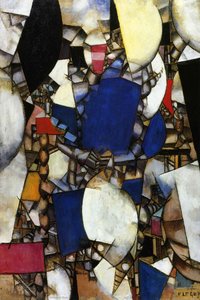
Fernand Léger's The Viaduct isn’t simply a depiction of an industrial scene; it is a bold declaration of faith in the machine age, rendered with his signature “Tubism” – a uniquely powerful evolution of Cubist principles. This painting transforms steel, brick, and the dynamism of transportation into a compelling visual symphony of form and color.
Deconstructing the Scene: Form & Technique
The composition is anchored by a robust, predominantly yellow building dramatically intersected by a viaduct – an elevated railway bridge. A speeding train on the right injects immediate energy and movement. Léger masterfully employs cylindrical forms, breaking down architectural elements and even human figures into simplified geometric shapes. These aren’t merely representations; they are *constructions*, emphasizing the underlying structural logic of the modern world.
Two subtly integrated human figures appear within this mechanical landscape – one positioned near the left edge and another closer to the center. They almost function as components within the larger machine, rather than independent observers, hinting at humanity’s evolving relationship with technology. A clock prominently placed in the top-left corner isn't a mere detail; it symbolizes Léger’s fascination with time, efficiency, and the rhythmic pulse of modern life.
Léger achieves his striking effect through flat planes of color – primarily yellows, reds, blues, and grays – and strong contrasts. He deliberately rejects traditional modeling techniques in favor of a more graphic, almost poster-like approach, enhancing the painting’s visual impact and immediacy.
Historical Context: Embracing the Industrial Revolution
Born in 1881, Léger lived through a period of rapid industrialization. Unlike many artists who mourned the loss of tradition, he wholeheartedly embraced it. He perceived beauty and heroism within machinery, believing it represented a new aesthetic possibility. Developing his distinctive style around 1910, he moved beyond analytical Cubism towards a more figurative and accessible form – “Tubism” – which focused on the inherent structural qualities of objects.
The Viaduct perfectly exemplifies this artistic evolution. It’s not just *about* industry; it's an attempt to capture its very essence, its underlying structure, and its profound impact on human experience. Léger’s work anticipated the Pop Art movement decades later with its embrace of everyday objects and mass-produced imagery.
Symbolism & Emotional Resonance
The painting evokes a sense of dynamism and optimism, yet also carries an undercurrent of detachment. The anonymized figures suggest the individual’s place within the vast industrial system. It's a powerful statement about modernity – its energy, scale, and potential for both progress *and* alienation.
Display & Interior Design Considerations
- Setting: The Viaduct would be stunning in modern or contemporary spaces. Its bold colors and geometric forms complement minimalist interiors.
- Complementary Furniture: Pair it with furniture featuring clean lines and industrial materials like steel, concrete, or polished wood.
- Lighting: A well-lit room is essential to showcase the vibrancy of Léger’s palette. Consider focused lighting to highlight the texture and color variations.
- Scale & Space: Allow ample breathing space around the artwork to maximize its impact. The painting's size (once known) will dictate ideal placement, but avoid overcrowding.
The Viaduct is more than just a painting; it’s a visual manifesto celebrating the beauty and complexity of the modern world – a testament to Fernand Léger’s visionary artistry. It invites viewers to contemplate not only what we build, but also how those creations shape our lives.
常见问题与解答
"The viaduct" 的作者是谁?
"The viaduct" 的创作者是 费尔南·莱热。该作品以 费尔南·莱热 的名义编入目录。
"The viaduct" 适合作为礼物送给谁,又适用于什么场合?
推荐将费尔南·莱热 的《The viaduct》作为送给Birthday的礼物,特别适合用于Statement。您可以将这件艺术品的复制品作为礼品赠送。
费尔南·莱热 的《The viaduct》 在艺术史中处于怎样的地位?
费尔南·莱热 的《The viaduct》 在艺术史上的分类属于 Cubism 运动,创作于 High Medieval 时期。





 切换至版画销售渠道


 对于任何边长超过 105 厘米(约 41 英寸)的艺术品或复制品,画框将以拆解后的组件形式发货。此方法可确保安全送达并防止运输过程中的损坏。


