

1930. Oil On Canvas.

§ 1目录数据


§ 2摘要
藏品详情
“Three musicians” was created in 1930 by Fernand Leger in Naïve Art (Primitivism) style. Find more prominent pieces of genre painting at Wikiart.org – best visual art database.
 展开全文
展开全文
艺术家简介
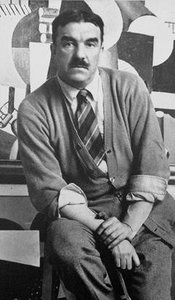
法国艺术家费尔南·莱热(1881-1955),现代主义先驱,以其独特的“筒状主义”和对机械美学的探索而闻名。他的作品融合了抽象与具象,预示着波普艺术的到来,并以大胆的色彩和简化形式描绘现代生活与工业景观。
§ 3赏析
A Rhythmic Convergence of Form and Color
In the pantheon of twentieth-century modernism, few works capture the pulse of the machine age with as much vibrant vitality as Fernand Léger’s "Three Musicians." Completed in 1930, this masterpiece serves as a breathtaking intersection where the raw energy of street performance meets the structured precision of industrial design. At first glance, the viewer is greeted by a trio of figures—a guitarist, a violinist, and a trombonist—whose presence feels less like a static portrait and more like a rhythmic composition in motion. Léger does not merely depict musicians; he orchestrates a visual symphony where every bold line and saturated hue contributes to a larger, melodic movement that resonates far beyond the canvas.
The subject matter, while seemingly grounded in the tradition of genre painting, is transformed through Léger’s unique lens. The figures are constructed from distinct, interlocking shapes that suggest both the organic grace of human performance and the sturdy, unyielding nature of mechanical components. This duality creates a fascinating tension: there is a profound sense of humanity in their musical endeavor, yet they are rendered with a geometric clarity that mirrors the burgeoning industrial landscape of the era. For the collector or interior designer, this piece offers a sophisticated balance, providing a focal point that is simultaneously playful and intellectually stimulating.
The Language of Modernity: Technique and Style
Léger’s approach to "Three Musicians" is a masterful departure from the ethereal abstractions of his contemporaries. Instead of retreating into pure form, he embraced a style often associated with Primitivism and Naïve Art, characterized by an unapologetic clarity and a commitment to direct observation. His technique utilizes bold, primary color blocks—striking reds, deep blues, and luminous yellows—that act as the percussion of the painting. These colors are not merely applied; they are layered with a deliberate texture that provides a tactile quality to the work, inviting the eye to wander across the surface and discover the subtle interplay of light and shadow.
The artist employs a technique reminiscent of trompe-l’œil, using sharp edges and flattened planes to create an illusionistic depth that defies traditional perspective. This method allows the musicians to appear as if they are stepping forward from the canvas, breaking the boundary between the painted world and the viewer's space. The heavy, confident brushwork lends a palpable physicality to the instruments and the figures, ensuring that the artwork possesses a monumental presence. It is this very strength of execution that makes a high-quality reproduction of this piece so impactful in a contemporary setting, as it brings an unmistakable sense of structural integrity and artistic weight to any room.
A Legacy of Industrial Harmony
To understand "Three Musicians" is to understand the soul of the early twentieth century. Léger, born in the rural landscapes of Normandy, was deeply moved by the transition from agricultural life to the mechanical dynamism of Paris. This painting stands as a testament to that evolution, finding beauty in the intersection of the human spirit and the machine. The musicians represent a timeless tradition of communal joy, yet their stylized forms celebrate the progress and precision of a new age. There is an inherent optimism in the work—a belief that even in an increasingly mechanized world, the fundamental rhythms of life and art remain unbreakable.
For those seeking to curate a space with character and historical depth, "Three Musicians" offers unparalleled inspiration. It is a piece that transcends mere decoration; it is an invitation to experience the joy of movement, the boldness of color, and the enduring power of modernism. Whether placed in a minimalist gallery setting or as a vibrant centerpiece in a richly textured interior, this work continues to command attention, reminding us that art, much like music, is a universal language of energy and light.
常见问题与解答
在Naive Art运动中,费尔南·莱热 的《Three musicians》传达了怎样的情感?
"Three musicians" 所蕴含的 Calm 情感,与其 Naive Art 风格相得益彰。
费尔南·莱热 的《Three musicians》 的复制品推荐用于哪些场景?
"Three musicians" 艺术版画的推荐用途为 Accent。
"Three musicians" 的色彩呈现出浓郁还是柔和的视觉感?
费尔南·莱热 的《Three musicians》 中的色彩呈现出 Monochromatic 的强度。


 切换至版画销售渠道


 对于任何边长超过 105 厘米(约 41 英寸)的艺术品或复制品,画框将以拆解后的组件形式发货。此方法可确保安全送达并防止运输过程中的损坏。


