

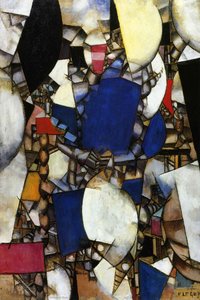
1911. Acrylic On Canvas.

§ 1目录数据


§ 2摘要
藏品详情
 展开全文
展开全文
艺术家简介
法国艺术家费尔南·莱热(1881-1955),现代主义先驱,以其独特的“筒状主义”和对机械美学的探索而闻名。他的作品融合了抽象与具象,预示着波普艺术的到来,并以大胆的色彩和简化形式描绘现代生活与工业景观。
§ 3赏析
Trouville: A Snapshot of Modern Impressionism
Fernand Léger’s “Trouville” (1949) isn't merely a depiction of a seaside town; it’s a distillation of the spirit of the burgeoning modernist movement, capturing a moment frozen in time with remarkable precision and emotional resonance. Executed in monochrome – a deliberate choice reflecting Léger’s fascination with geometric abstraction – this drawing transcends simple representation to convey a palpable sense of dynamism and urban energy. Léger's signature style, Tubism, prioritizes simplified forms and rhythmic lines, mirroring the influence of Cubism on his artistic vision. The scene unfolds against a backdrop of weathered buildings bathed in muted blues and yellows, colors that subtly evoke the Mediterranean light characteristic of Trouville’s coastal landscape.- Style: Tubism – Léger's innovative approach to Cubism championed geometric abstraction while retaining recognizable elements of the subject matter.
- Medium: Charcoal on paper – The artist favored charcoal for its ability to achieve tonal variations and convey texture, lending an immediacy to the composition.
- Composition: Léger skillfully employs overlapping planes and intersecting lines to create a sense of depth and movement, mirroring the rhythm of industrial life.
- Symbolism: The clock symbolizes time and progress – themes central to Léger's exploration of modernity and its relationship to humanity.
- Historical Context: Created during World War II, “Trouville” reflects Léger’s desire to express optimism and resilience amidst the devastation of conflict.





 切换至版画销售渠道


 对于任何边长超过 105 厘米(约 41 英寸)的艺术品或复制品,画框将以拆解后的组件形式发货。此方法可确保安全送达并防止运输过程中的损坏。


