cows
手工油画复制品
由我们的艺术家按需定制,为您提供您所选尺寸及画框的布面手工油画。 ( Switch to Print
Switch to Image)
P118B $10
P118H $10
P118W $10
P438Z $10
P508JH $12
P508YH $12
P805H $10
P805Z $10
P919BZ $10
P919G $10
P919XJ $10
P959ZH $10
P968JZ $12
W106C $8
W218G $10
W218JH $8
W218Y $10
W307PJ $10
W316G $10
W316PJ $8
W316Y $10
W398PJ $8
W4111J $10
W500HY $15
W500JH $15
W692G $12
W849H $8
W940BG $15
W953PJ $8
从与原作比例一致的预设尺寸中进行选择。
您可以输入自定义尺寸,以适配特定的画框或空间。如果所选尺寸与原图比例不符,我们将通过裁剪作品或添加手绘元素来扩展画面。数字样稿将在制作开始前发送给您确认。
请注意,屏幕预览无法准确反映实际的裁剪或扩展效果,只有样稿才能真实呈现最终的构图。
虽然我们提供定制尺寸服务,但为了保留原作比例,建议您从预设列表中选择尺寸。
下单后,AllPaintingsStore.com 团队将通过电子邮件联系客户获取具体要求,并提供效果预览图。
cows
复制材质
复制品尺寸
-
最终总价
$ 258
作品详情
Franz Marc's "Cows": A Symphony of Spirit and Color
Franz Marc’s “Cows,” painted in 1912, is more than just a depiction of livestock; it’s a profound meditation on the soul of nature itself. Executed during a pivotal moment in the development of German Expressionism, this work embodies Marc's deeply held belief that animals possessed an inherent spiritual significance, offering a direct connection to the divine. The painting captures two bovine figures locked in a dynamic struggle, rendered with a bold palette and a confident, almost brutal, application of paint. This isn’t a realistic portrayal of farm animals; it’s a symbolic representation of primal forces – life, death, and the eternal cycle of existence – distilled into form and color.
A Window into Expressionist Philosophy
Created just before Marc's untimely death in 1916, “Cows” reflects the core tenets of Expressionism. Rejecting the objective observation championed by Impressionism and Post-Impressionism, Expressionists sought to convey subjective emotions and inner experiences through art. Marc’s use of intense color – the vibrant yellow of the lion and the rich red of the bull – isn't merely decorative; it’s a deliberate attempt to evoke powerful emotional responses in the viewer. The painting’s raw energy and distorted forms align perfectly with this movement’s desire to express the anxieties and spiritual yearnings of the modern age. The influence of Vincent van Gogh is palpable, particularly in Marc’s expressive brushwork and his commitment to using color to convey mood and feeling.
Technique and Composition
Marc's technique is characterized by thick impasto – a building up of paint that creates a tactile surface. This adds to the painting’s dramatic intensity, emphasizing the physicality of the animals and their struggle. The composition itself is deliberately unbalanced, with the lion dominating the left side and the bull on the right. This asymmetry contributes to the sense of unease and conflict inherent in the scene. The background forest, rendered in muted greens and browns, serves not as a mere backdrop but as an integral part of the narrative, grounding the figures within a wild, untamed landscape. The artist’s meticulous attention to detail, particularly in capturing the textures of fur and muscle, elevates this work beyond simple representation.
Symbolism and Legacy
"Cows" is laden with symbolic meaning. The pairing of the lion and bull – traditionally associated with strength, courage, and aggression – suggests a fundamental struggle within nature itself. Marc frequently used animals to represent spiritual concepts, believing they possessed a purity and innocence unattainable by humanity. This painting’s enduring power lies in its ability to tap into our primal instincts and confront us with questions of existence, mortality, and the relationship between humankind and the natural world. It remains a cornerstone of Marc's oeuvre and a powerful example of Expressionism’s profound impact on 20th-century art.
相似艺术品
艺术家简介
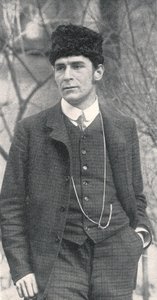
Franz Marc (1880-1916): Pioneer of German Expressionism and the Soulful Vision of Color
Franz Moritz Wilhelm Marc, born on February 8, 1880, in Munich, was a painter whose brief but intensely focused career irrevocably altered the course of German Expressionism. His story is one of profound spiritual seeking translated into a vibrant visual language—a quest to understand the essence of life through the purity he found in the natural world, particularly within the animal kingdom. Initially influenced by his father, Wilhelm Marc, a landscape painter who instilled in him a love for observation and detail, young Franz’s artistic path wasn't immediately certain. He briefly contemplated theology, grappling with questions of faith and existence before ultimately dedicating himself to art at the Academy of Fine Arts in Munich—a decision driven by an innate desire to express inner truths through visual form.Early Influences and Artistic Training
Marc’s formative years were marked by a fascination with Romantic literature and philosophy, mirroring the sensibilities of his time. He studied drawing first with Gabriel Hackl and then painting with Wilhelm von Diez at Munich University—receiving instruction from masters who championed naturalism and studio production. However, it was a transformative encounter with Vincent van Gogh’s paintings during visits to Paris that truly ignited his artistic vision. Van Gogh's expressive use of color and raw emotion resonated deeply with Marc—liberating him from conventional techniques and setting him on a path toward a more subjective and emotionally charged style. This influence is palpable in Marc’s early works, characterized by muted palettes and meticulous attention to detail—reflecting the prevailing artistic trends of his era. He sought to capture not merely what he saw but also *how* he felt—a deeply personal response to the world around him.The Birth of Der Blaue Reiter and Artistic Collaboration
Marc’s artistic development wasn't solitary; it flourished within the dynamic context of Munich’s burgeoning bohemian scene. He experimented with various artist groups, including the Neue Künstlervereinigung München, before co-founding *Der Blaue Reiter* (The Blue Rider) in 1911 alongside Wassily Kandinsky—a pivotal moment that would define his artistic trajectory and solidify his place as a leader of German Expressionism. This wasn’t merely a group or an exhibition series; it was a philosophical and artistic revolution—a concerted effort to move beyond representational art and express inner spiritual truths through abstraction and symbolic color. The journal *Der Blaue Reiter* became a platform for disseminating these ideas, showcasing not only their own work but also that of fellow artists who shared his vision—artists like August Macke and Franz Kupffer—and exploring diverse cultural influences from folk art to primitive sculpture. Marc’s contribution during this period was instrumental in establishing the core tenets of Expressionism: prioritizing emotion over rational observation and utilizing simplified forms and bold colors to convey profound spiritual concepts.Exploring Animal Symbolism and Color Theory
Marc's artistic style is immediately recognizable for its distinctive use of color—a conscious departure from naturalistic conventions that reflected his belief in art’s capacity to transcend the material realm. He eschewed descriptive color palettes, instead employing hues imbued with symbolic meaning—primarily blue (representing spirituality), yellow (signifying joy and femininity), and red (embodied violence and materiality). This systematic approach to color—informed by Kandinsky's theories of color psychology—was a hallmark of his oeuvre and underscored his conviction that art could communicate ideas beyond the literal level. His fascination with animals stemmed from their perceived purity and connection to nature—a perspective rooted in Romantic ideals and mirroring the broader cultural preoccupation with the sublime during his time. Marc’s paintings of horses, deer, foxes, and other creatures are not merely depictions of animals; they are symbolic representations of fundamental human values—innocence, harmony, courage, and vulnerability—expressed through simplified forms and vibrant colors.Legacy and Enduring Influence
Marc's untimely death on March 4, 1916, during the Battle of Verdun—a tragic consequence of his involvement in World War I—marked a devastating loss for the art world but cemented his legacy as one of the most influential figures in modern art history. His work continues to inspire awe and contemplation today—demonstrating the enduring power of art to provoke emotion and engage intellect. Marc’s paintings are exhibited in prominent museums worldwide, including the Lenbachhaus in Munich—where a comprehensive collection showcases the breadth and depth of his artistic vision. He is remembered not only as a pioneer of German Expressionism but also as a visionary artist who dared to explore the profound connection between art, spirituality, and the natural world—a legacy that transcends time and continues to resonate with audiences across generations. His exploration of color symbolism and abstraction remains a cornerstone of artistic thought—a testament to his unwavering belief in art’s ability to illuminate the human condition and inspire transformative insight.马克·弗朗茨
1880 - 1916 , 德国
艺术家简介
- Artistic Movement Or Style: 德國表現主義
- Artists Or Movements Influenced By This Artist: ['抽象藝術']
- Artists Who Influenced This Artist:
- 梵高
- 德拉奧內
- Date Of Birth: 二月八日, eighteen eighty 年
- Date Of Death: 三月四日, nineteen sixteen 年
- Full Name: Franz Moritz Wilhelm Marc
- Nationality: 德國人
- Notable Artworks:
- 紅鹿
- 藍馬塔
- Place Of Birth: 慕尼黑,德國


玻璃选项仅适用于110厘米以下的尺寸。
