100天退款保障 全球免运费
449587艺术品 30613艺术家 4660博物馆 32语言
币种
    语言
      工作室 · 始于2015 · 法国巴黎
      AllPaintingsStore
      allpaintingsstore.com
      Catalogue entry

      Small Composition III

      1914. Tempera, 46.0 x 58.0 cm.

      Fig. 1. 马克·弗朗茨, Small Composition III, 1914. Shown as the reproduction you are specifying: , .

      § 1Catalogue data

      § 2Abstract

      藏品详情

      A vibrant symphony of crimson and geometric fruit shapes defines this 1914 German Expressionist masterpiece by Franz Marc, offering a profound spiritual experience for those looking to bring abstract energy into their home.

      艺术家简介

      德国表现主义先驱弗朗茨·马克的艺术世界!探索他的标志性动物绘画、鲜艳的色彩和深刻的精神主题。他是“蓝骑士”团体的联合创始人,作品充满象征意义,反映了对自然与人性的思考。

      § 3Commentary

      A Symphony in Crimson: The Spiritual Vibrancy of Franz Marc

      In the pantheon of German Expressionism, few works capture the raw, pulsating energy of the early twentieth century quite like Franz Marc’s “Small Composition III.” Painted in 1914, on the precipice of a world about to be transformed by the shadows of war, this masterpiece serves as a profound testament to the artist's quest for spiritual purity. Unlike the Impressionists, who sought to document the fleeting dance of light upon a surface, Marc turned his gaze inward. He utilized the canvas not as a mirror to reality, but as a window into the soul, employing a language of abstraction to communicate truths that words often fail to grasp. Through this work, we encounter a moment of intense chromatic harmony, where the boundaries between object and emotion begin to dissolve.

      The visual journey begins with an arresting, dominant crimson background—a sea of deep red that immediately envelops the viewer in a sense of primal passion and vital force. This is not merely a backdrop; it is the very heartbeat of the composition. Scattered across this fiery expanse is a rhythmic arrangement of organic forms: apples, oranges, and bananas. While these elements may appear as simple still-life subjects at first glance, they are transformed by Marc’s hand into geometric symbols of life and fertility. The way these shapes interact with the red void creates a dynamic tension, a celestial dance where the weight of the fruit is balanced by the ethereal lightness of the surrounding space.

      Technique and the Language of Color

      To appreciate the depth of “Small Composition III,” one must look closely at the meticulous application of tempera paint. Marc’s choice of medium was deliberate, as tempera offers a unique luminosity and a matte, velvety texture that allows colors to appear both saturated and incredibly pure. The artist employed a sophisticated layering technique, building up hues of yellow, orange, and deep red to create a sense of internal glow. This meticulousness results in a surface that feels alive, where the light seems to emanate from within the pigment itself rather than reflecting off it.

      The influence of Cubism is subtly woven into the fabric of the piece, visible in the fractured planes and the simplified, almost architectural, arrangement of the fruit. However, Marc avoids the coldness often associated with purely geometric abstraction. Instead, he infuses these shapes with a sense of organic movement. The composition is governed by an underlying mathematical harmony that feels natural rather than forced, guiding the eye in a continuous loop across the canvas. For the collector or interior designer, this creates a piece that is both intellectually stimulating and visually soothing—a focal point that commands attention through its structural integrity and vibrant warmth.

      An Eternal Legacy for the Modern Space

      Beyond its formal beauty, “Small Composition III” carries an emotional weight that remains profoundly relevant. As a founding member of Der Blaue Reiter (The Blue Rider), Marc sought to find a universal spiritual language through color. In this painting, the interplay of warm tones evokes a sense of optimism and the enduring cycle of nature. It is a work that celebrates existence in its most fundamental, colorful form. For those looking to curate a space with meaning, this artwork offers more than just decoration; it provides an atmosphere of contemplative energy.

      Whether placed in a contemporary gallery setting or as a bold statement piece in a sophisticated residential interior, a high-quality reproduction of this work brings the transformative power of German Expressionism into the home. It invites viewers to pause, to look past the surface, and to reconnect with the primal, beautiful rhythms of the natural world that Marc so passionately sought to immortalize.

      常见问题与解答

      马克·弗朗茨 的《Small Composition III》 的亮度如何?

      "Small Composition III" 的色彩呈现出 Soft Shadow 的亮度。

      马克·弗朗茨 的《Small Composition III》 的对比度表现如何?

      马克·弗朗茨 的《Small Composition III》 在明暗区域之间呈现出 Gentle 的对比度。

      马克·弗朗茨 的《Small Composition III》 的色彩特征是什么?

      马克·弗朗茨 的《Small Composition III》 采用了 Dark 色调,并以 Mahogany (#c93316) 作为主导色。
      § 4The artist

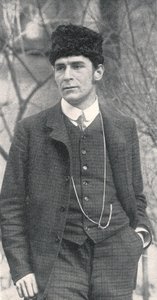
      马克·弗朗茨

      马克·弗朗茨

      1880 - 1916, 德国

      Quick facts about 马克·弗朗茨

      • Artistic Movement Or Style: 德國表現主義
      • Artists Or Movements Influenced By This Artist: ['抽象藝術']
      • Artists Who Influenced This Artist:
        • 梵高
        • 德拉奧內
      • Date Of Birth: 二月八日, eighteen eighty 年
      • Date Of Death: 三月四日, nineteen sixteen 年
      • Full Name: Franz Moritz Wilhelm Marc
      • Nationality: 德國人
      • Notable Artworks:
        • 紅鹿
        • 藍馬塔
      • Place Of Birth: 慕尼黑,德國

      艺术家简介

      Franz Marc (1880-1916): Pioneer of German Expressionism and the Soulful Vision of Color

      Franz Moritz Wilhelm Marc, born on February 8, 1880, in Munich, was a painter whose brief but intensely focused career irrevocably altered the course of German Expressionism. His story is one of profound spiritual seeking translated into a vibrant visual language—a quest to understand the essence of life through the purity he found in the natural world, particularly within the animal kingdom. Initially influenced by his father, Wilhelm Marc, a landscape painter who instilled in him a love for observation and detail, young Franz’s artistic path wasn't immediately certain. He briefly contemplated theology, grappling with questions of faith and existence before ultimately dedicating himself to art at the Academy of Fine Arts in Munich—a decision driven by an innate desire to express inner truths through visual form.

      Early Influences and Artistic Training

      Marc’s formative years were marked by a fascination with Romantic literature and philosophy, mirroring the sensibilities of his time. He studied drawing first with Gabriel Hackl and then painting with Wilhelm von Diez at Munich University—receiving instruction from masters who championed naturalism and studio production. However, it was a transformative encounter with Vincent van Gogh’s paintings during visits to Paris that truly ignited his artistic vision. Van Gogh's expressive use of color and raw emotion resonated deeply with Marc—liberating him from conventional techniques and setting him on a path toward a more subjective and emotionally charged style. This influence is palpable in Marc’s early works, characterized by muted palettes and meticulous attention to detail—reflecting the prevailing artistic trends of his era. He sought to capture not merely what he saw but also *how* he felt—a deeply personal response to the world around him.

      The Birth of Der Blaue Reiter and Artistic Collaboration

      Marc’s artistic development wasn't solitary; it flourished within the dynamic context of Munich’s burgeoning bohemian scene. He experimented with various artist groups, including the Neue Künstlervereinigung München, before co-founding *Der Blaue Reiter* (The Blue Rider) in 1911 alongside Wassily Kandinsky—a pivotal moment that would define his artistic trajectory and solidify his place as a leader of German Expressionism. This wasn’t merely a group or an exhibition series; it was a philosophical and artistic revolution—a concerted effort to move beyond representational art and express inner spiritual truths through abstraction and symbolic color. The journal *Der Blaue Reiter* became a platform for disseminating these ideas, showcasing not only their own work but also that of fellow artists who shared his vision—artists like August Macke and Franz Kupffer—and exploring diverse cultural influences from folk art to primitive sculpture. Marc’s contribution during this period was instrumental in establishing the core tenets of Expressionism: prioritizing emotion over rational observation and utilizing simplified forms and bold colors to convey profound spiritual concepts.

      Exploring Animal Symbolism and Color Theory

      Marc's artistic style is immediately recognizable for its distinctive use of color—a conscious departure from naturalistic conventions that reflected his belief in art’s capacity to transcend the material realm. He eschewed descriptive color palettes, instead employing hues imbued with symbolic meaning—primarily blue (representing spirituality), yellow (signifying joy and femininity), and red (embodied violence and materiality). This systematic approach to color—informed by Kandinsky's theories of color psychology—was a hallmark of his oeuvre and underscored his conviction that art could communicate ideas beyond the literal level. His fascination with animals stemmed from their perceived purity and connection to nature—a perspective rooted in Romantic ideals and mirroring the broader cultural preoccupation with the sublime during his time. Marc’s paintings of horses, deer, foxes, and other creatures are not merely depictions of animals; they are symbolic representations of fundamental human values—innocence, harmony, courage, and vulnerability—expressed through simplified forms and vibrant colors.

      Legacy and Enduring Influence

      Marc's untimely death on March 4, 1916, during the Battle of Verdun—a tragic consequence of his involvement in World War I—marked a devastating loss for the art world but cemented his legacy as one of the most influential figures in modern art history. His work continues to inspire awe and contemplation today—demonstrating the enduring power of art to provoke emotion and engage intellect. Marc’s paintings are exhibited in prominent museums worldwide, including the Lenbachhaus in Munich—where a comprehensive collection showcases the breadth and depth of his artistic vision. He is remembered not only as a pioneer of German Expressionism but also as a visionary artist who dared to explore the profound connection between art, spirituality, and the natural world—a legacy that transcends time and continues to resonate with audiences across generations. His exploration of color symbolism and abstraction remains a cornerstone of artistic thought—a testament to his unwavering belief in art’s ability to illuminate the human condition and inspire transformative insight.

      § 5Comparanda

      § 6Questions

      作品详情

      • Artistic style: Abstract Expressionism
      • Subject or theme: Still life
      • Movement: Expressionism
      • Title: Small Composition III
      • Dimensions: 46 x 58 cm
      • Year: 1914

      艺术知识测试

      每道题只有一个正确答案。

      题目 1:
      What is the primary background color used in 'Small Composition III'?
      题目 2:
      Which medium did Franz Marc use to achieve a unique luminosity and matte texture in this work?
      题目 3:
      What types of organic forms are scattered across the red background?
      题目 4:
      In which year was 'Small Composition III' painted?
      题目 5:
      Which art movement is Franz Marc associated with?

      § 7Cite this entry

      AllPaintingsStore.com, “马克·弗朗茨, Small Composition III (1914)”, https://allpaintingsstore.com/zh/art/franz-marc-small-composition-iii-8BWPUM-en/ (accessed 2 October 2026).

      § 8The reproduction

      手工油画复制品

      由我们的艺术家按需定制,为您提供您所选尺寸及画框的布面手工油画。 ( 切换至版画销售渠道 切换至数字图像销售渠道)

      It is specified on the order sheet in the margin; the present state of that sheet reads as follows.

      Small Composition III

      复制品材质

      复刻品尺寸

      -

      精选资深艺术家

      更丰富的细节、更精湛的工艺以及更充裕的制作时间

      -

      复制画装裱选项

      -

      -

      对于任何边长超过 105 厘米(约 41 英寸)的艺术品或复制品,画框将以拆解后的组件形式发货。此方法可确保安全送达并防止运输过程中的损坏。

      需由专业人员组装 —— 本产品不适用于 DIY 操作。
      该组件必须由经验丰富的专业装裱师进行组装及画布绷装,过程中需使用木工胶(不随附)、画布绷边钳以及夹具,以确保在胶水干燥期间保持内框方正。组装不当或画布张力不均可能会对艺术品造成永久性损坏,且此类情况不在我们的保修范围之内。

      • 包含所有实木条,尺寸精确,便于组装。

      • 使用随附的螺丝进行组装,另需准备用于角部连接的木工胶(本品不含木工胶),请由您的装裱师自行准备。

      • 需另备专业工具(本套件不含):画布绷紧钳以及用于在胶水干燥过程中保持木条方正的夹具。

      重要提示:
      角部连接处需要使用木工胶,边框条必须使用夹具固定直至胶水完全干透,且在组装好的框架上绷紧画布需要用到画布拉伸钳。以上工具均不包含在套装内。请在订购此尺寸前,预先联系经验丰富的专业装裱师。

      展品铭牌

      -

      -

      保护性清漆

      光泽清漆(提亮色彩,防光防潮)

      -

      定制我的艺术品

      定制化示例:替换面部为客户照片;添加宠物(例如,将猫替换为狗);在背景中加入隐藏信息;更改背景风景或元素。

      -

      加急

      全球配送()仅需 3-4 周即可送达,无需等待标准时效的 5 周。(31 October)。品质始终如一,绝不妥协。

      -

      极速达

      全球配送(),预计 5 周送达。(7 November)。

      已包含

      最终结算价

      ¥ 1732

      Included with every order

      • 全球免运费特快专递服务
      • 优质亚麻画布
      • 全程运输保险
      • 关税退款保证
      • 色彩精准还原保证
      • 100天退货保障(仅限制造缺陷)
      • 100% 退款保证
      • 多件购买优惠
      Order sheet