

1996. Acrylic On Canvas, 51.0 x 46.0 cm.

§ 1Catalogue data
 Acrylic On Canvas
- WallArt
- Contemporary Realism
 1996
1996- Contemporary
 51.0 x 46.0 cm
 了解更多
了解更多§ 2Abstract
藏品详情
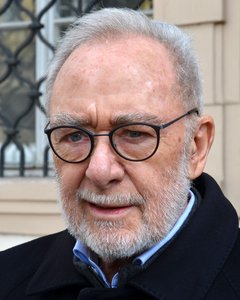
Explore Gerhard Richter's haunting 1996 self-portrait – a blurred, introspective study of identity and uncertainty. This oil on canvas captures the artist’s quiet contemplation, reflecting his complex life and artistic legacy.
艺术家简介
德国艺术家格哈德·里希特(Gerhard Richter),以抽象画和照片写实主义绘画闻名,作品探索记忆、身份与历史。他的“资本主义现实主义”挑战艺术规范,色彩图谱等系列作品极具影响力,是当代艺术的重要代表。
§ 3Commentary
Gerhard Richter’s ‘Self-Portrait’: A Study in Uncertainty and Reflection
Gerhard Richter's 1996 self-portrait is not merely a depiction of a man; it’s an embodiment of the anxieties and ambiguities that defined much of his oeuvre. This particular work, rendered in oil on linen and measuring a modest 51 x 46 cm, feels both intensely personal and profoundly detached, mirroring the artist's own complex relationship with representation and memory. The photograph itself – blurry, almost indistinct – immediately establishes an atmosphere of uncertainty. Richter deliberately obscures sharp detail, employing a technique he would later famously refine into his ‘photo-paintings,’ where he layers photographic images onto canvas, manipulating their source material to create works that are simultaneously familiar and unsettling. The subject, a man in a white shirt and tie, appears almost lost within the haze, his eyes holding a serious, contemplative gaze – a gaze that seems to question not just the viewer, but perhaps also himself.
A Life Shaped by Division: Contextualizing Richter’s Early Years
To fully appreciate this self-portrait, it's crucial to understand the formative experiences that shaped Gerhard Richter’s artistic vision. Born in Dresden in 1932, his childhood unfolded during a period of immense upheaval – the rise of Nazism and subsequent displacement. His family moved repeatedly throughout the war years, an experience that instilled within him a deep-seated sense of instability and a questioning spirit. This early exposure to political turmoil and social disruption profoundly influenced his later work, often characterized by a deliberate ambiguity and a refusal to offer definitive answers. Richter’s father, a schoolteacher navigating the complexities of life under authoritarian rule, and his mother, fostering a love for literature and music within their home, created a duality – a pragmatic acceptance of circumstance alongside a yearning for cultural expression—a tension that would become a recurring theme in his art. The landscapes of Reichenau and Waltersdorf, initially idyllic, were irrevocably altered by conflict, leaving an indelible mark on his psyche.
Technique and the Illusion of Reality: Richter’s ‘Photo-Paintings’
Richter's approach to painting is notoriously complex. He doesn’t simply replicate what he sees; instead, he engages in a process of layering and manipulation. This self-portrait exemplifies his signature technique – the ‘photo-painting.’ He begins with photographic images, often sourced from newspapers or magazines, which he then applies to canvas using thin layers of oil paint. The resulting surface is not smooth and polished but rather textured and fragmented, creating an illusion of reality that is simultaneously present and absent. The blur in this particular portrait isn’t a flaw; it's a deliberate choice, intensifying the sense of detachment and inviting the viewer to actively participate in constructing meaning. The subtle shifts in color and tone suggest movement and change, mirroring the instability inherent in memory and experience.
Symbolism and Emotional Resonance: A Portrait of Contemplation
While Richter’s work often resists straightforward interpretation, this self-portrait offers a glimpse into the artist's internal landscape. The man’s serious expression suggests introspection and perhaps even melancholy. The blurred features contribute to a sense of anonymity, transforming the portrait from a simple likeness into a meditation on identity and perception. It’s not a triumphant declaration of self but rather a quiet acknowledgment of one’s place within the world – a recognition of uncertainty and the difficulty of capturing a definitive truth. The photograph's lack of background further emphasizes this feeling of isolation, drawing all attention to the subject himself. Ultimately, Richter’s ‘Self-Portrait’ is a powerful reminder that art can be more than just representation; it can be an exploration of the complexities of human experience and the elusive nature of reality.
Further Information: Explore Gerhard Richter's work at The Metropolitan Museum of Art or delve deeper into his artistic journey on Wikipedia.
常见问题与解答
格哈德·里希特 的《Self-portrait》中的主导色调是什么?
Green to Violet Spectrum 色调贯穿了 格哈德·里希特 的《Self-portrait》。
格哈德·里希特 的《Self-portrait》 的视觉明亮度如何?
就视觉亮度而言,格哈德·里希特 的《Self-portrait》 呈现出 deep_shadow 的效果。
格哈德·里希特 的《Self-portrait》 的创作年代与艺术风格是什么?
格哈德·里希特 的《Self-portrait》创作于1996年,属于Contemporary Realism流派。


 切换至版画销售渠道


 对于任何边长超过 105 厘米(约 41 英寸)的艺术品或复制品,画框将以拆解后的组件形式发货。此方法可确保安全送达并防止运输过程中的损坏。


