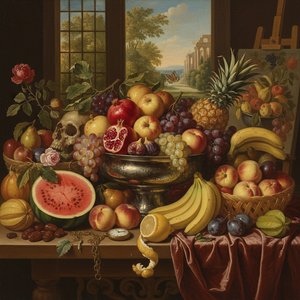
1563. Oil On Canvas, 67.0 x 51.0 cm. Kunsthistorisches Museum.

§ 1目录数据

- 67.0 x 51.0 cm


§ 2摘要
藏品详情
Discover Giuseppe Arcimboldo’s ‘Winter’! A stunning Mannerist oil painting of a tree-figure, rich in detail & symbolism. Explore this unique artwork's beauty & historical significance.
 展开全文
展开全文
艺术家简介
Giuseppe Arcimboldo (1527-1593) 是一位意大利曼尼尔主义画家,以其将水果、蔬菜和物品巧妙组合成人物肖像而闻名。他的作品充满奇思妙想,富含象征意义,是文艺复兴时期独特的艺术表达,对后世超现实主义绘画产生了深远影响。
§ 3赏析
A Frozen Tableau: The Surreal Majesty of Winter
In the quiet, chilling depths of Giuseppe Arcimboldo’s Winter, we encounter one of the most profound enigmas of the Late Renaissance. Painted around 1563, this masterpiece does not merely depict a season; it breathes life into an allegory of survival and transformation. At first glance, the viewer is met with a striking, anthropomorphic figure—a creature born from the very essence of the earth’s dormant period. This is not a traditional portrait of flesh and bone, but a surrealist precursor that uses the textures of nature to construct a human likeness. The composition centers on a tree-like entity emerging from a woven wicker basket, creating a sense of grounded, organic weight that commands the room. It is a work that demands a second, third, and fourth look, rewarding the observant eye with a hidden world of intricate detail.
The technique employed by Arcimboldo is nothing short of miraculous, showcasing a mastery of Mannerist precision. Using oil paints on canvas, the artist meticulously layered pigments to achieve a tactile richness that feels almost sculptural. One can trace the rugged, furrowed bark of the branches and the delicate, frost-like textures of the foliage through his expert brushwork. The lighting is intentionally dramatic, casting deep shadows against an abyssal black background, which serves to push the illuminated subject forward into the viewer's space. This high-contrast approach, reminiscent of later chiaroscuro, lends the piece a theatrical intensity, making the organic forms appear to glow with an inner, ancient light.
Symbolism and the Cycle of Existence
Beyond its visual trickery, Winter is steeped in the complex intellectual currents of the 16th century. To the Renaissance mind, every element was a vessel for meaning. The choice of a tree-like figure emerging from a basket suggests the concept of latent life—the idea that even in the dead of winter, the seeds of spring are held in a state of suspended animation. The fruits and organic shapes nestled within the composition act as symbols of abundance and the cyclical nature of time, representing the transition between decay and rebirth. For the collector or interior designer, this piece offers more than mere decoration; it provides a profound philosophical anchor, evoking themes of resilience, patience, and the enduring strength of the natural world.
The emotional impact of the artwork is a delicate balance of mystery and unsettling beauty. There is a certain melancholic grandeur in the way the figure stands solitary against the darkness, yet there is also an undeniable sense of wonder. It is a piece that invites contemplation, making it an ideal centerpiece for a sophisticated study, a grand library, or a curated gallery space. As a high-quality reproduction, this painting brings the whimsical yet profound spirit of Arcimboldo into the modern home, offering a window into a time when art was a puzzle to be solved and a mirror held up to the mysteries of the universe.
常见问题与解答
朱塞佩·阿尔钦博尔多 (Zhū Sèipèi Ā'Ěrqīnbó'Ěrduō) 的《Winter》 的观众来自哪里?
关于 朱塞佩·阿尔钦博尔多 (Zhū Sèipèi Ā'Ěrqīnbó'Ěrduō) 的《Winter》 的统计数据可在该作品的 访问统计 页面查看:包括作品的每月访问量、艺术家其他作品的访问量,以及近期访客的国家和语言分布情况。
"Winter" 的色彩饱和度如何?
"Winter" 的色彩饱和度为 Subtle Color。
朱塞佩·阿尔钦博尔多 (Zhū Sèipèi Ā'Ěrqīnbó'Ěrduō) 的《Winter》 的创作年份是哪一年?
朱塞佩·阿尔钦博尔多 (Zhū Sèipèi Ā'Ěrqīnbó'Ěrduō) 的《Winter》 创作于 1563 年。


 切换至版画销售渠道


 对于任何边长超过 105 厘米(约 41 英寸)的艺术品或复制品,画框将以拆解后的组件形式发货。此方法可确保安全送达并防止运输过程中的损坏。