

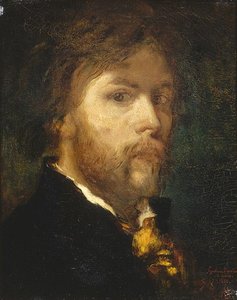
1887. Acrylic On Canvas.

§ 1Catalogue data


§ 2Abstract
藏品详情
 展开全文
展开全文
艺术家简介
莫罗(1826-1898)是法国象征主义绘画的杰出代表,以其《沙乐美》等神话题材和圣经故事作品闻名。他的画作充满梦幻色彩、神秘符号和华丽细节,对马蒂斯和鲁奥等后代艺术家产生了深远影响,是19世纪艺术史上的重要人物。
§ 3Commentary
A Dream Weaver's Echoes: Gustave Moreau’s Cleopatra
Gustave Moreau (1826-1898) stands apart from the luminaries of his era—Impressionism and Realism—as a true visionary of Symbolist painting. Rather than striving for immediate visual sensation, Moreau embarked on a profound quest to translate inner experience into tangible form, channeling mythology, religion, and psychology into canvases imbued with an otherworldly beauty. His oeuvre is characterized by meticulous detail, muted palettes dominated by earthy tones accented by flashes of iridescent color, and a deliberate rejection of conventional perspective—techniques that deliberately obscure reality in favor of conveying emotional resonance and spiritual contemplation. Moreau’s artistic journey began within the framework of academic training at the École des Beaux-Arts, where he honed his draughtsmanship under François Édouard Picot, yet swiftly abandoned these established conventions to forge his own distinctive path toward artistic expression.- Subject Matter & Narrative
- Symbolism and Mythological Resonance
- Technique: Watercolor Mastery
- Historical Context: The Spirit of Symbolism
- Emotional Impact: A Portrait of Contemplation
Subject Matter & Narrative
Moreau’s “Cleopatra” depicts a woman seated upon a weathered stone wall, her head resting gently on the shoulder of an unseen companion. The scene unfolds within the evocative setting of ancient Egypt, subtly reinforced by the presence of a monumental sphinx statue—a symbol of wisdom and royal authority—positioned in the background. This deliberate juxtaposition speaks to Moreau’s fascination with archetypal narratives and his desire to explore themes of power, vulnerability, and timeless beauty. Unlike Impressionist depictions focused on fleeting moments of observation, Moreau's composition invites viewers into a realm of psychological introspection, prompting contemplation about identity, memory, and the enduring influence of mythic figures.Symbolism and Mythological Resonance
The painting’s symbolism extends far beyond its immediate visual elements. The woman herself embodies idealized femininity—a figure draped in luxurious fabrics and adorned with elaborate hairstyles—representing not merely physical attractiveness but also spiritual grace and inner strength. Moreau skillfully employs color to heighten the emotional impact of the scene, favoring hues that evoke a sense of melancholy and serenity. The sphinx statue serves as a conduit for ancient wisdom and divine judgment, anchoring the narrative within the broader context of Egyptian mythology and reinforcing the painting’s contemplative mood. Furthermore, the inclusion of potted plants—likely symbolic representations of fertility and renewal—adds another layer of meaning to the composition.Technique: Watercolor Mastery
Moreau's mastery of watercolor is evident in every brushstroke. He achieved remarkable luminosity and textural depth through painstaking layering of translucent washes, meticulously blending colors to create subtle gradations and capturing the nuances of light and shadow with exceptional precision. The artist’s meticulous attention to detail—particularly in rendering the woman’s hair—demonstrates his unwavering commitment to conveying a sense of realism within an idealized framework. This technique allowed Moreau to capture the ethereal quality characteristic of Symbolist art, prioritizing atmosphere and emotional expression over photographic accuracy.Historical Context: The Spirit of Symbolism
“Cleopatra” emerged during the zenith of Symbolism—a movement that rejected materialism and embraced spirituality as guiding principles. Influenced by Nietzsche’s philosophy and Wagnerian opera, Moreau sought to liberate art from the constraints of realism, prioritizing subjective experience and psychological exploration. He aligned himself with fellow Symbolist artists like Alexandre Cabanel and Gustave Brion, establishing a collective dedicated to reviving medieval artistic traditions and delving into the realms of dreams and subconsciousness. Moreau's work stands as a testament to this transformative period in European art history—a defiant assertion of imagination and emotion against the prevailing tide of scientific rationalism.Emotional Impact: A Portrait of Contemplation
Ultimately, “Cleopatra” transcends mere visual representation; it invites viewers into a state of profound contemplation. The woman’s serene repose and the subtle melancholy conveyed by Moreau's palette evoke feelings of wistful beauty and timeless grace. More than simply depicting a historical figure, Moreau captures an essence—a moment of inner stillness amidst the grandeur of mythic past. This enduring emotional resonance underscores the power of Symbolist art to communicate universal themes of longing, vulnerability, and spiritual yearning—themes that continue to captivate audiences today.常见问题与解答
"Cleopatra" 采用了什么技法,创作于何时?
古斯塔夫·莫罗 的《Cleopatra》 的创作媒介为 Acrylic On Canvas,创作于 1887 年。
古斯塔夫·莫罗 的《Cleopatra》 为室内空间增添了怎样的氛围?
古斯塔夫·莫罗 的《Cleopatra》 营造出一种 Ethereal 的氛围,推荐用于 Living Room。作品的情绪感即是其为周围空间带来的意境。
"Cleopatra" 的材质是什么,采用了哪种风格?
古斯塔夫·莫罗 的《Cleopatra》 将 Acrylic On Canvas 技法与 Symbolist Painting 流派风格完美融合。技法与流派分别描述了作品的创作手法及其艺术风格。


 切换至版画销售渠道


 对于任何边长超过 105 厘米(约 41 英寸)的艺术品或复制品,画框将以拆解后的组件形式发货。此方法可确保安全送达并防止运输过程中的损坏。


