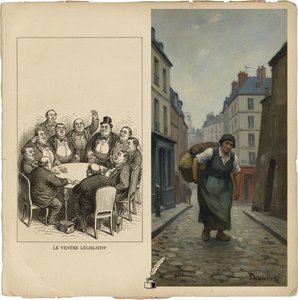
1865. Acrylic On Canvas, 65.0 x 90.0 cm. 加拿大国家美术馆.

§ 1Catalogue data
 Acrylic On Canvas
- WallArt
- Realism
 1865
1865- 19th Century
 65.0 x 90.0 cm
 加拿大国家美术馆
§ 2Abstract
藏品详情
Honoré Daumier’s poignant 1865 black and white depiction of third-class train passengers captures a slice of Victorian life with realistic detail and social commentary, offering a captivating glimpse into travel and human connection. Discover this exquisite hand-painted reproduction.
 展开全文
展开全文
艺术家简介
奥诺雷·达米埃 (1808-1879) 是法国现实主义大师,以尖锐的社会讽刺而闻名。他的版画、绘画和雕塑深刻批判了19世纪的社会百态,影响了现代艺术的发展。探索他对波西米亚生活、法律体系和政治人物的独特见解。
§ 3Commentary
Honoré Daumier’s ‘The Third-Class Carriage’: A Chronicle of Urban Life
Honoré Daumier's 1865 painting, “The Third-Class Carriage,” is more than a simple depiction of a train journey; it’s a poignant snapshot of mid-19th century French society, rendered with the artist’s characteristic blend of realism and social commentary. Measuring 65 x 90 cm, this black and white composition immediately draws the viewer into the cramped confines of a third-class railway car, capturing a moment of everyday life that speaks volumes about class divisions and the burgeoning urbanization of France during the Second Empire.
- Subject Matter: The scene meticulously portrays passengers in a third-class train carriage. The focus is on the ordinary individuals – their postures, expressions, and belongings – revealing a slice of life rarely afforded attention in formal portraiture.
- Composition: Daumier’s masterful use of perspective creates a sense of claustrophobia, emphasizing the density of the space and the close proximity of the travelers. The arrangement of luggage—suitcases, handbags, and personal effects—adds to the feeling of lived-in authenticity.
Daumier's Artistic Style and Technique
Daumier’s style is immediately recognizable through his meticulous draftsmanship and a deliberate avoidance of idealized beauty. He was deeply influenced by artists like Rubens, particularly in his use of dramatic lighting (chiaroscuro) to sculpt forms and create mood. In “The Third-Class Carriage,” this influence is evident in the strong contrasts between light and shadow, which highlight the textures of the benches, luggage, and clothing. The artist’s technique relies on precise lines and detailed observation, reflecting his commitment to capturing reality with unflinching honesty. His work was often characterized by a rough, almost sketch-like quality, contributing to its raw emotional impact.
Historical Context: A Nation in Transition
Painted in 1865, “The Third-Class Carriage” reflects the significant social and political changes occurring in France during this period. The rapid growth of Paris and other industrial centers led to a massive influx of rural populations seeking work and opportunity – often finding themselves crammed into overcrowded, poorly maintained train cars like the one depicted here. Daumier’s work aligns with the broader trend of Realist art, which sought to depict everyday life without romanticizing or idealizing it. The painting subtly critiques the social inequalities inherent in this transition, offering a glimpse into the lives of those marginalized by industrialization and urbanization.
Symbolism and Emotional Impact
Beyond its documentary value, “The Third-Class Carriage” possesses a powerful symbolic resonance. The presence of a woman holding a baby amidst the bustling crowd evokes themes of family, vulnerability, and the challenges faced by working-class families. The scattered luggage represents not just possessions but also dreams, aspirations, and the burdens carried on journeys – both literal and metaphorical. The overall mood is one of quiet observation, inviting viewers to contemplate the lives of these anonymous individuals and consider their place within a rapidly changing society. This artwork’s enduring appeal lies in its ability to capture a fleeting moment of human experience with remarkable sensitivity and artistic skill.
常见问题与解答
在“The Third-class Carriage”中,融合了怎样的心境与情感?
在“The Third-class Carriage”中,Dramatic 的氛围伴随着 Melancholic 的情感。
"The Third-class Carriage" 是何时以及使用什么材料创作的?
奥诺雷·达米埃 的《The Third-class Carriage》 的创作媒介为 Acrylic On Canvas,创作于 1865 年。
这幅 奥诺雷·达米埃 的《The Third-class Carriage》 的复制品会为房间增添怎样的氛围?
奥诺雷·达米埃 的《The Third-class Carriage》 营造出 Dramatic 的氛围,与推荐的陈设空间——Living Room 完美契合。


 切换至版画销售渠道


 对于任何边长超过 105 厘米(约 41 英寸)的艺术品或复制品,画框将以拆解后的组件形式发货。此方法可确保安全送达并防止运输过程中的损坏。