


 效果预览
效果预览
 购买手绘画作
 分享
分享 分享
分享
 详情
详情

 下载
下载
 相似作品
相似作品 X射线
X射线 幻灯片播放
幻灯片播放Untitled
 Abstract Expressionism
 1964
1964 152.0 x 127.0 cm
 展开详情
展开详情




































从与原作比例一致的预设尺寸中进行选择。

您可以输入自定义尺寸,以适配特定的画框或空间。如果您选择的尺寸与原图比例不符,我们将对作品进行裁剪,或通过镜像填充/纯色填充边缘的方式来扩展图像。在开始制作之前,我们会向您发送一份数字效果图供您确认。
请注意,屏幕上的预览并不能反映实际的裁剪或扩展效果。只有效果图才能准确展示最终的构图。
虽然我们提供定制尺寸,但为了保持原图比例,我们建议您从预设列表中选择尺寸。


 玻璃选项仅适用于110厘米以下的尺寸。

Untitled
艺术微喷/版画
复制品尺寸
-


最终总价
$ 64
藏品详情
Lorser Feitelson's "Untitled": A Study in Abstract Classicism
- Artwork: Untitled
- Artist: Lorser Feitelson
- Date: 1964
- Dimensions: 152 x 127 cm
A Vision of Order and Flow
Lorser Feitelson’s "Untitled" (1964) is a captivating example of California Hard-Edge painting, showcasing the artist's unique approach to abstraction. The artwork presents a serene composition centered around flowing yellow lines that gracefully intersect within a roughly rectangular space against a subtly textured off-white background. A prominent circle anchors the design near its center, from which these lines radiate outwards, creating a sense of movement and dynamism despite the minimalist aesthetic. The piece isn't about depicting recognizable objects; instead, it invites contemplation through the interplay of form, line, and color. The lighting is soft and diffused, contributing to an overall feeling of calm and serenity. Perspective is implied through subtle tonal variations and overlapping lines, suggesting a receding space within the abstract field.The Artist and His Influences
Lorser Feitelson (1898-1978) was born in Savannah, Georgia, but spent his formative years in New York City. He relocated to Southern California in 1927, a move that profoundly shaped his artistic development. Initially influenced by Cubism and Surrealism, Feitelson quickly forged his own distinct style, characterized by geometric precision and evocative color relationships. He was part of a group known as the ‘Four Abstract Classicists,’ alongside Helen Lundeberg, demonstrating a shared commitment to clarity, order, and intellectual rigor in their abstract works. His earlier pieces like "Magical Space Forms" (1951) exemplify this period, blending geometric elements with evocative color palettes. Feitelson’s work stands apart from the gestural abstraction of the New York School, emphasizing instead a controlled and deliberate approach to form and composition.Technique and Materials
Feitelson's technique in "Untitled" is marked by its fluidity and precision. The yellow lines are painted with varying thicknesses, adding visual interest and emphasizing their movement across the canvas. Brushstrokes are largely absent, suggesting a carefully considered application of paint – likely oil or acrylic – to achieve smooth transitions and organic shapes. The subtle texture of the background, possibly from the canvas weave or an applied layer of paint, provides a gentle contrast to the smoother appearance of the lines. This interplay of textures enhances the depth and visual complexity of the composition.Symbolism and Emotional Resonance
While abstract, "Untitled" is rich in potential symbolic meaning. The central circle can be interpreted as representing wholeness, continuity, or unity. The flowing yellow lines evoke feelings of movement, energy, and interconnectedness, creating a sense of rhythm and flow within the artwork. The restrained color palette – primarily variations of yellow against an off-white background – contributes to the piece's quiet contemplation and understated elegance. This work is not merely a visual exercise; it’s an invitation to experience a moment of calm reflection and appreciate the beauty of abstract form.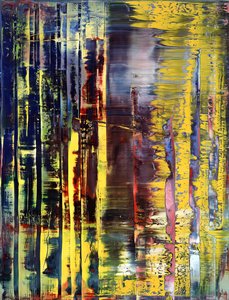
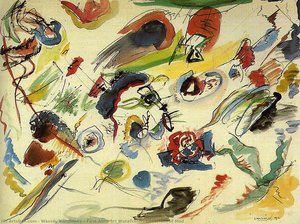
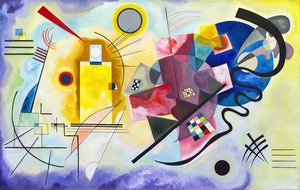


![Abstract Composition [triptych] — Vaclav Vytlacil, Abstract Expressionism](/media/artworks/images/thumbnails/e5/3d/e53db42ea02644b9a8e722f9d4dd3742.jpg)


艺术家简介
Lorser Feitelson: A Pioneer of California Hard-Edge Painting
Early Life and Education
- Born: 1898 in Savannah, Georgia.
- Feitelson’s family relocated to New York City shortly after his birth, where he was raised.
- Details regarding his formal art education are limited, but he developed a strong foundation in artistic principles early on.
Move to California and Artistic Development
- In 1927, Feitelson moved to Southern California, a pivotal moment that shaped his artistic trajectory.
- He began exploring abstraction, moving away from representational styles. His early work showed influences of Cubism and Surrealism but quickly evolved into something distinctly his own.
- Magical Space Forms (1951) exemplifies this period, showcasing a unique blend of geometric precision and evocative color relationships.
The ‘Four Abstract Classicists’ and Hard-Edge Painting
- Feitelson gained significant recognition as one of the “Four Abstract Classicists” alongside Karl Benjamin, Frederick Hammersley, and John McLaughlin.
- This group was featured in a landmark 1959 exhibition at the San Francisco Museum of Modern Art (and later LACMA), curated by Jules Langsner.
- The exhibition introduced the public to the emerging style of Hard-edge painting, characterized by clean lines, flat planes of color, and precise execution.
- A revised version titled “West Coast Hard Edge” was presented in London and Belfast, further solidifying the movement’s international recognition.
Influences and Artistic Philosophy
- While influenced by earlier movements like Cubism and Surrealism, Feitelson developed a unique visual language rooted in clarity, order, and geometric abstraction.
- He rejected the psychological introspection of Abstract Expressionism prevalent in New York, instead focusing on externalizing experience through form and color.
- Dave Hickey, a contemporary art writer, described Feitelson and his peers as creating an art that granted “the privilege of their sanity” by grounding it in the physical and social world rather than subjective emotion.
- His wife, Helen Lundeberg, was also a significant artist who influenced his work and shared similar artistic concerns.
Major Achievements and Historical Significance
- Feitelson played a crucial role in establishing California as a major center for abstract art, distinct from the New York School.
- His work was included in the influential “Birth of the Cool: California Art, Design and Culture at Midcentury” exhibition at the Orange County Museum of Art.
- Hickey famously dubbed Feitelson and his contemporaries as "The Los Angeles School," recognizing their profound contribution to American abstract painting.
- Feitelson’s legacy lies in his pioneering approach to Hard-edge painting, his commitment to clarity and precision, and his role in shaping the artistic landscape of Southern California.
Death and Legacy
- Died: 1978.
- Lorser Feitelson’s work continues to be exhibited and studied, cementing his place as a significant figure in the history of American abstract art. His influence can still be seen in contemporary artists exploring geometric abstraction and hard-edge techniques.

Lorser Feitelson
1898 - 1978 , United States of America
艺术家简介
- Birth Date: 1898
- Birth Place: Savannah, United States of America
- Death Date: 1978
- Movement: Hard-edge painting, Abstract Classicism
- Name: Lorser Feitelson
- Nationality: American
- Notable Works: Magical Space Forms
相关文章

Strategic Sourcing of Premium Abstract Art for High-Impact Commercial Interiors and Large-Scale Hotel Projects
Streamline your commercial art procurement with our expert guide to sourcing premium abstract art for hotel and large-scale projects. Discover professional solutions for custom sizing, multi-panel layouts, and reliable bulk ordering designed for hospitality designers.

Expressionist Abstraction: A Procurement Guide to Bold Colors and Emotional Impact for Modern Hotel Interiors
Elevate hospitality spaces with Expressionist Abstraction. A professional procurement guide for hotel designers on sourcing bold, large-scale abstract oil paintings to create impactful, high-end modern interiors through reliable bulk-order art solutions.



