

布面油画.

§ 1Catalogue data


 了解更多
了解更多§ 2Abstract
藏品详情
Explore Marcel Duchamp’s ‘Paradise,’ a captivating Post-Impressionist oil painting depicting Adam & Eve. Discover its cubist influence, bold colors, and unsettling symbolism at the Philadelphia Museum of Art.
艺术家简介
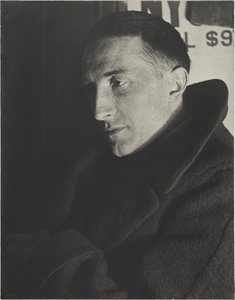
布莱尼维尔-苏尔-默 法国 马塞尔·杜尚 罗丝·塞拉维 挑战艺术定义的革命性艺术家杜尚,以达达主义和《泉》等现成品闻名。探索他的标志性作品及其哲学影响。 立体主义 观念艺术 19 世纪 80 年代 7 月 28 日 20 世纪 60 年代 10 月 2 日 马塞尔·杜尚 法国裔美国人 《泉》 立体主义 3 马塞尔·杜尚最著名的与哪个艺术运动有关?
§ 3Commentary
A Glimpse of Paradise: Duchamp’s Subversion of Eden
Marcel Duchamp's *Paradise* (circa 1918-1927) is a captivating and deliberately unsettling take on the traditional depiction of Adam and Eve. Far removed from the idyllic Renaissance visions of the Garden, Duchamp presents a scene charged with psychological tension and ambiguity. The painting, executed in oil on canvas, immediately draws the viewer into its complex world through bold color choices and fragmented forms.Deconstructing the Myth: Style & Technique
While often categorized within Post-Impressionism due to its departure from strict realism, *Paradise* defies easy categorization. Duchamp’s style here is a precursor to his later explorations in Cubism and Surrealism. The figures are not rendered with anatomical precision; instead, they are constructed from simplified planes and angular lines. This deliberate distortion creates a sense of unease and challenges conventional notions of beauty. The application of oil paint is visible – thick impasto adds texture and depth, while swirling brushstrokes contribute to the painting’s dynamic energy. The background isn't a lush garden but an abstract space filled with dark, ominous shapes and flashes of red, hinting at impending doom or internal conflict.Symbolism & Interpretation
The composition is striking: Adam stands rigidly, defensively covering his genitals – a gesture that feels less about shame and more about guardedness. Eve sits on the ground, her pose suggesting both vulnerability and a knowing awareness. Their gaze isn’t one of innocent connection but rather an intense, almost confrontational exchange. The title itself is ironic. Duchamp doesn't offer a vision of blissful harmony; instead, he presents a fractured paradise – a world already tainted by knowledge and desire. The painting can be interpreted as a commentary on the loss of innocence, the complexities of human relationships, or even a premonition of societal anxieties in the wake of World War I. The deliberate ambiguity is key to Duchamp’s artistic intent; he invites viewers to project their own interpretations onto the work.Historical Context & Artistic Influences
Created during a period of radical experimentation in art, *Paradise* reflects Duchamp's rejection of traditional academic painting. While influenced by artists like Paul Cézanne and Vincent van Gogh – particularly in his use of color and expressive brushwork – Duchamp quickly moved beyond their styles to forge his own unique path. He was deeply engaged with the intellectual currents of his time, including Freudian psychoanalysis and emerging theories about perception and consciousness. This painting foreshadows his later “readymades” – found objects presented as art – by questioning the very definition of artistic creation.Emotional Impact & Interior Design Considerations
*Paradise* is not a comforting or decorative piece; it’s a work that demands attention and provokes thought. Its dark palette and unsettling imagery create a sense of drama and intrigue. For interior design, this painting would serve as a powerful focal point in a modern or contemporary space. It pairs well with minimalist furnishings and neutral color schemes, allowing the artwork to take center stage.- Its bold forms and striking composition make it suitable for living rooms, studies, or dining areas.
- Consider pairing it with sculptural elements that echo its angularity.
- The painting’s emotional intensity requires careful consideration of the surrounding décor; avoid overly bright or cheerful colors that might clash with its somber mood.


 切换至版画销售渠道


 对于任何边长超过 105 厘米(约 41 英寸)的艺术品或复制品,画框将以拆解后的组件形式发货。此方法可确保安全送达并防止运输过程中的损坏。


