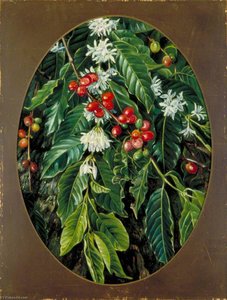
1876. Oil On Canvas, 29.0 x 51.0 cm. 英国图书馆.

§ 1目录数据

- 29.0 x 51.0 cm


§ 2摘要
藏品详情
 展开全文
展开全文
§ 3赏析
Marianne North’s ‘Dienge, Java, August 1876’: A Symphony of Tranquility and Scientific Observation
“Dienge, Java, August 1876,” painted by Marianne North in 1876, isn't merely a landscape; it’s a distillation of Victorian fascination with the natural world combined with meticulous botanical documentation. Held within The British Library’s collection, this artwork transcends its modest dimensions (29 x 51 cm) to convey an atmosphere of profound serenity and invites contemplation on themes of history, beauty, and the enduring power of observation.
- Composition & Perspective: North skillfully employs atmospheric perspective—a technique championed by luminaries like Constable—to establish depth. Distant mountains recede into hazy blues and greys, subtly diminishing in size as they ascend, guiding the viewer’s gaze towards the central focus: a crumbling ancient structure nestled on a hillside alongside a tranquil pool of water. The horizontal lines dominating the foreground mirror the stability of the landscape itself, while diagonal lines suggest the slopes of the hills, creating a dynamic interplay between stillness and movement.
- Color Palette & Light: Dominated by muted earth tones—browns, greys, greens—the painting’s palette is punctuated by delicate washes of pink and orange in the sky. North eschews harsh contrasts, favoring diffused light that imbues the scene with a soft glow. This subdued illumination enhances the overall mood of tranquility and reinforces the impression of timeless beauty.
- Style & Technique: Marianne North’s artistic style leans towards representational realism but deliberately avoids excessive detail. Instead, she prioritizes capturing an “overall impression,” mirroring the aesthetic sensibilities of her era. Her technique involves layering thin washes of oil paint—a hallmark of Victorian botanical illustration—to build up color and tone gradually. Visible brushstrokes contribute to the painting’s textural richness, particularly in the depiction of rough grass and weathered rock surfaces.
- Symbolism & Context: The crumbling ruins serve as a poignant reminder of civilizations past, prompting reflection on the passage of time and the impermanence of earthly grandeur. Simultaneously, North's unwavering dedication to recording plant life speaks to the burgeoning scientific spirit of the Victorian age—a period marked by groundbreaking discoveries in biology and fueled by an expanding understanding of the interconnectedness between humanity and nature. This painting embodies a desire to preserve beauty and knowledge for future generations.
- Emotional Impact: Viewing “Dienge, Java, August 1876” evokes feelings of peace, wonder, and nostalgia. It’s more than just a depiction of a landscape; it's an invitation to reconnect with the natural world and appreciate its enduring majesty—a testament to Marianne North’s artistic vision and her profound respect for scientific inquiry.
This artwork exemplifies North’s commitment to capturing not only visual splendor but also the essence of a place, reflecting her belief that art could illuminate both beauty and knowledge. Its quiet grandeur continues to inspire collectors and interior designers alike who seek pieces that resonate with timeless elegance and intellectual curiosity.
常见问题与解答
玛丽安·诺思 的《'Dienge, Java, August 1876'》传达了怎样的情感?
“'Dienge, Java, August 1876'” 传达出一种 Tranquil 的情感。这种情感基调描述了作品给人的印象。
"'Dienge, Java, August 1876'" 属于 玛丽安·诺思 艺术生涯中的哪个时期?
在玛丽安·诺思的艺术生涯中,"'Dienge, Java, August 1876'"创作于Mature Period时期。这一阶段有助于将其与艺术家的其他作品进行比较。
为什么“'Dienge, Java, August 1876'”目前的版权状态是这样的?
玛丽安·诺思 的《'Dienge, Java, August 1876'》 已进入 属于公有领域 —— 其版权已过期。版权保护期自艺术家逝世之日起计算,该艺术家于 1890 年逝世。


 切换至版画销售渠道


 对于任何边长超过 105 厘米(约 41 英寸)的艺术品或复制品,画框将以拆解后的组件形式发货。此方法可确保安全送达并防止运输过程中的损坏。