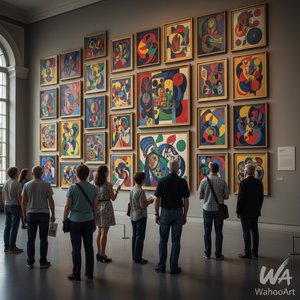
Oil On Canvas.

§ 1目录数据


 了解更多
了解更多§ 2摘要
藏品详情
The painting depicts a man standing before a window, dressed in yellow shirt and black pants, gazing out at the scenery. A vibrant red wall serves as backdrop, enhancing the composition's dynamism. Rothko’s masterful technique captures the subject’s posture and expression.
艺术家简介
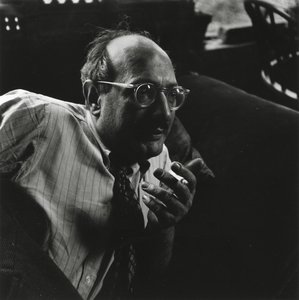
达乌加夫匹尔斯 拉脱维亚 马克·罗斯科 马库斯·雅各夫列维奇·罗斯科维茨 (1940 年前) 探索马克·罗斯科 (1903-1970) 的标志性色彩田绘画和抽象表现主义。 发现这位具有里程碑意义的现代艺术家作品中的深刻情感和持久影响,包括《无题》系列、西格拉姆壁画和罗斯科礼拜堂。 色彩田绘画 极简主义 1903年9月25日 1970年2月25日 马克·罗斯科 美国人 《无题》(1950) 纽约市,美国 1 马克·罗斯科在哪里出生?
§ 3赏析
The Weight of Silence: Contemplating Rothko’s Existential Vision
In the quietude of Mark Rothko’s Portrait 1, one encounters more than just a visual arrangement; one enters a profound dialogue with mortality. This work, emerging from the twilight of the artist's life in 1963, serves as an arresting stillness—a portrait not merely of a man, but of the deep, heavy contemplation inherent in confronting one's own end. While the canvas presents a figure standing before a window, the true subject is the palpable tension between the physical presence of the man and the vast, psychological space he inhabits. The composition captures a moment of profound introspection, where the boundaries between the individual and the infinite begin to blur.
The technique employed here is a masterclass in emotional condensation. Eschewing the frantic gestures of his contemporaries, Rothko utilized thin, luminous washes of pigment—vibrant cadmium yellows, deep crimsons, and somber ultramarine blues—to create expansive planes that seem to breathe upon the canvas. These colors are not merely decorative; they are conduits for raw sensation. As the edges of the rectangular forms bleed into one another, the viewer is invited to bypass intellectual analysis and instead tap into a primal, visceral experience. The way the red wall behind the subject vibrates against his yellow shirt creates a chromatic tension that mirrors the internal struggle between life's vitality and the encroaching shadows of uncertainty.
A Mirror to a Turbulent Era
To understand the gravity of this piece, one must look toward the historical landscape of the 1960s. As the world grappled with the anxieties of the Vietnam War and the looming threat of nuclear annihilation, Rothko sought refuge in a deliberate stripping away of the extraneous. This movement toward a refined minimalism was a reaction against the chaotic energy of earlier Abstract Expressionism. In this portrait, the simplicity of the man’s posture—hands on hips, gaze fixed outward—acts as a vessel for the collective anxieties of an era. The window behind him does not merely provide depth; it serves as a threshold between the known and the unknown, much like the artist's own transition from the tangible world to the realm of pure abstraction.
For the discerning collector or interior designer, this reproduction offers more than just aesthetic beauty; it provides an anchor of contemplative depth. The painting’s ability to command a room through its symbolic weight makes it a centerpiece for spaces dedicated to reflection and intellectual engagement. It is a work that demands presence, inviting anyone who stands before it to pause, breathe, and confront the beautiful, terrifying mystery of existence. Whether placed in a modern gallery setting or a private study, Portrait 1 remains an enduring testament to the power of color to evoke the human soul.
常见问题与解答
马克·罗斯科 的《Portrait 1》 的色彩饱和度如何?
马克·罗斯科 的《Portrait 1》 的色彩饱和度为 Clear Color Presence。
马克·罗斯科 的《Portrait 1》 的图像可以自由转载吗?
马克·罗斯科 的《Portrait 1》 属于 仍受版权保护。此版权状态决定了该作品图像的复制方式。
马克·罗斯科 的《Portrait 1》 是否属于备受追捧的 Abstract Expressionism 流派作品之一?
马克·罗斯科 的《Portrait 1》 被归类为 Iconic,并属于 Abstract Expressionism 流派。


 切换至版画销售渠道


 对于任何边长超过 105 厘米(约 41 英寸)的艺术品或复制品,画框将以拆解后的组件形式发货。此方法可确保安全送达并防止运输过程中的损坏。