


 效果预览
效果预览
 分享
分享 分享
分享
 详情
详情 指南
指南

 下载
下载
 相似作品
相似作品 X射线
X射线 幻灯片播放
幻灯片播放 统计数据
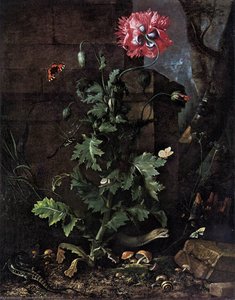
统计数据Still-Life with Insects and Amphibians
 Dutch Golden Age
 1662
1662 50.0 x 68.0 cm
 展开详情
展开详情
手工油画复制品
由我们的艺术家按需定制,为您提供您所选尺寸及画框的布面手工油画。 ( 切换至版画销售渠道 切换至数字图像销售渠道)




































从与原作比例一致的预设尺寸中进行选择。

您可以输入自定义尺寸,以适配特定的画框或空间。如果所选尺寸与原图比例不符,我们将通过裁剪作品或添加手绘元素来扩展画面。数字样稿将在制作开始前发送给您确认。
请注意,屏幕预览无法准确反映实际的裁剪或扩展效果,只有样稿才能真实呈现最终的构图。
虽然我们提供定制尺寸服务,但为了保留原作比例,建议您从预设列表中选择尺寸。
下单后,AllPaintingsStore.com 团队将通过电子邮件联系客户获取具体要求,并提供效果预览图。


 玻璃选项仅适用于110厘米以下的尺寸。

Still-Life with Insects and Amphibians
复制材质
复制品尺寸
-


最终总价
$ 258
相似艺术品





艺术家简介
A Pioneer of the Dutch Forest Floor: The Life and Art of Otto Marseus van Schrieck
Otto Marseus van Schrieck emerged during the vibrant flourishing of the Dutch Golden Age, a period defined by both remarkable artistic innovation and burgeoning scientific inquiry. Born around 1613 in Nijmegen, Netherlands, Van Schrieck carved a unique niche for himself within the landscape of 17th-century painting—one that focused on the often-overlooked beauty and intricate details of forest undergrowth. While biographical details surrounding his early life remain somewhat scarce, it’s clear he possessed an innate aptitude for meticulous observation and naturalistic representation, qualities that would come to define his artistic career. He wasn't drawn to grand historical narratives or portraits of societal elites; instead, Van Schrieck found inspiration in the humble world beneath our feet—a realm teeming with life, decay, and subtle beauty.From Italy to Amsterdam: A Journey of Artistic Refinement
A pivotal period in Van Schrieck’s development was his sojourn to Italy between 1652 and 1657. He traveled extensively through Rome and Florence, studying alongside prominent painters like Matthias Withoos and Willem van Aelst. This exposure proved transformative, allowing him to absorb new techniques and refine his own distinctive style. In Rome, he became a member of the *Bentvueghels*, a society of Dutch and Flemish artists known for their eccentric nicknames and often boisterous behavior. Van Schrieck’s moniker within this group—"the Snuffelaer” (sniffer)—reveals much about his artistic inclinations; it was bestowed upon him due to his fascination with reptiles and amphibians, creatures that would become recurring motifs in his work. This period wasn't merely a technical education; it fostered an intellectual curiosity and a willingness to explore unconventional subject matter. Following his Italian experience, Van Schrieck briefly served at the court of the Grand Duke of Tuscany before venturing through England and France, eventually settling in Amsterdam in 1664, the same year he married Margarita Gysels, daughter of engraver Cornelius Gysels.A World in Miniature: Themes and Techniques
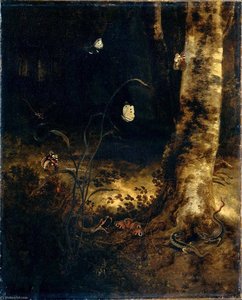
Van Schrieck’s paintings are immediately recognizable for their dark, atmospheric backgrounds and extraordinarily detailed depictions of flora and fauna. He didn't simply paint flowers or insects; he created immersive worlds—miniature ecosystems teeming with life. Key themes within his oeuvre include the transience of life, the beauty inherent in nature’s details, and a subtle exploration of decay. His compositions frequently feature forest floors covered in mushrooms, decaying leaves, and an array of reptiles (snakes and lizards) and insects. These weren't merely decorative elements; they were symbolic representations of mortality, transformation, and the cyclical nature of existence. He masterfully employed light and shadow to create a sense of depth and realism, drawing viewers into these intimate scenes. He was also one of the first artists known to experiment with *lepidochromy*, a technique involving pressing butterfly wings onto canvases to transfer their iridescent scales—a testament to his innovative spirit and dedication to capturing nature’s delicate beauty.Legacy and Influence: A Lasting Impression on Dutch Still Life
Otto Marseus van Schrieck occupies a unique position within the canon of Dutch Golden Age painting. He pioneered a specialized niche, focusing on subjects that were largely ignored by his contemporaries. His work contributed to the growing interest in botanical illustration and scientific observation during the 17th century, reflecting a broader cultural shift towards empirical inquiry. He influenced a generation of artists, most notably Rachel Ruysch, who would further develop the genre of flower and insect painting with her own distinctive style. Other artists who felt his influence include Willem van Aelst, Antonie van Borssom, Elias van den Broeck, Jacob Marrel, Abraham Mignon, Christiaen Striep, Isac Vromans, Matthias Withoos, and Pieter Withoos. Van Schrieck’s legacy extends beyond direct artistic imitation; he encouraged a deeper appreciation for the natural world and demonstrated the artistic potential of seemingly mundane subjects. He died in Amsterdam in 1678, leaving behind a body of work that continues to captivate audiences with its exquisite detail, atmospheric depth, and profound contemplation of life's ephemeral qualities. His paintings serve as a reminder to look closely at the world around us—to find beauty in the unexpected and to appreciate the intricate interconnectedness of all living things.
Otto Marseus van Schrieck
1620 - 1678 , Netherlands
艺术家简介
- Artistic Movement Or Style: Dutch Golden Age painting
- Artists Or Movements Influenced By This Artist:
- Rachel Ruysch
- Willem van Aelst
- Antonie van Borssom
- Artists Who Influenced This Artist:
- Matthias Withoos
- Willem van Aelst
- Date Of Birth: 1620
- Date Of Death: 1678
- Full Name: Otto Marseus van Schrieck
- Nationality: Dutch
- Notable Artworks:
- Wild butterflies and plants...
- Vase of Flowers with Butterflies
- Still Life with Poppy...
- Place Of Birth: Nijmegen, Netherlands
相关文章
荷兰黄金时代:十幅定义艺术史的巨作 | AllPaintingsStore
探索荷兰黄金时代的艺术巅峰! 伦勃朗、维米尔等大师名作,带您领略巴洛克艺术的辉煌。高清画作、博物馆级品质,点亮您的家居空间。AllPaintingsStore.com 提供精选艺术复制品和定制装饰方案。立即在线探索全系列!
荷兰黄金时代绘画:文化创新中的现实主义反思
深入探索荷兰黄金时代绘画的文化创新与现实主义反思。本文解读伦勃朗、维米尔等大师的作品,并结合玛莉特·韦斯特曼的图像学研究,揭示艺术史背后的社会语境与现代性意识觉醒。

Golden Light & Dutch Skies: The Timeless Magic of Dutch Golden Age Landscapes
Discover the breathtaking beauty of Dutch Golden Age landscapes. Explore the mastery of light, chiaroscuro, and 17th-century realism through an expert art history lens, celebrating the enduring legacy of the Dutch Masters for discerning collectors and art lovers.
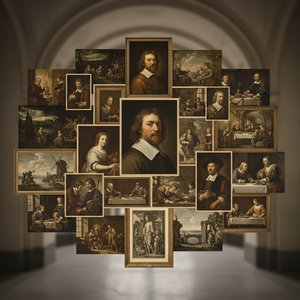
伦勃朗25幅杰作:光影大师的艺术传奇与家居臻选
探索伦勃朗25幅杰作,领略荷兰黄金时代光影大师的艺术传奇!从《夜巡》到自画像,深入了解巴洛克艺术、历史绘画与人物肖像背后的故事。AllPaintingsStore.com提供高清艺术复制品及家居装饰灵感。立即探索完整系列!

Mastering Light & Shadow: A Journey Through the Dutch Golden Age's Luminous Legacy
Embark on a cultural journey through the Dutch Golden Age. Explore the masterful interplay of light and shadow in 17th-century masterpieces, from Rembrandt to Vermeer, and discover how this era of profound realism continues to inspire fine art collectors today.

